


Extreme rainfall events could become four times more frequent by 2080 if climate change continues, according to Britain's top weather forecasters.
For every degree of regional warming, the intensity of extreme downpours could also increase by 5 to 15 per cent, said climate scientists at the Met Office.
The warning echoes findings by the world’s top climate scientists that a hotter planet will be more prone to natural disasters.
Higher temperatures create more extreme rainfall because warmer air holds more moisture — 7 per cent for each degree — leading to a greater amount of water falling when clouds finally burst.
By the 2070s, downpours of more than 20mm of rain per hour could occur four times as frequently as they did in the 1980s. London typically currently receives about 40-50mm of rain each month.
A reading of 4mm per hour or more is considered heavy rain by the Met Office, while a threshold of 30mm will trigger flash-flood warnings.
In July 2021, 40mm of rain fell on the capital in just three hours, flooding 31 Tube stations and 2,000 properties.
Forecasting long-term trends for extreme rain will help planners and policymakers adapt to the changing risk, said the Met Office researchers.
Three million properties across England are currently at risk from surface water flooding, with urban areas in steep catchments, such as Hebden Bridge in West Yorkshire, particularly vulnerable.
Using a high resolution model normally used for weather forecasting, Met Office climate scientist Professor Lizzie Kendon and colleagues examined how local weather patterns could change over a 100-year timespan — between 1980 and 2080.
They ran the model 12 times at a resolution of 2.2km which gave them a more accurate picture of how the frequency of heavy downpours is likely to change over the coming decades.
Previously, less accurate, lower resolution models had found a smaller increase of two to three times as many extreme rain events by the 2070s.
Prof Kendon said: “Being able to look at our projected future climate in such detail has unlocked an incredible amount of information and has shown how expected increases in intense rainfall events will actually manifest at local scale and for the coming years.
“Having this level of detail is crucial to ensure that we're prepared for the possible extremes of the future.”
Much of the UK's wet weather comes from clouds which form over the Atlantic and are carried east on the jet stream, which is why the West and north of the UK are generally wetter than the south and east.
Flooding around the world in 2022 — in pictures
-
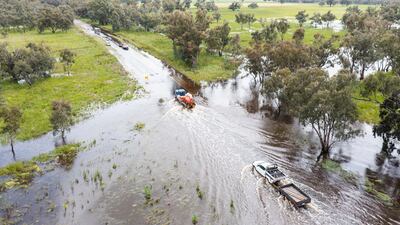
Vehicles negotiate floodwater from the Bundaburrah Creek in New South Wales, Australia, on October 11, 2022. Rains have eased but New South Wales is still on high alert with another rain onslaught set to hit the state which has already seen repeated flood events. EPA -
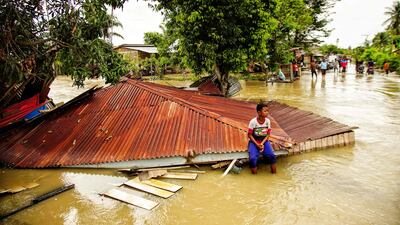
A villager sits on the roof of a flooded home in Lhokseumawe, in Indonesia's Aceh province, on October 10, 2022. AFP -
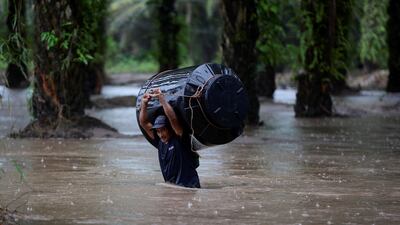
A man carries an empty water tank through a flooded area after the impact of tropical storm Julia, in Progreso, Honduras, on October 9, 2022. Reuters -
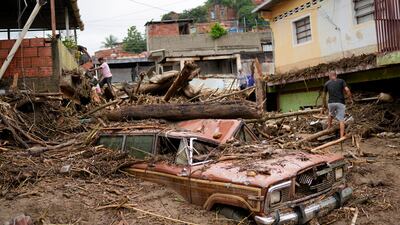
Residents walk through the debris left by flooding caused by a river that overflowed in Las Tejerias, Venezuela, on October 9, 2022. AP Photo -
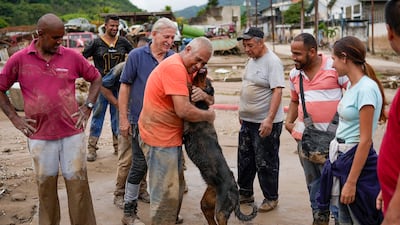
A man is reunited with his dog, rescued by neighbours from the mud, after flooding in Las Tejerias, Venezuela, on October 9, 2022. AP Photo -

A woman grieves following a boat accident in Anambra, Nigeria, on October 7, 2022. Seventy-six people are missing after the boat capsized in a flooded community in Nigeria's south-east Anambra state, emergency officials said. AP -
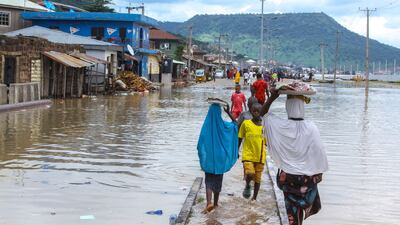
People stranded following several days of downpours in Kogi Nigeria, on October 6, 2022. Thousands remained stranded after major connecting roads to other parts of the West African nation were submerged in floods, locals and authorities said. AP Photo -

A resident carries a water container and money while wading through flood water caused by typhoon Noru in Bulacan province, north of Manila, Philippines, on September 26, 2022. EPA -

A man sets up camps for people displaced from flooded areas, on the outskirts of Karachi in Pakistan, on September 24, 2022. According to disaster management authorities, flash floods triggered by heavy monsoon rains have killed more than 1,200 people across Pakistan since June 2022. EPA -

People take shelter inside a school in the aftermath of floods in Karachi, Pakistan, on September 21, 2022. EPA -

People stand next to an eroded section on the banks of river Padma in Bangladesh on September 18, 2022. AFP -
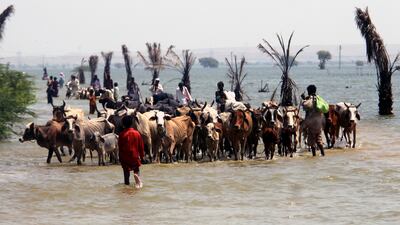
People affected by floods move to higher ground in Bajara Sehwan, Pakistan, on September 9, 2022. EPA -
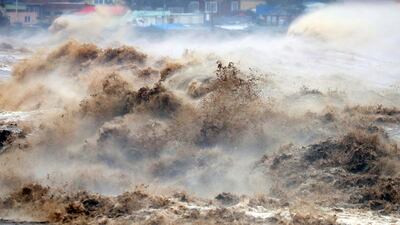
A high wave caused by Typhoon Hinnamnor in Pohang, South Korea, on September 6, 2022. Reuters -

Firefighters and military officials rescue one of the missing residents from the underground parking lot of an apartment building which was submerged in heavy rain caused by Typhoon Hinnamno, in Pohang, South Korea, on September 7, 2022. EPA -
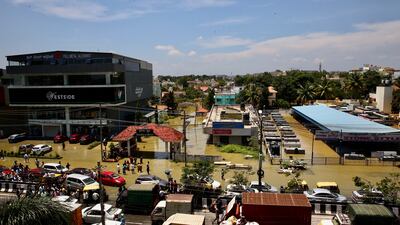
A flooded area following overnight heavy rainfall in Bangalore, India, on September 5, 2022. EPA -
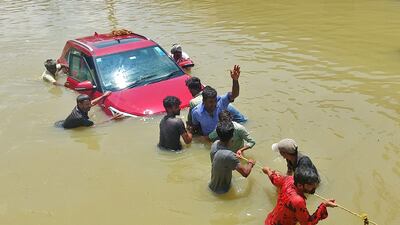
People pull a car on a flooded road following torrential rains in Bengaluru, India, on September 5, 2022. Reuters -
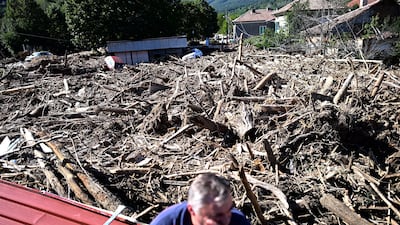
Heavy floods hit in the village of Slatina in Bulgaria on September 5, 2022. Rain caused floods in half of Bulgaria - both in the south and in the north. EPA -
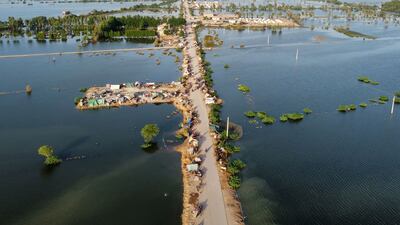
Aerial view of makeshift tents for people displaced due to flooding after heavy monsoon rains in Balochistan province in Pakistan, on September 4, 2022. AFP -

People cross the water during a flood in Al-Managil, Sudan, on August 23, 2022. Reuters -
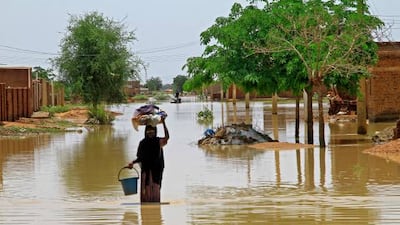
Flood water in the village of Makaylab in Sudan's River Nile state, on August 23, 2022. Sudan declared a state of emergency due to floods in six states, including River Nile. AFP -
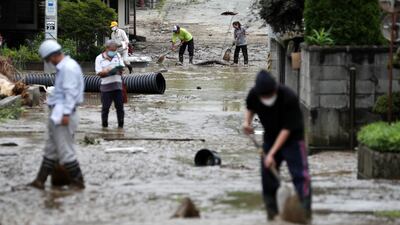
Residents clean a street covered with mud following floods in Oe city, in north-eastern Japan, on August 4, 2022. Large areas of north-eastern and central Japan were hit by torrential rainfall, and more than 100,000 residents were asked to evacuate. EPA -
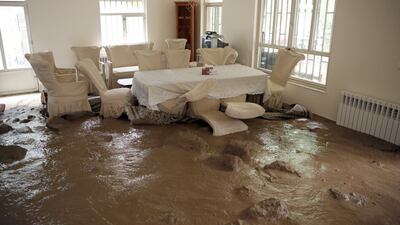
A dining room inside a residence at the site of a flash flood in the Iranian village of Zayegan, north of Tehran, on August 2, 2022. EPA -

Flooded streets of Kalba, in the UAE. Khushnum Bhandari / The National -
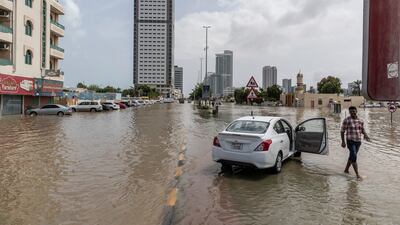
Flooding in Fujairah city. Antonie Robertson/The National -
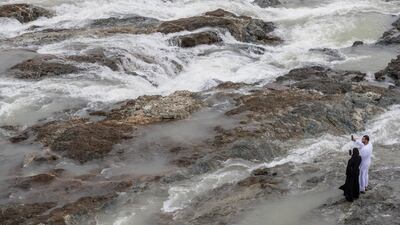
Flooding in Fujairah city. Antonie Robertson/The National -
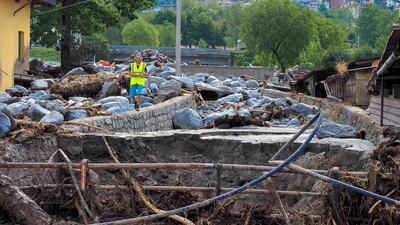
View of damage after flooding in Niardo, Italy, on July 28, 2022. EPA -
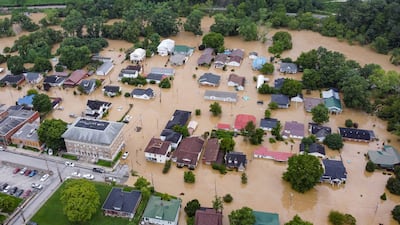
Homes submerged under flood waters from the North Fork of the Kentucky River in Jackson, Kentucky, on July 28, 2022. AFP -
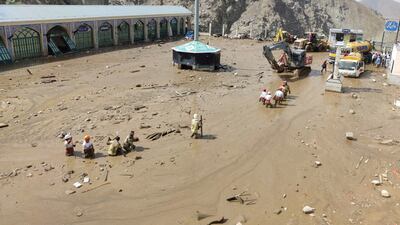
Rescuers work following a flood in Imamzadeh Davoud village in the north of Tehran, on July 28, 2022. Reuters -

Rescuers work in Imamzadeh Davoud village in Iran on July 28, 2022. Reuters -
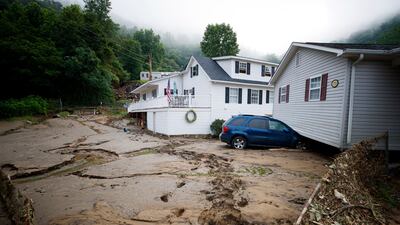
A house that was shifted off its foundation following a flash flood rests on top of a vehicle, on July 14, 2022, in Whitewood, Virginia. AP Photo -

Volunteers in an inflatable rescue boat in Camden, in Sydney, Australia, on March 8, 2022. EPA -
An aerial view of flooded streets in Arbil, the capital of Iraq's northern Kurdish autonomous region, after flash floods on January 13, 2022. AFP


The researchers found such regional differences in their climate modelling. North-west Scotland for example could see almost 10 times as many extreme downpours in 2080 as in 1980, whereas the south of the UK could see around three times as many.
The modelling also showed that extreme downpours are likely to fall in clusters because of natural climate variability adjusting conditions favourable for their occurrence.
Prof Kendon warned against trying to predict long-term trends through observation, adding: “The observed rainfall record in the UK is fairly erratic with a large amount of variability, these latest projections show that this is likely to continue through the century.
“What we can see from the higher resolution output is an even more erratic frequency of extreme events each year, so this could mean we see clusters of record-breaking intense rainfall events, followed by a period when no records are broken.
“Despite the underlying trend, these pauses in the intensification of local rainfall extremes can last a surprisingly long time — even multiple decades.”
She also said that alongside helping planners and policymakers, the study will be useful for other climate scientists seeking to attribute the likelihood of current extreme rainfall events being caused by climate change.
“Our study highlights the complexity of how natural climate variability and human-induced climate change will come together in the extreme rainfall events we experience over the UK — it is far from a simple picture of more extreme events decade by decade as a steadily increasing trend,” she said.
Last year was the warmest on record in the UK, according to the Met Office.
The average annual temperature topped 10°C for the first time, representing a “notable moment” in the country’s climatological history, the bureau said.
The mercury on July 19 also hit more than 40°C for the first time in 2022, reaching 40.3°C in Coningsby, Lincolnshire.
Data shows 15 of the UK's top 20 warmest years on record have all occurred this century, with the entire top 10 within the past two decades.

