


On a frosty February morning in 2003, hundreds of people of different faiths took their seats in a convoy of 15 coaches lining Bradford’s historic Centenary Square.
Their journey of 350 kilometres would take them to London, epicentre of the biggest global anti-war rally in history.
The people of the northern English city, still coping with the fall out from ethnic disturbances a year earlier, knew better than most what was at stake.
Many felt an overwhelming compulsion to stand up for peace in the Middle East after seeing their own streets rocked by race riots 18 months earlier.
“We knew it would be a milestone event and would go down in history,” Methodist minister and protest supporter Rev Geoff Reid told The National. “We knew that one day, people would ask us if we were there.”
As Rev Reid explains, minority community business leaders, trying to make sense of an outbreak of race riots, were intent on taking positive steps towards a more cohesive future in which nothing similar would repeat.
Never before had he seen the depth of interfaith unity in the district over a single political issue, such was the foreboding about Western intervention in Iraq.
“It was clear that this was going to be serious,” Rev Reid says. “When the outbreak of war was imminent, we still felt shell-shocked from the riots but we knew we should put some muscle into campaigning to stop the US and others from shelling innocent people.
“We were moving on from our trauma in the city to the trauma in the Middle East. People made this connection with them; the community united to help Iraq. I think everybody here had learnt lessons.”

The coaches, many filled with people from Muslim and Asian communities, joined hundreds of others from across the country that had answered the rallying call issued by the likes of Chris Nineham, the political activist and founder member of the Stop the War Coalition.
In the months leading up to the demonstration, it had been Mr Nineham’s idea to impel others around the world to take part in a mass mobilisation on a scale hitherto unparalleled.
He had journeyed to Italy and Brazil to harness the groundswell of opinion that Iraq was not responsible for the atrocities committed on September 11, 2001, and that any counter-attack under such a premise would only make matters worse.
“There was a strong sense of the US trying to use 9/11 to project its power, and Britain was its number one enabler,” Mr Nineham told The National.
“Added to the fact we had built up this quite exceptional anti-war movement … all these things came together and allowed us to propose something quite extraordinary: the biggest global protest in history.”

But though that was the stated ambition, Mr Nineham had no concept then of how many people were about to converge into major cities around the world — not least the one where he was acting as chief steward.
The sheer number of coaches expected in London meant that the demonstration would require two starting points to allow the human flow to get most effectively under way.
Even so, many had to wait four or five hours before they could begin marching. One of the Yorkshire organisers, Sandra Flitcroft, of the Otley Stop the War Group, was forced to return to the coach that had carried her to the capital without hearing any of the speakers, such as Harold Pinter, George Galloway, Tony Benn and Bianca Jagger.
“It was a very moving thing to take part in, but we had to give up,” Ms Flitcroft said. She never made it to the Hyde Park endpoint due to the crush of protesters — as many as two million, according to organisers.
As planned by Mr Nineham and others, the two feeder marches were supposed to join as one at Piccadilly Circus by the statue of Eros.
-
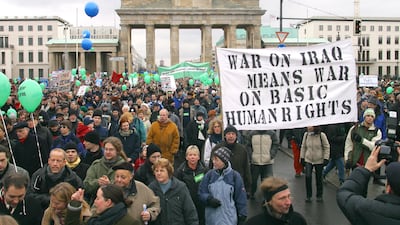
Protesters at the Brandenburg Gate in Berlin, demonstrating against war in Iraq, on February 15, 2003 - the day that saw peace demonstrations around the world. All photos: Getty Images -

Thousands of protesters gather in New York. -
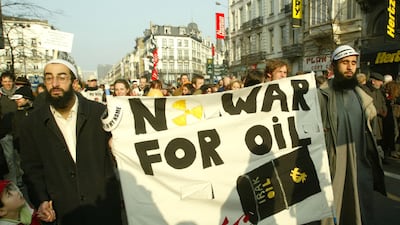
Demonstrators rally in Brussels, Belgium. -
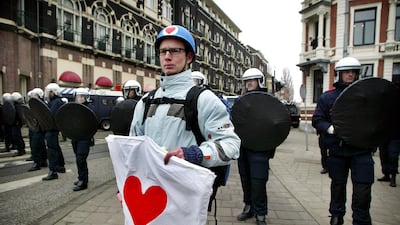
A protester holds a heart flag near riot police in Amsterdam. -

A huge rally for peace in Paris. -

Protesters make their way up Queen Street in Auckland, New Zealand. -
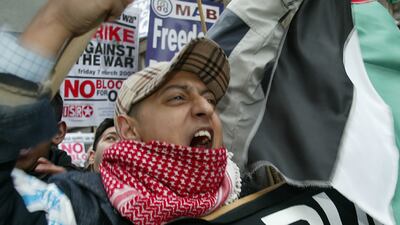
Anti-war demonstrators in London. -

Activists attend a rally in Dublin. -
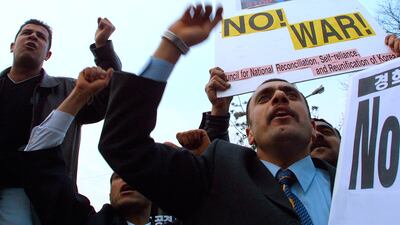
Muslim protesters at an anti-war rally in Seoul. -

Protesters with an inflatable globe at demonstrations in New York. -
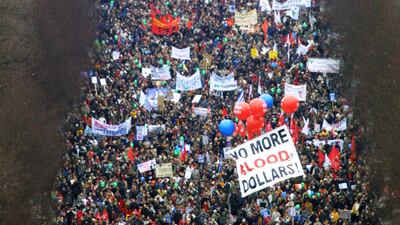
An estimated 500,000 protesters gathered in Berlin.


“It was at that moment the absolute enormity of it sunk in,” he said. “A few minutes before, I had a phone call from someone who was lost by Oxford Street and she was asking which way to go. It was miles away from the route.
“I asked how many were there and she said: ‘There’s about 8,000 of us.’ The whole of the centre of London was just taken over. It was the kind of experience that just changes you forever. It was incredible.”
After the simultaneous rallies involving 14 million people in 800 cities across 60 countries, a New York Times writer famously suggested that there were two superpowers on the planet: the US and world public opinion.
Mr Nineham said participants were given a sense of their own might and a realisation that they could make a difference in the hardest of circumstances if they were well organised and ambitious enough.
“It didn’t stop the war, tragically, but it had a big impact,” he said. “The legacy of that day lives on 20 years later. It brought together such a diverse coalition of people. It was a once-in-a-generation occurrence.
“A huge section of society took the fight into their own hands. They would not sit down and let these people take them into an illegal war. They wanted to do something about it. It was an extremely life-enhancing experience.

“It was not about low wages, conditions in Britain or jobs, it was about not wanting to kill lots of people 4,000 miles away. It was completely selfless. It is extremely energising when you realise people are willing to take a stand for ordinary people thousands of miles away. It was a very emotional and powerful event.
“We need to make sure we do not allow this legacy to be lost or suppressed.”
Rev Reid, who was Lord Mayor of Bradford for a year from 2016, agreed that there were long-lasting, positive repercussions following that weekend.
As the 20th anniversary approached, he and many others among the 400 or so residents of Bradford who rode the buses spoke of the sense of togetherness they felt back then — and still do.
“Bradford showed how important it was for all faiths to unite and speak with one voice,” he said. “We made history that day.
“Sadly, it didn’t make a difference to the war but, as a city, we left as strangers and returned as friends.”

