


Latest: Ambulance strike: Unions choose to ‘inflict harm’ on patients, says UK health secretary
Paramedics are sharing emotional stories about the difficulties they face treating patients on the emergency front line, as they join nurses on the picket line.
Ambulance workers are staging a mass strike on Wednesday, with health chiefs warning the walkout represents the most serious threat to patients to date.
The action comes after at least three ambulance services declared critical incidents this week and the public was warned to avoid “risky activities” on the day of the paramedics' strike.
One ambulance worker took to Twitter to share how she had the “worst shift” of her career this week.
“Today was the worst shift I've ever had in the ambulance service,” the paramedic tweeted.
“The entire system has collapsed. We're no longer practicing emergency medicine. We're just desperately trying to put out fires and triage the sickest patients but it's just not enough.”
In the long and emotionally charged thread, she wrote how there are “hundreds of emergency calls” coming through with no resources to send.
“This is true up and down the country. People are dying waiting for ambulances as we queue outside [Emergency Departments], themselves in crisis and experiencing critical incidents.
“We queue with sick patients. Patients so sick, that years ago, would have been immediately seen in resus. Now however, they are looked after in the backs of ambulances, or in corridors, or cohorting areas.
“We watch these patients deteriorating, sometimes dying in front of us, desperately trying to help them but powerless as the system is so utterly broken that there is simply no space, no bed, no doctor that isn't already treating someone equally as sick.”
Paramedics queue outside emergency departments “for entire shifts” and finish hours late, often without having a break, she said.
“We queue and our radio's sound constantly, with general broadcasts for Category 1 patients, from dispatchers and control staff equally desperate, trying to find anyone that can respond. Except there is no one. There is no available resource to respond.”
Receiving the calls for patients in cardiac arrest, with their family members desperately trying to resuscitate them, knowing there is no available resources to send is “morally injurious” to crews.
“Being trained to help, surrounded by the kit to help, but being physically unable to help as you are stuck queuing outside equally broken Emergency Departments is soul destroying,” she said.
“The NHS was the greatest healthcare system in the world, but it's utterly broken and has collapsed.”
Another healthcare worker, a Sheffield-based consultant in emergency medicine, tweeted: “Prob the worst Monday I've ever worked. 17 years in EM. 12 as a Consultant.”
A reply on his post said it was the worst weekend they had ever worked, “even worse than Jan 21”.
“111 and OOH GP teams completely overwhelmed and unable to meet demand. 90 per cent fever/cough/sore throat/Covid/flu.”
Another reply said nurses, who staged a second walkout in a dispute over pay on Tuesday, were crying after only being on shift for 30 minutes.
“Apparently the plan is to free up beds so the ambulance crews can safely strike….people are paid [huge] amounts of money to come up with this plan. Amazing,” they wrote.
At least three ambulance services have declared critical incidents this week as NHS services around the country face “unprecedented” pressure.
North-East Ambulance Service, South-East Coast Ambulance Service and the East of England Ambulance Service have all moved to the status as staff try to respond to calls.
The services said they took the decision due to pressures including 999 call volumes and hospital handover delays, and that declaring the status allows them to instigate additional measures to protect patient safety.
North-East Ambulance Service said it declared a critical incident on Monday afternoon as a result of “significant delays for more than 200 patients waiting for an ambulance, together with a reduction in ambulance crew availability to respond because of delays in handing over patients at the region's hospitals”.
Stephen Segasby, chief operating officer at the service, said: “Our service is under unprecedented pressure.
“Declaring a critical incident means we can focus our resources on those patients most in need and communicates the pressures we are under to our health system partners who can provide support.
Nurses strike in the UK — in pictures
-
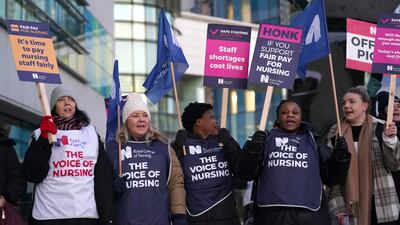
Members of the Royal College of Nursing on the picket line outside Queen Elizabeth Hospital in Birmingham, as nurses in England, Wales and Northern Ireland strike over pay. PA -
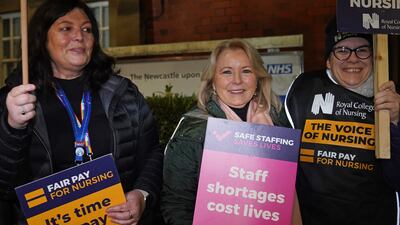
Royal College of Nursing (RCN) General Secretary Pat Cullen joins members on the picket line outside the Royal Victoria Infirmary in Newcastle. PA -
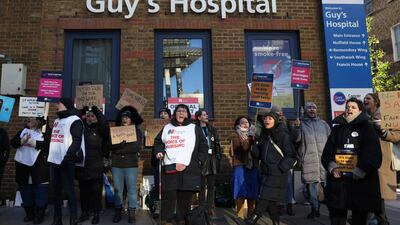
NHS nursing staff outside Guy's Hospital in London. Bloomberg -

Demonstrators outside St Thomas' Hospital in London. Bloomberg -
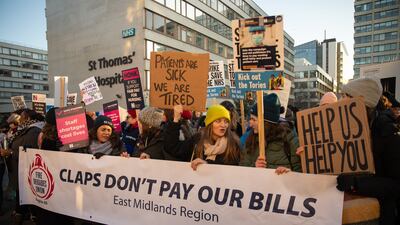
The picket line outside St Thomas' Hospital. PA -
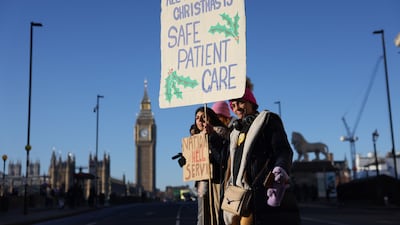
About a quarter of hospitals and community teams in England are striking, alongside all trusts in Northern Ireland and all but one health board in Wales. Bloomberg -
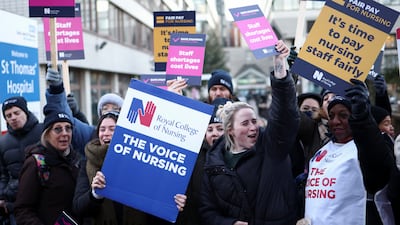
RCN members outside St Thomas' Hospital. Reuters -
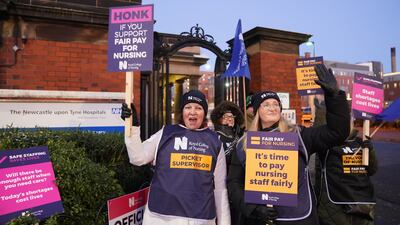
Nurses on strike outside Royal Victoria Infirmary in Newcastle. PA -

A message to the government outside St Thomas' Hospital. Reuters -
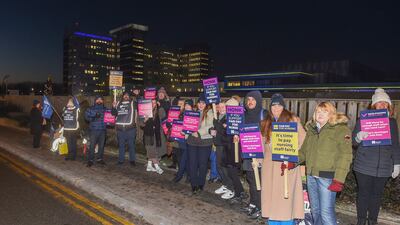
Nurses on the picket line outside Aintree University Hospital in Liverpool. PA -

Nurses brave the cold for the strike in London. Reuters -

Ms Cullen, head of the RCN union, speaks to the media outside St Thomas' Hospital. Reuters -

A sign, right, referring to the Clap for our Carers campaign during the Covid-19 pandemic. Many nurses say they would rather be rewarded with a pay rise. Reuters


“We are asking the public to call us only in a life-threatening emergency.”
The government urged the public to avoid “risky activities” as ambulance drivers stage strike action.
Health minister Will Quince urged people to stay safe on Wednesday, which will likely see the NHS hit by major disruption as ambulance workers including paramedics, control room workers and technicians walk out in England and Wales.
During the strike, the military will not drive ambulances on blue lights for the most serious calls but are expected to provide support on other calls.
The junior minister said that armed forces personnel would play a key role but would not be able to “break the law” when covering for ambulance workers.
Mr Quince told BBC Breakfast: “Where people are planning any risky activity, I would strongly encourage them not to do so because there will be disruption on the day.”
The health minister did not offer examples of what might be defined as risky behaviour but said in any emergency calling 999 should still be the first option.
“But the key thing is for anybody that does have an emergency situation or a life-threatening situation that they continue to call 999 as they would have done previously, and for any other situation, NHS 111 or NHS 111 online.”
Later on BBC Radio 4, he also said that anyone with chest pains on Wednesday should still call 999.
Downing Street later declined to set out what “risky activities” might include, with the Prime Minister's official spokesman telling reporters: “The public, as we saw through Covid, can be trusted to use their common sense.”
Negotiations between unions and ambulance services are ongoing to work out which incidents should be exempt from strike action.
It is expected that all category 1 calls, the most life-threatening such as cardiac arrest, will be responded to.
Some ambulance trusts have agreed exemptions with unions for specific incidents within so-called category 2 which covers serious conditions, such as stroke or chest pain.
Last week, former health secretary Sajid Javid warned Britain’s National Health Service model — which is funded entirely by taxation and free at the point of delivery — is “not sustainable”.
The Tory MP, who is stepping down at the next election, said radical change is required and the UK should look to emulate other European countries, such as Germany and France.
Their health systems are funded by a mix of general taxation and health insurance schemes.

