



Boris Johnson's headache dealing with his increasingly rebellious party is going to be substantial.
The question as to how long his newly cobbled-together government can last until the inevitable next leadership challenge remains.
His authority, following the resignation of chancellor Rishi Sunak and health secretary Sajid Javid, is rapidly slipping away.
Downing Street had hoped the domino effect of resignations would subside after 10 people — from parliamentary private secretaries to trade envoys and ministers — quit government on Tuesday night.
However, the terminal atmosphere for the Johnson resignation continued on Wednesday morning when Will Quince, the children’s minister, left government, rapidly followed by another ministerial aide and another junior minister.
Curiously, The National had spotted Mr Quince on the Commons' terrace on Tuesday evening talking in friendly fashion to well-known Tory rebels just 20 minutes before Mr Javid resigned.
Mr Quince was one of several ministers who had been ordered to go on the airwaves to defend Mr Johnson’s position over the Chris Pincher affair, after the deputy chief whip resigned last Thursday after allegedly groping two men.
Mr Quince had originally stated in interviews that he had been given “categorical assurances” that Mr Johnson was unaware of other allegations about Mr Pincher when he appointed him in February.

This was subsequently shown to be false, with Mr Johnson claiming on Tuesday he had “forgotten” being told about past complaints over Mr Pincher for which the prime minister apologised.
In his departure letter, Mr Quince said he had accepted the assurances about Mr Pincher in “good faith” and therefore had “no choice” but to resign.
His act was rapidly duplicated by Laura Trott, a ministerial aide in the Department for Transport.
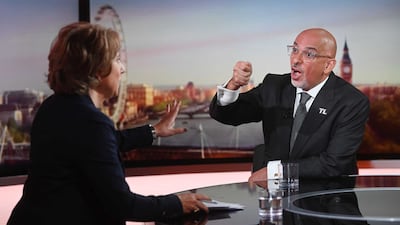
The new chancellor, the widely respected Nadhim Zahawi, was live on air with the BBC when he was told about the resignations. “I am sorry to see Will Quince go... he was my children and families minister and a great minister,” he said. “All I would say to colleagues is people don't vote for divided teams.”
Earlier in the interview, the chancellor, who is expected to cut taxes if he remains in power long enough, was flummoxed for a few seconds when asked if he would be repeating untruths over the Pincher affair.
-
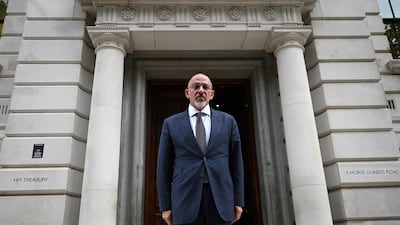
Nadhim Zahawi has been appointed Chancellor of the Exchequer by British Prime Minister Boris Johnson, replacing Rishi Sunak. AFP -
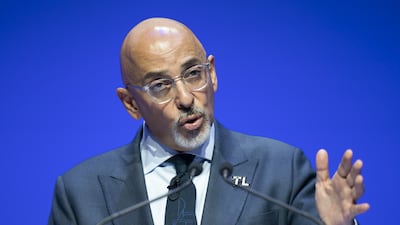
Mr Zahawi, 55, inherits an economy that is heading for a sharp slowdown or even a recession, and will face immediate pressure to do more to help struggling taxpayers. PA -
Mr Zahawi was previously education secretary and was replaced by Michelle Donelan. PA -
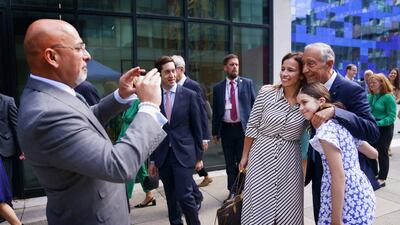
Mr Zahawi with Portugal's President Marcelo Rebelo de Sousa during a visit to Imperial College London in June. PA -
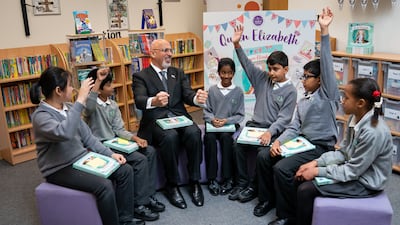
Mr Zahawi answers questions from pupils during a visit to Manor Park Primary School in Sutton in May. PA -
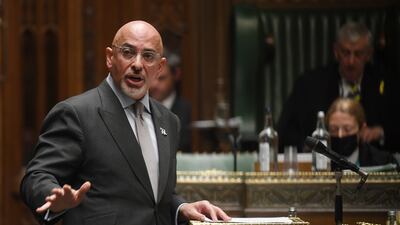
Mr Zahawi makes a statement in the House of Commons in March. PA -
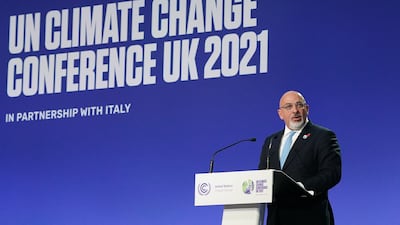
Mr Zahawi attends the Cop26 summit in Glasgow, Scotland, in November. Getty Images -
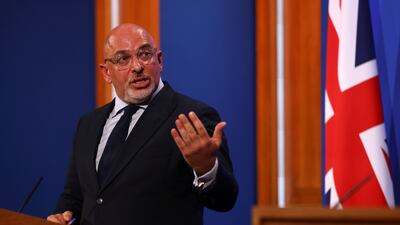
Mr Zahawi holds a media briefing on the coronavirus pandemic at Downing Street in June 2021. Mr Zahawi was appointed minister in charge of the Covid-19 vaccine rollouts in 2020. Getty Images -
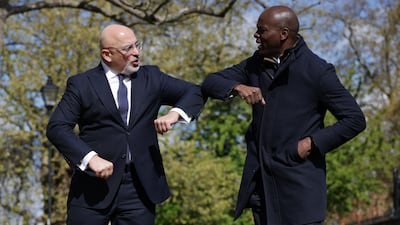
Conservative London mayor candidate Shaun Bailey and Mr Zahawi on the final day of local election campaigning in May 2021. Getty Images -

Mr Zahawi visits the Cullimore independent community chemist in Edgware in January last year after it became the first pharmacy in London to offer the Covid-19 vaccination. Getty Images -
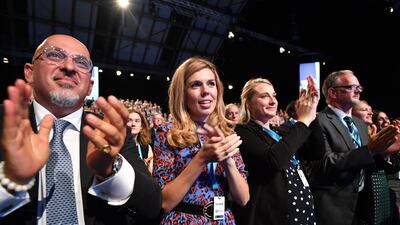
Mr Zahawi stands next to Carrie Symonds at the 2019 Conservative Party conference in Manchester. Getty Images -
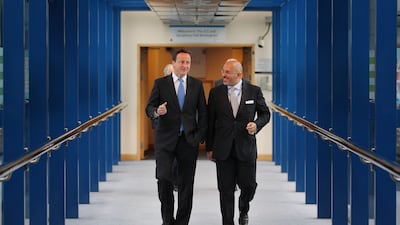
Former prime minister David Cameron and Mr Zahawi at the Conservative Party conference in Birmingham in 2010. Getty Images


It was a painful moment. But more of those will inevitably arrive in the coming hours for Mr Johnson.
First, he has to get through Prime Minister’s Questions at noon on Wednesday and then questioning before the influential Liaison Committee at 3pm.
Mr Johnson’s character is such that he is likely to bludgeon his way through the crisis no matter what happens around him. Even if more Cabinet ministers resign, he is likely to cling onto power until it is taken away from him.
That may well happen now more rapidly than expected via the 1922 Committee of backbench MPs, that oversees the Conservative parliamentary party.
Elections to its executive will take place next Wednesday where it is now all but inevitable that anti-Johnson MPs will take the majority. They will almost certainly change the rules within a few days to hold a second no confidence vote before summer recess on July 21.
In the last vote, 148 MPs voted against him, with 211 for. All it now requires is a further 32 MPs to switch their votes to “not having confidence in the Prime Minister” for Mr Johnson to be out.

