



If the power draining away from Boris Johnson's premiership was visible during what might be his final Prime Minister’s Questions the whole ornate chamber would have quickly emptied.
There was even space on the government front bench where cabinet ministers are normally packed shoulder-to-shoulder. Not one minister risked the cosy positioning that is a weekly feature of the proceedings.
That was true of the new chancellor, Nadhim Zahawi who was next to the prime minister but keeping a polite distance from Mr Johnson’s increasingly toxic brand, knowing that a leadership contest was imminent and one in which the Iraq-born MP could be a front-runner.
On the other side was Deputy Prime Minister Dominic Raab, who made no eye contact with the prime minister throughout an extraordinary 45 minutes of a government in free fall.
The opposition benches were lively with boos, shouts and at one point — much to the Speaker’s distress — they clapped a Tory MP who stated the prime minister should go because he “always tries to blame other people for his mistakes”.
Throughout, those on the government benches sat in grim, icy silence. The whips, whose authority has almost entirely disappeared with the departure of the disgraced deputy chief whip Chris Pincher, and more than 20 government resignations, had not even bothered to attempt to drum up support for Mr Johnson.
It was a one man act. A rather sorrowful, repetitive one at that, but still playing to a sold-out House of Commons.
The packed gathering was there to witness the last rites of a man whose legacy will be of bringing down one prime minister and taking Britain away from its biggest trading partner, the European Union. That and the dissembling that has marked much of the last eight months of his downward spiral.

“I'm going to hang on in there, that’s what I’m going to do,” Mr Johnson pledged to sniggers, reinforcing the views of many backbenchers who may now oust him quicker than first thought.
Greeted by boos and few cheers, Mr Johnson had initially attempted to make light of the resignations. “Today is a big day,” he said in response to opposition jeers. “I suspect I will have further such meetings,” he added, in reference to possible further resignations.
That prompted laughter from Labour but stony silence from those sitting behind him.
Sir Keir Starmer, the Labour leader, launched a withering assault, striking with some of his sharpest phrases, honed from his days as a criminal prosecutor.
A deep silence descended as he outlined the grim mechanics of Mr Pincher’s alleged sexual assault from the young male victim’s witness statement.
-

UK Prime Minister Boris Johnson is to stand down as leader after a rebellion in the ruling Conservative Party. Officials who have resigned from his government include: Sajid Javid, health secretary. AP -

Rishi Sunak, chancellor. PA -

Andrew Murrison, trade envoy. PA -

Bim Afolami, Tory party vice chairman. PA -

Jonathan Gullis, aide. AFP -
Saqib Bhatti, aide. Photo: UK Parliament -
Nicola Richards, aide. Photo: UK Parliament -
Virginia Crosbie, aide. Photo: UK Parliament -
Theodora Clarke, trade envoy. Photo: UK Parliament -

Alex Chalk, solicitor general. PA -

Will Quince, children’s minister. AFP -

Laura Trott, aide. PA -

Robin Walker, schools minister. PA -

John Glen, Treasury minister. PA -
Victoria Atkins, home office minister. Photo: UK Parliament -
Felicity Buchan, aide. Photo: UK Parliament -

Jo Churchill, environment minister. PA -

Stuart Andrew, housing minister. Getty Images -

Claire Coutinho, parliamentary private secretary to the Treasury. Reuters -

Selaine Saxby, aide. PA -

David Johnson, parliamentary private secretary at the Department for Education. PA -
Kemi Badenoch, minister for levelling up communities and for equalities. Photo: UK Parliament -
Julia Lopez, data minister. Photo: UK Parliament -
Mims Davies, employment minister. Photo: UK Parliament -
Lee Rowley, industry minister. Photo: UK Parliament -
Neil O’Brien, levelling up minister. Photo: UK Parliament -
Alex Burghart, skills minister. Photo: UK Parliament -

Craig Williams, parliamentary private secretary to the Treasury. PA -

Fay Jones, parliamentary private secretary to the Department for Environment, Food and Rural Affairs. PA -

Mark Logan, parliamentary private secretary at the Northern Ireland Office. PA -
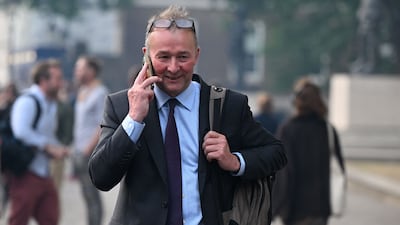
Simon Hart, secretary of state for Wales. AFP -

Brandon Lewis, Northern Ireland secretary. AP -

Rachel Maclean, minister for safeguarding. PA -

Mike Freer, minister for exports and minister for equalities. PA -

Edward Argar, minister for health. PA -

Damian Hinds, security minister. AP -

Helen Whately, exchequer secretary to the treasury. AP -

George Freeman, science minister. PA -
Duncan Baker, aide. Photo: UK Parliament -

Mark Fletcher, aide. PA -

Sara Britcliffe, aide. PA -

Ruth Edwards, aide. PA -

Peter Gibson, aide. PA -

James Sunderland, aide. PA -

Jacob Young, aide. PA -

James Daly, aide. PA -

Danny Kruger, aide. PA -
Dr James Davies, aide. Photo: UK Parliament -
Gareth Davies, aide. Photo: UK Parliament -
David Duguid, trade envoy. Photo: UK Parliament -

David Mundell, trade envoy. PA -

Guy Opperman, pensions minister. PA -

Michelle Donelan, education secretary. PA -

Chris Philp, technology minister. PA -

James Cartlidge, courts minister. PA -

Rebecca Pow, environment minister. PA -
Caroline Johnson, Tory Party vice-chairwoman. Photo: UK Parliament -
Rob Butler, aide. Photo: UK Parliament -
Luke Hall, deputy chair of the Conservative Party. Photo: UK Parliament


Whatever happens next, the British parliament will need to significantly reform how it deals with people in power taking advantage of those who are not.
That is unlikely to be on Mr Johnson’s watch. He could only look on bemused as Sir Keir skewered him with verbal rapiers. “The sinking ship is fleeing the rat,” Sir Keir said, referring to the raft of ministerial resignations. Those left in the government were attempting the “charge of the lightweight brigade”, he went on, and Mr Johnson’s most recent appointments were the “dying act of a political career”.
There was no killer blow from the government benches. “Does the prime minister think there any circumstances in which he should resign?” asked one of his exasperated MPs.
“The job of a PM in difficult circumstances is to keep going,” Mr Johnson retorted. “That’s what I’m going to do.” His sentiment seemed to merely reinforce the will of those who want him out.
As Mr Johnson stood up to leave a Labour backbencher shouted “bye Boris!” It was perhaps the nicest thing something had said to him all day.


