


British Prime Minister Boris Johnson is to face Parliament on Wednesday for the first time since the damaging revolt by Conservative MPs in Monday’s confidence vote.
Mr Johnson survived the rebellion by 211 votes to 148, but now faces an uphill battle to restore authority over his own party.
Behind the scenes, tensions are running high after 40 per cent of Conservative MPs refused to support him.
Allies of the prime minister can be expected to stage a noisy show of support when he steps up for his weekly questions in the House of Commons.
Health Secretary Sajid Javid said some colleagues who did not support Mr Johnson in the confidence vote have told him they are now “getting behind the prime minister”.
He told Sky News the prime minister had achieved a “clear and decisive win” in the ballot on Monday.
"They’re democrats, like all of us, and they accept the result of the vote and they’re getting behind the prime minister", he said.
Although it was the Sue Gray report into lockdown parties in Downing Street that prompted the vote, it also revealed deep unhappiness among MPs on different wings of the party across a range of issues.
They include promised legislation to override the Northern Ireland Protocol with the EU, as well as concerns about the high levels of tax and spend amid reports that rebel MPs could start staging “vote strikes” on policies they oppose.
After Mr Johnson insisted on Tuesday it remained a “fundamental Conservative instinct” to cut taxes, Chancellor Rishi Sunak used a speech to the Onward think tank to reaffirm his intention to reduce taxes for business in the autumn.
-
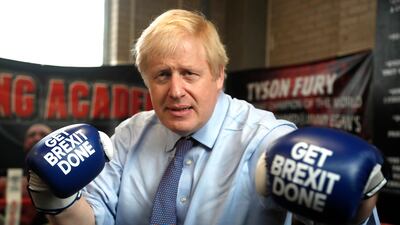
Boris Johnson has had an eventful time during his life in politics and journalism. Here, 'The National' looks back at his life in pictures. Getty Images -

Mr Johnson attends the coronation ceremony of Britain's King Charles III at Westminster Abbey in May. Getty Images -
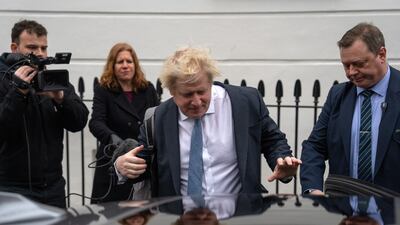
Mr Johnson leaves his home to attend a televised evidence session in March in front of the Commons Privileges Committee. Getty Images -
Mr Johnson listening to Ukrainian President Volodymyr Zelenskyy address parliamentarians in Westminster Hall in February. Getty Images -
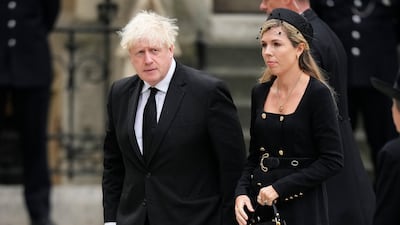
Mr Johnson and Carrie Johnson arrive at Westminster Abbey for the state funeral of Queen Elizabeth II in September 2022. Getty Images -
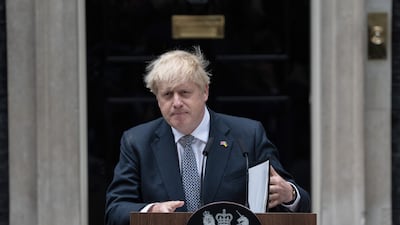
Mr Johnson he announces his resignation as prime minister outside 10 Downing Street in July 2022. Getty Images -
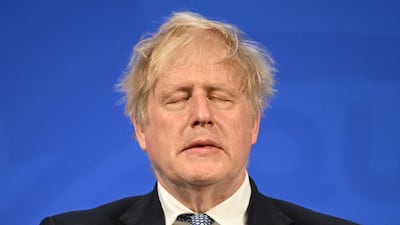
Mr Johnson at a press conference in response to the publication of the Sue Gray report into Partygate at Downing Street in May 2022. Getty Images -
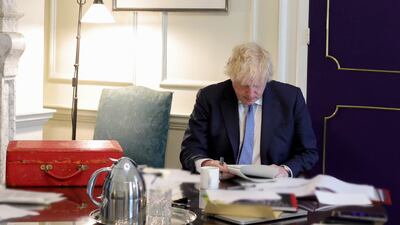
Mr Johnson reads the long-awaited report by senior civil servant Sue Gray into the Downing Street party scandal, in his Downing Street office in May 2022. Photo: Downing Street -
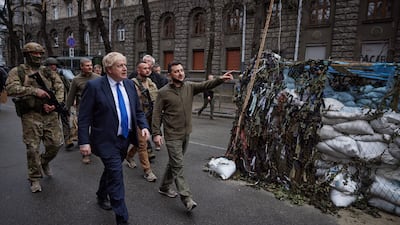
Mr Johnson and Ukrainian President Volodymyr Zelenskyy in central Kyiv in April 2022. The British prime minister paid an unannounced visit to Kyiv in a show of solidarity with Ukraine. AFP -
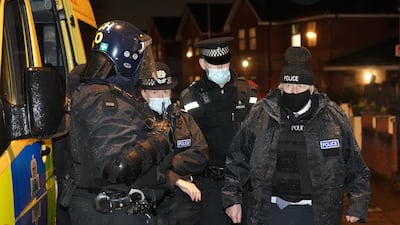
Mr Johnson watches an early morning police raid on a home in Liverpool as part of an operation to thwart drug dealing, in December, 2021. Getty Images -
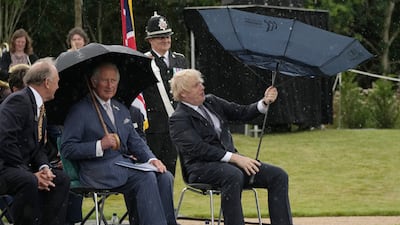
The prime minister battles with his umbrella while with Prince Charles at The National Memorial Arboretum in July 2021, in Stafford, England. Getty Images -
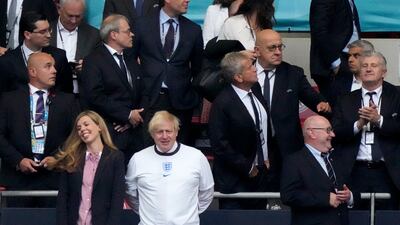
Mr Johnson and his wife before the Uefa European Championship final between Italy and England at Wembley Stadium, London, in July last year. Getty Images -

The British prime minister with US President Joe Biden, European Council President Charles Michel, former Japanese prime minister Yoshihide Suga and Italian Prime Minister Mario Draghi during the G7 Summit in Cornwall, in June 2021. Getty Images -
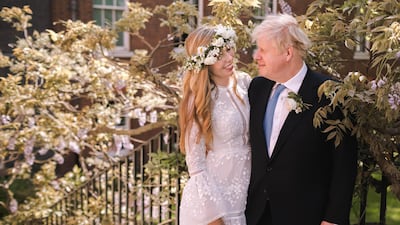
Mr Johnson with his wife Carrie in the garden of 10 Downing Street after their wedding at Westminster Cathedral, in May last year. Getty Images -
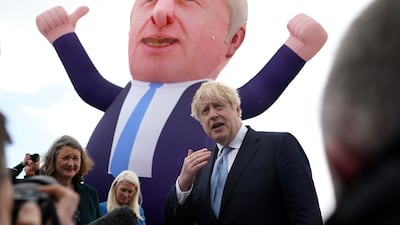
Boris Johnson visits Hartlepool after Conservative Party candidate Jill Mortimer won a parliamentary by-election in May, 2021. Getty Images -
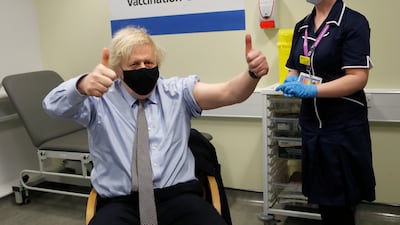
The prime minister after receiving the first dose of the AstraZeneca vaccine at St Thomas' Hospital in London in March, 2021. Getty Images -
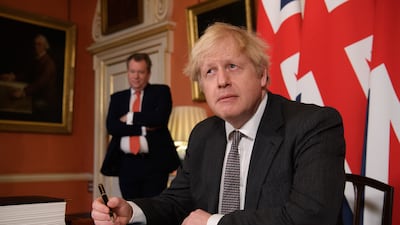
Boris Johnson after signing a Brexit trade deal with the EU in December 2020. Getty Images -
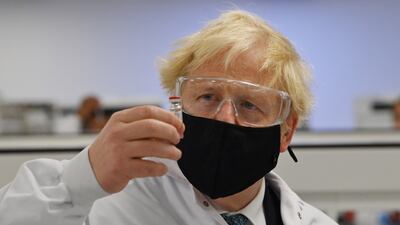
Mr Johnson examines a vial of the AstraZeneca Covid-19 candidate vaccine, at a pharmaceutical manufacturing facility in Wrexham, Wales, in November 2020. Getty -
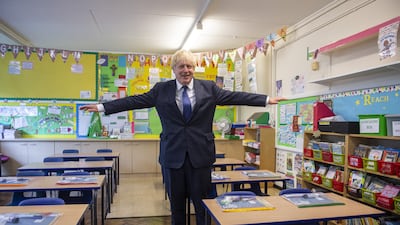
Mr Johnson demonstrating the two-metre distancing rule during his visit to St Joseph's Catholic Primary School in Upminster, East London, in August 2020. PA -
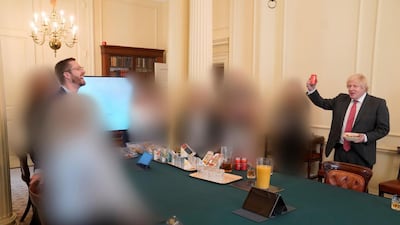
In this photo, published alongside the Sue Gray report into the Partygate affair, Mr Johnson is seen at a gathering in the Cabinet Room in 10 Downing Street on his birthday in June, 2020. Getty Images -
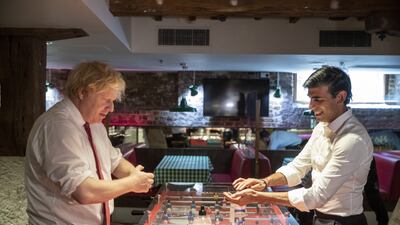
Mr Johnson and former chancellor Rishi Sunak use hand sanitiser during a visit to the Pizza Pilgrims restaurant in June 2020, in east London, to see how they are getting their business ready to reopen as coronavirus lockdown restrictions were lifted in England. PA -
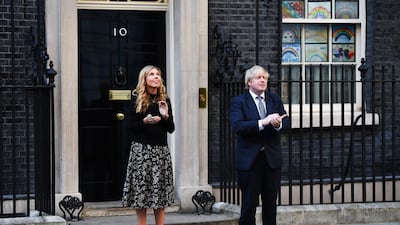
Mr Johnson and his fiancee Carrie Symonds applaud key workers outside 10 Downing Street in May 2020, during the coronavirus pandemic. Getty Images -
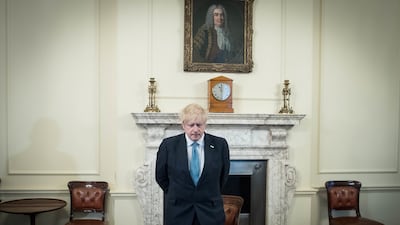
Mr Johnson in the Cabinet Room observing a minute's silence in April 2020 in a tribute to the health staff and key workers who died during the coronavirus outbreak. PA -
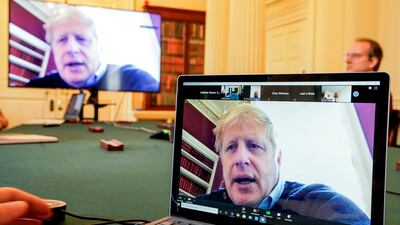
Boris Johnson appears on monitors for a meeting in March 2020. The prime minister chaired morning meetings on the coronavirus remotely from Number 11 Downing Street, while self-isolating after testing positive for the virus. Reuters -
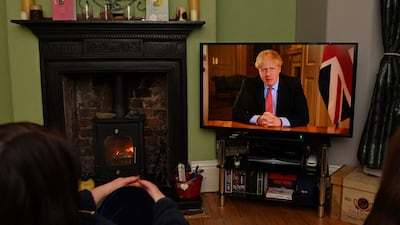
Members of a family listen as BMr ris Johnson makes a televised address to the nation from 10 Downing Street in March 2020, where he outlined the latest instructions to stay at home to help contain the Covid-19 outbreak. AFP -

Mr Johnson speaks to British troops stationed in Estonia during a one-day visit to the Baltic country in December 2019. Getty Images -
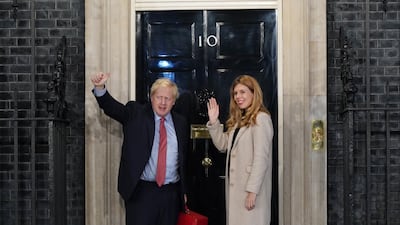
Mr Johnson and Carrie Symonds enter Downing Street as the Conservatives celebrate a sweeping election victory in December 2019. Getty -

Boris Johnson is greeted by staff at 10 Downing Street after meeting Queen Elizabeth II and accepting her invitation to form a new government in December 2012. PA -
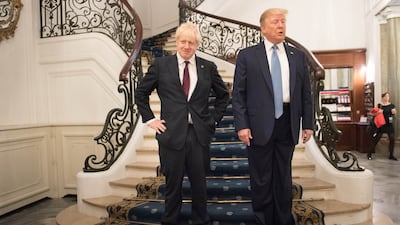
Former US president Donald Trump and Mr Johnson arrive for a bilateral meeting during the G7 summit in August 2019 in Biarritz, France. Getty -
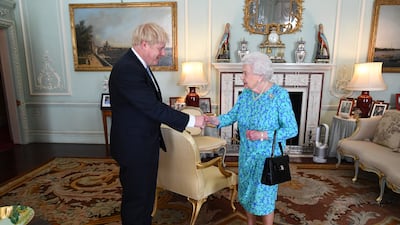
The queen welcomes Mr Johnson as the newly elected leader of the Conservative Party, during an audience in July 2019. Getty Images -
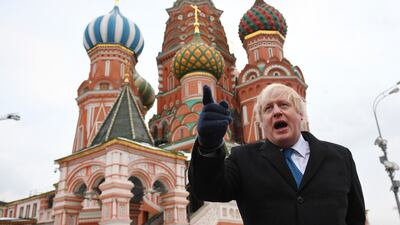
Mr Johnson, then Britain's foreign secretary, stands in front of St Basil's Cathedral during a visit to Moscow's Red Square in December 2017. Getty -
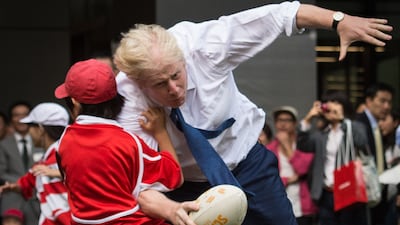
Mr Johnson collides with a child during a Street Rugby tournament in Tokyo in 2015, held to mark Japan hosting the 2019 Rugby World Cup -
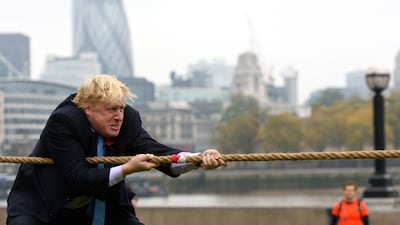
As mayor of London Mr Johnson competes in a tug-of-war in October 2015. Getty Images -
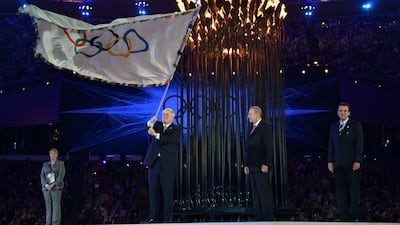
The Olympic Flag is passed from Mr Johnson to IOC President Jacques Rogge during the closing ceremony of the London 2012 Olympic Games. Getty Images -
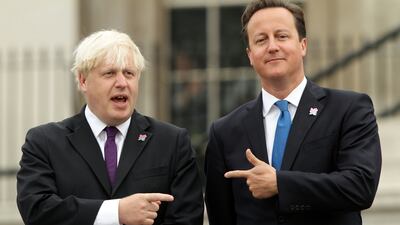
Mayor of London Boris Johnson with Prime Minister David Cameron during the lighting of the Paralympic Cauldron in Trafalgar Square, in August 2012. PA -
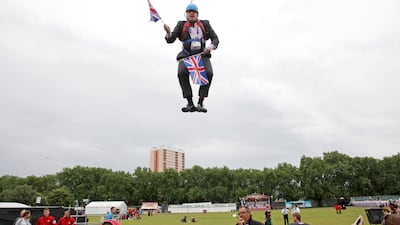
Boris Johnson gets stuck on a zip-line during a BT London Live event in Victoria Park in August 2012. Getty -
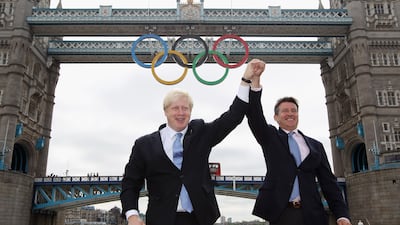
Mr Johnson and Lord Sebastian Coe cheer as a giant set of Olympic rings is displayed from Tower Bridge in June 2012, Getty Images -
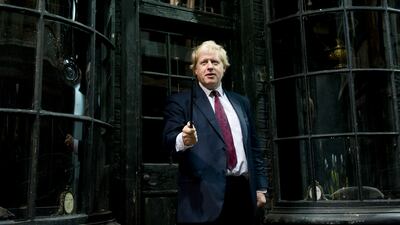
Mr Johnson gestures attends a Harry Potter studio tour of Diagon Alley, at the Warner Brother Studios, London, in December 2011. AP Photo -
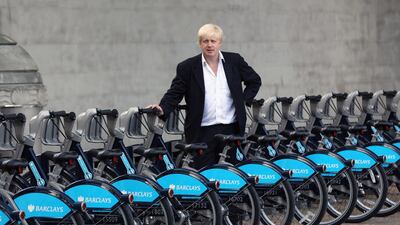
Mr Johnson at the launch of London's first cycle hire scheme in July 2010. Getty Images -
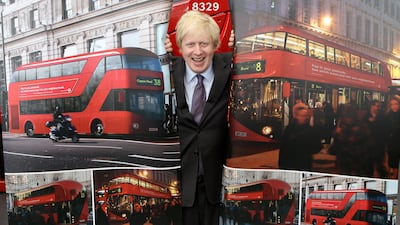
Mr Johnson with artists' impressions of the design for London's new Routemaster bus in May 2010. Getty Images -
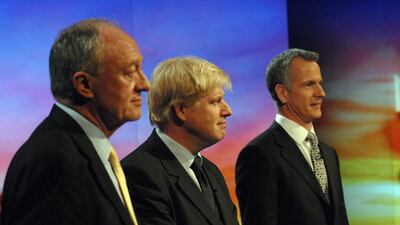
The candidates to be mayor of London; Labour's Ken Livingstone, Conservative Boris Johnson and Liberal Democrat Brian Paddick, being questioned on BBC's 'Newsnight' programme in April 2008. Getty Images -
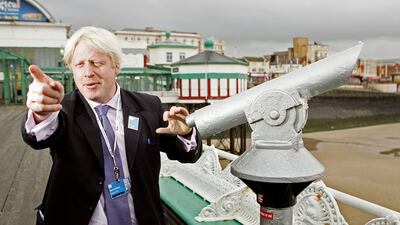
Boris Johnson on the North Pier in Blackpool during the Conservative Party conference there in October 2005. Getty Images -
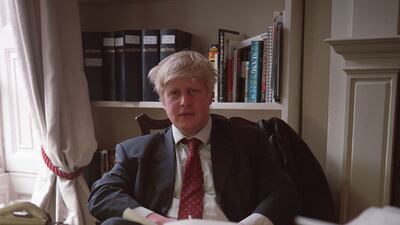
Mr Johnson at his desk in 2000 while he was a journalist for 'The Telegraph'. Getty Images -
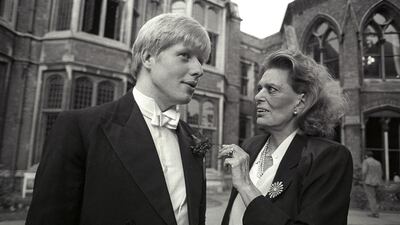
Mr Johnson when he was president of the Oxford Union society speaking to the Greek minister for culture Melina Mercouri when she addressed the union. Reuters -
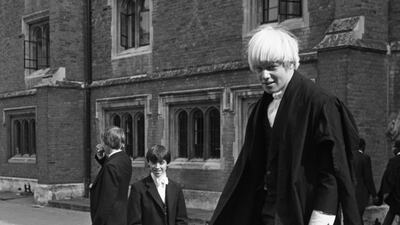
Boris Johnson in September 1979, at Eton School. Shutterstock


It followed a call from former Brexit minister Lord Frost for previously announced rises to national insurance and corporation tax to be reversed, warning they were “not Conservative” and were “undermining growth and prosperity”.
His view that the British government needs to move on to a tax-cutting agenda to shore up Mr Johnson’s leadership is reportedly shared by some in the Cabinet.
Meanwhile, The Daily Telegraph reported that allies of the prime minister were urging him to replace Mr Sunak with former foreign secretary Jeremy Hunt.
Mr Hunt — who was runner-up to Mr Johnson in a 2019 leadership election and is expected to stand again if there is another contest — infuriated some in the Cabinet when he announced he would be voting for “change” in the confidence vote.
However, proponents of the idea argue that bringing back his rival into the Cabinet would help stabilise Mr Johnson’s leadership, heal rifts within the party and bind Mr Hunt to the prime minister’s agenda.
Under current party rules, Mr Johnson is safe now from another formal confidence vote, although the backbench 1922 Committee could potentially rewrite the regulations if there is renewed pressure for change.
Former YouGov president Peter Kellner seemingly suggested the rules should be changed so ministers and their aides could not take part in confidence votes.
“The 1922 Committee exists to represent Tory backbenchers. Suppose it had done so this week,” he wrote in a letter to the editor of The Times.
“It would have honoured the electorate’s wish to depose Johnson, the need for effective government and the electoral interests of the Conservative Party — had its rules allowed it to bar ministers and their aides from taking part in Monday’s vote.
“Johnson would be out, as should any party leader who cannot retain the loyalty of their backbenchers.”
At the moment, there would appear to be no appetite among the rebels for another immediate move against Mr Johnson.
However, he has two tricky by-elections coming up in Wakefield, West Yorkshire, and in Tiverton and Honiton, Devon, amid warnings they could fall to Labour and the Liberal Democrats respectively.
Such a double defeat could be the catalyst for a fresh bout of soul-searching within the party, leading to renewed demands for change at the top.
Despite the speculation, one Cabinet ally — Business Secretary Kwasi Kwarteng — said he was “pretty confident” that Mr Johnson would still lead them into the next general election.
“I’m pretty confident he will but lots of things happen in politics. I’m 100 per cent behind him,” he told Channel 4 News on Tuesday.
“As far as this particular prime minister is concerned, he has been written off dozens of times. He’s somebody who’s extremely resilient and is extremely focused on delivering what matters to people.”

