


Live updates: follow the latest news on Russia-Ukraine
The UK government has imposed a new range of sanctions on Russia and Belarus that will affect trade worth £1.7 billion ($2.1bn).
The sanctions will impose import tariffs and export bans on the two countries, and have been drawn up by International Trade Secretary Anne-Marie Trevelyan and Chancellor Rishi Sunak.
For the UK, it is the third round of widening sanctions, with Russian oligarchs and generals personally targeted, and comes as the European Union also looks to tighten the economic noose.
The Department for International Trade (DIT) said import tariffs on £1.4bn worth of goods, including platinum and palladium, will hamper Mr Putin's “ability to fund his war effort”.
The move will bring the total value of products subjected to full or partial import and export sanctions since Russia’s invasion of Ukraine began to more than £4 billion ($4.9bn), the department said.
Planned export bans “intend to hit more than £250 million worth of goods in sectors of the Russian economy most dependent on UK goods, targeting key materials such as chemicals, plastics, rubber and machinery”, the DIT said.
-
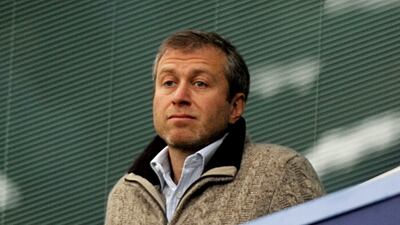
The UK has sanctioned more than 1,400 individuals and businesses, including 100 oligarchs and their relatives, since Russia invaded Ukraine in February. The list of oligarchs includes: Roman Abramovich, 55. PA -

Katerina Tikhonova, left, and Maria Vorontsova, unseen, also known as Maria Putina, daughters of Russia President Vladimir Putin. Reuters -
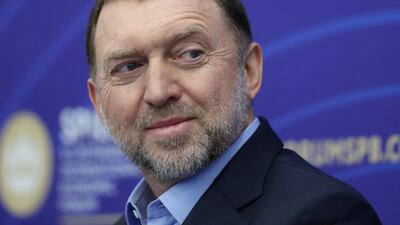
Oleg Deripaska, 54. The industrialist is worth £2 billion and has had close links with the British political establishment. He has a multimillion pound property portfolio in the UK. Reuters -

Igor Sechin, 61. Officials described Mr Sechin as Mr Putin's right-hand man and the second most important person in the country. Reuters -
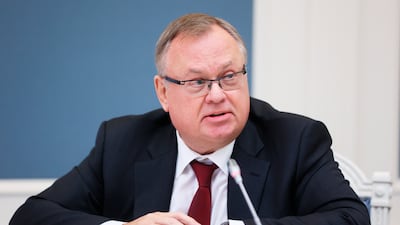
Andrey Kostin, 65. The chairman of VTB, a Russian state-owned bank. Mr Kostin is also a member of the supreme council of the United Russia political party and deemed a close associate of Mr Putin. AP Photo -
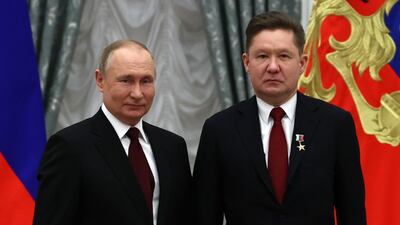
Alexei Miller, 60. The chief executive of energy company Gazprom, Russia's largest company and the world's biggest public energy supplier. AFP -
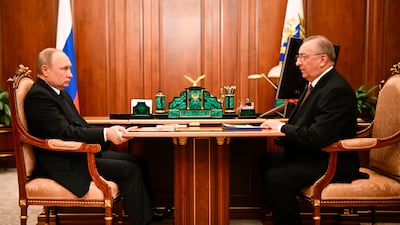
Nikolai Tokarev, 71, president of the Russia state-owned pipeline company Transneft. Mr Tokarev is a former KGB officer who served with Mr Putin in East Germany towards the end of the Cold War. AP Photo -

Kirill Shamalov, 39. He is Russia's youngest billionaire and the ex-husband of Mr Putin's daughter Katerina Tikhonova. Reuters -

Pyotr Fradkov, 43. He is head of the sanctioned Promsvyazbank, which finances Russian defence industries, and the son of Mikhail Fradkov, a former prime minister of Russia and chief of its foreign intelligence service. Reuters -
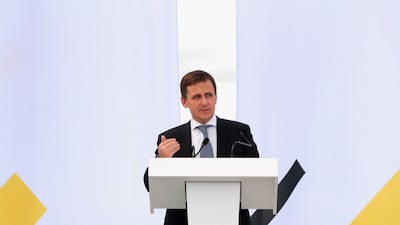
Denis Bortnikov, 47. The deputy president of government-affiliated VTB bank. His father, Alexander Bortnikov, is head of the Federal Security Service. Getty Images -
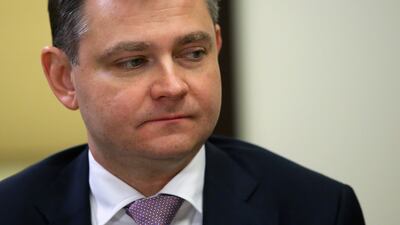
Yury Slyusar, 47. The director of United Aircraft Corporation, one of the major defence organisations that has also been sanctioned. Getty Images


“We are determined to do our utmost to thwart Putin’s aims in Ukraine and undermine his illegal invasion, which has seen barbaric acts perpetrated against the Ukrainian people. This far-reaching package of sanctions will inflict further damage on the Russian war machine,” said Ms Trevelyan.
Mr Sunak said the Russian president's decision to invade Ukraine was causing suffering on an enormous scale.
“His barbaric war must be stopped. Over £4 billion worth of goods will now be subject to import and export sanctions, doing significant damage to Putin’s war effort,” said Mr Sunak.
This is the third round of trade sanctions announced by the UK government “and, excluding gold and energy, will bring the proportion of goods imports from Russia hit by restrictions to more than 96 per cent, with more than 60 per cent of goods exports to Russia under whole or partial restrictions”, said the DIT.
The department said about “£1.4 billion of imports will face an additional 35 percentage point tariff”, and legislation “will be laid in due course” to enable these measures.
Meanwhile, the EU should consider using frozen Russian foreign exchange reserves to help pay for the cost of rebuilding Ukraine after the war, its foreign policy chief Josep Borrell said in an interview on Monday.
Mr Borrell said the EU and US could follow the lead provided by the seizure of Afghan central bank assets to use as humanitarian aid in the country.
“I would be very much in favour because it is full of logic,” he told the Financial Times. “We have the money in our pockets, and someone has to explain to me why it is good for the Afghan money and not good for the Russian money.”
“This is one of the most important political questions on the table: who is going to pay for the reconstruction of Ukraine?”
The G7 group of industrial powers has pledged to ban or phase out imports of Russian oil. Some EU nations are pushing for a ban on Russian oil but so far a timetable has not been agreed.
The US has also announced extra measures, cutting off western advertising from Russia’s three biggest TV stations, banning US accounting and consulting firms from providing services, and cutting off Russia’s industrial sector from wood products, industrial engines, boilers and bulldozers.

