

Live updates: follow the latest news on Russia-Ukraine
For the two men who planned the flawed invasion of Ukraine, responsibility for Russia’s inept attack means that they must account for the thousands of their own men killed in a month, military analysts have suggested.
Generals Valery Gerasimov and Sergei Shoigu, the respective Chief of the General Staff and Minister for Defence, both 66, have overseen an unimaginable scale of loss for a modern army.

Since his appointment a decade ago, the chief of staff has won respect for introducing the “Gerasimov doctrine”, an approach that fused military, diplomacy, cultural, information, war and technological domains to attain a strategic goal.
“He struck me as quite a thoughtful soldier and some of his doctrine made a lot of sense,” retired Brigadier Ben Barry of the IISS think tank said. “He made several major speeches analysing the changing character of combat of war, including drawing on lessons from Russian operations in Syria.”
What went wrong?
Leading military strategist Prof Michael Clarke suggests Gen Gerasimov is not “a flexible thinker” and was not a “young, well-promoted tyro” in the fashion that the Red Army often produced.
Gen Gerasimov’s doctrine has either been ignored or proved unworkable against determined resistance by Ukraine or “they obviously didn't train for it at a high enough level of detail”, said the Rusi think tank academic.
The lack of a single, overall commander in charge of the campaign has been a glaring omission, said Col Richard Kemp, a retired British officer. “That there’s no one tying it all together is a significant failure, particularly when you look at the use of reserves, aircraft and artillery which should be switched around between different elements of a campaign. If you don’t have someone to co-ordinate that, it makes fighting much more difficult.”

Gen Shoigu was also part of Soviet-era management where endemic corruption and blame deflection formed a malaise that is clearly still sustained in the Russian army.
“The forces are very corrupt, very inefficient and the cumulative effect leads to senior levels being told that ‘this and this’ have been done,” said Prof Clarke. “Everybody says everything's fine when actually it isn't and when a training exercise suddenly becomes a combat operation, all the deficiencies which had been tolerated or turned a blind eye to suddenly become very important.”
Gen Shoigu is also not a real general. The title came with his ministerial post after he was promoted from the Emergencies Ministry when his predecessor was fired in 2012.
Despite coming from outside the president’s cabal of former KGB officers and of Tuvan-Turkic heritage, Gen Shoigu has formed a bond with Mr Putin and was unquestionably deeply involved in planning the invasion, albeit in a tiny group that gave the military little time to plan for a complex, all-arms attack.
“Demonstrating competence as emergencies minister did make he seem to be a safe pair of hands,” said Brig Barry. “But the apparent failure of logistics can be laid Gen Shoigu’s feet.”
With his ethnic background, racism might be undermining Gen Shoigu from within the oligarchs and former KGB cohort, Prof Clarke said.
“There is a degree of closet racism around,” he said. “Gen Shoigu is also a very buttoned-up character and he's not a real Putin man, in the way that others are. He's a bit detached and it’s been rumoured for some time that he has a heart problem.”

Gen Shoigu, a fluent speaker of nine languages, including English and Chinese, led defence during the 2014 invasion of Crimea and a year later in Syria.
Gen Gerasimov has also picked up operational experience both from the Second Chechen War and in 2014 where he was allegedly the general in charge of the Battle of Illovaisk in which 1,000 Ukrainian soldiers were killed.
-
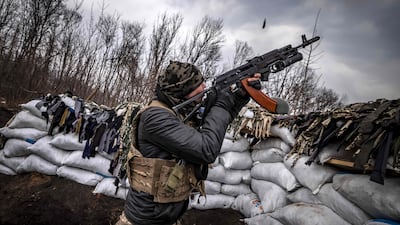
A Ukrainian soldier fires his rifle from a trench at the front east of Kharkiv in the north of Ukraine, which continues to be shelled by Russian forces. AFP -
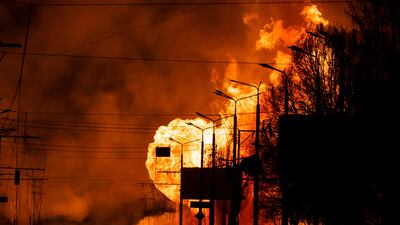
A gas station on fire in Kharkiv after Russian ttack on the northern city. AFP -
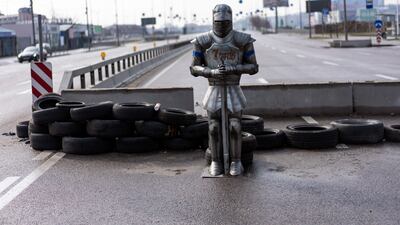
A medieval suit of armour 'stands guard' at a a Ukrainian checkpoint, on the outskirts of the capital Kyiv. AP Photo -
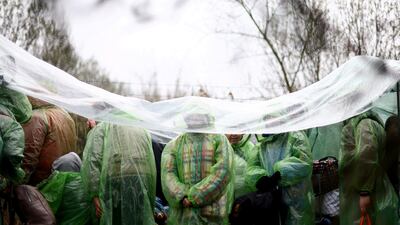
Ukrainian refugees wait in line to cross the border into Poland at Shehyni. Reuters -
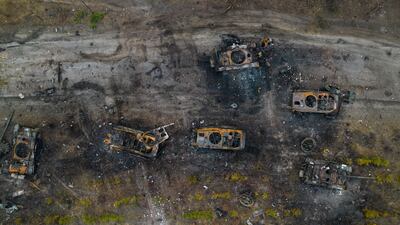
Destroyed Russian armoured vehicles on the outskirts of Kyiv. AP Photo -
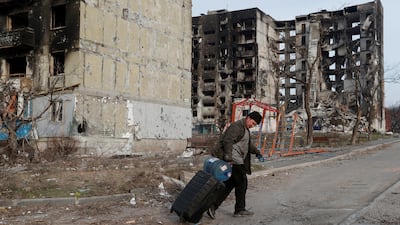
A resident passes apartment buildings destroyed by Russian attacks in the besieged southern port city of Mariupol, Ukraine. Reuters -
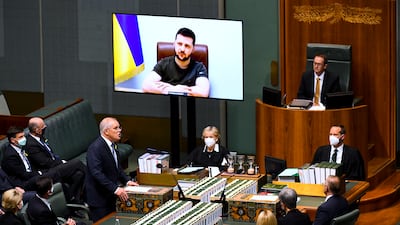
Australian Prime Minister Scott Morrison, standing, welcomes Ukrainian President Volodymyr Zelenskyy to address the House of Representatives via video link at Parliament House in Canberra. Mr Zelenskyy appealed directly to Australian legislators for more help in the war against Russia, including armoured vehicles and tougher sanctions. AP -
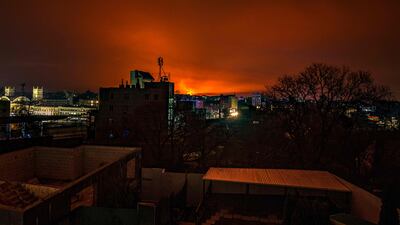
Fire lights up the sky east of Kharkiv, where Ukrainian forces pushed back Russian troops from a motorway outside the country's second-largest city. AFP -
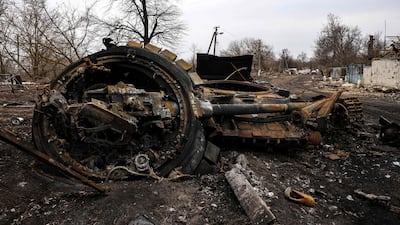
A destroyed Russian tank in the village of Lukianivka near Kyiv. AFP -
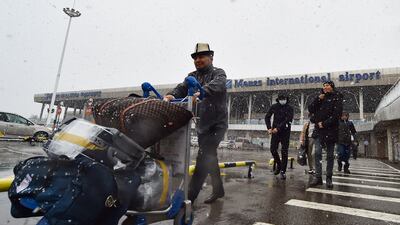
Passengers arriving from Moscow at Manas International Airport, Bishkek, Kyrgyrzstan. Hundreds of thousands of citizens of former Soviet countries in Central Asia are facing difficult choices: shrinking work opportunities in Russia and wages in the weakened rouble versus a return to the homeland where they have family homes, but even fewer job prospects. AFP -

Fire and smoke light up the sky east of Kharkiv as Ukrainian forces push back Russian troops from a motorway outside the country's second-largest city. AFP -
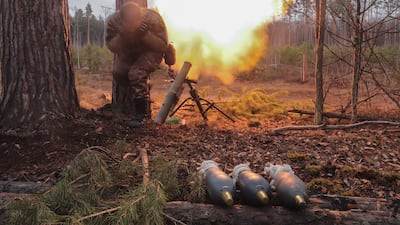
A Ukrainian soldier shoots at the Russian positions not far from the capital Kyiv. EPA -
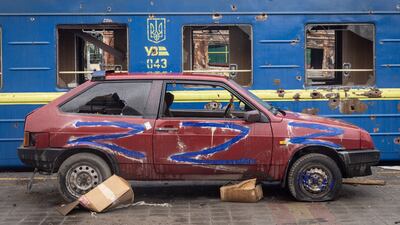
A car marked with the English letter 'Z' is found destroyed at the central Ukrainian train station that was used as a Russian base in Trostyanets. Ukrainian forces said they had retaken the north-eastern town from the Russians. Getty Images -
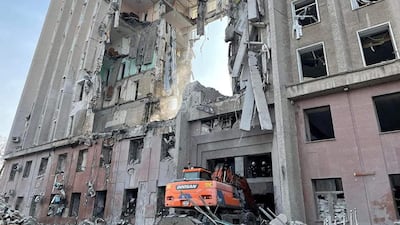
Rescue workers at the site of the regional administration building hit by Russian cruise missiles, in Mykolaiv, Ukraine. Reuters -
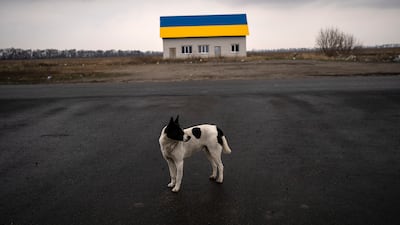
A dog looks at cars passing by on the road near a house painted with the colors of the Ukrainian flag, on the outskirts of the capital Kyiv. AP Photo -
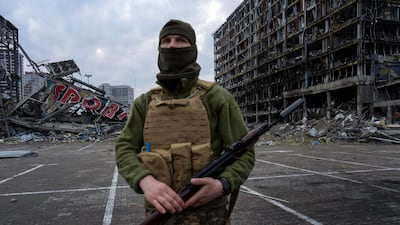
A soldier poses for the picture in Kyiv, Ukraine, while standing guard amid the destruction caused after shelling of a shopping center. AP Photo -
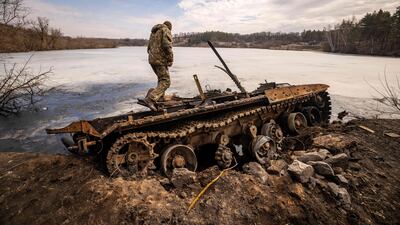
A Ukrainian serviceman stands near a destroyed Russian tank in the north-eastern city of Trostianets. AFP -
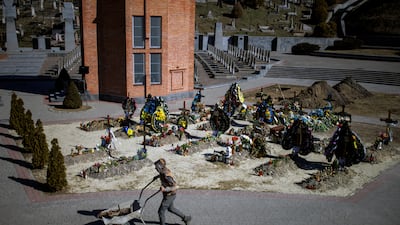
A worker pushes a cart past graves of Ukrainian soldiers who were killed in battle during Russia’s attack on Ukraine, at the Lychakiv cemetery in Lviv. Reuters -
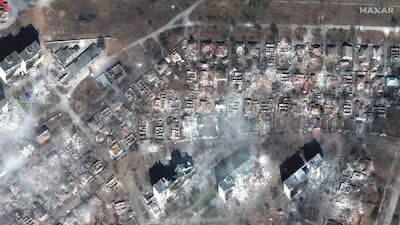
This satellite image provided by Maxar Technologies shows damaged apartment buildings and homes in Mariupol. AP -
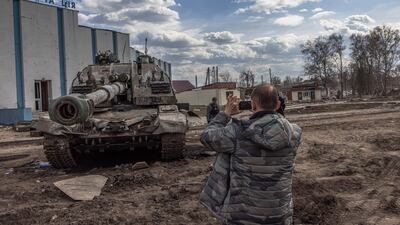
A resident takes photos of a destroyed Russian tank next to the railway station where the Russian forces were stationed, in Trostyanets, a town recaptured by the Ukrainian army. EPA -

A rescuer clears the rubble of a warehouse containing more than 50,000 tons of deep-frozen food in the town of Brovary, north of Ukrainian capital of Kyiv, after it was destroyed by Russian shelling. AFP -
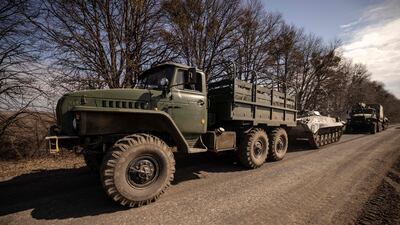
A Ukrainian army vehicle carries a Russian tank in Trostyanets. AFP -
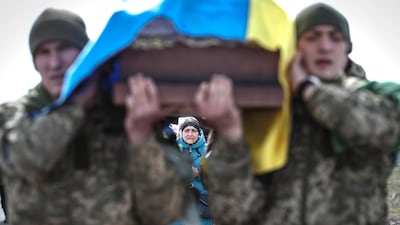
Ukrainian soldiers carry a coffin during the funeral ceremony of a comrade in Odesa. EPA -
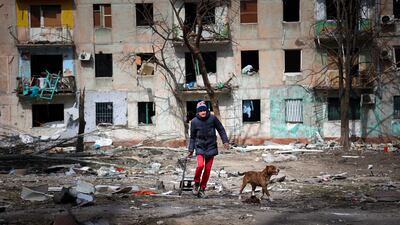
A man walks with his dog near an apartment building damaged by shelling from fighting on the outskirts of Mariupol. AP Photo -
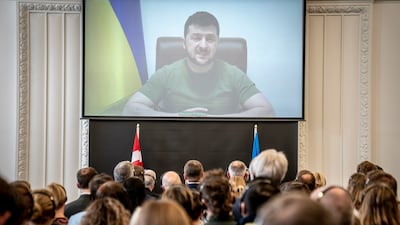
Members of the Danish Parliament attend the Ukrainian President, Volodymyr Zelensky's speech to the Danish Parliament via a video link, at the Christiansborg Castle in Copenhagen, Denmark. EPA -

A satellite image shows crowds outside a Metro grocery store in Mariupol. Reuters -
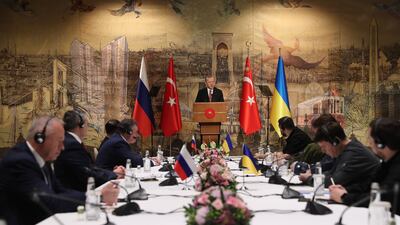
Turkish President Recep Tayyip Erdogan opens Ukrainian-Russian talks in Istanbul. President Erdogan told the delegations that "both parties have legitimate concerns." AFP -
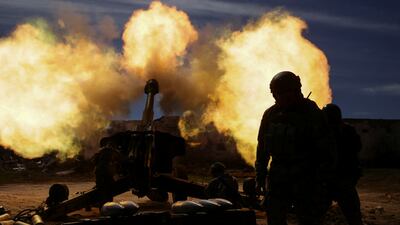
Members of the Ukrainian Volunteer Corps fire a howitzer at a position in the Zaporizhzhia region. Reuters -
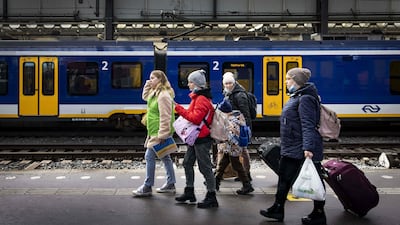
Ukrainian refugees are helped by volunteers upon their arrival at Amsterdam Central station by train from Berlin. AFP -

Ukrainian soldiers ride an armoured people carrier through the town of Trostsyanets, about 400 kilometres east of Kyiv. AP Photo -
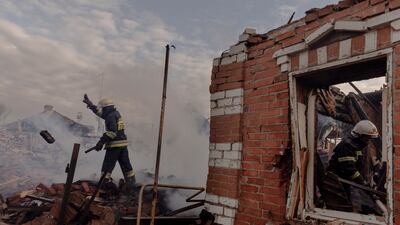
Firefighters work amid the debris of residential houses that were destroyed by Russian shelling in a settlement outside Kharkiv. Reuters -
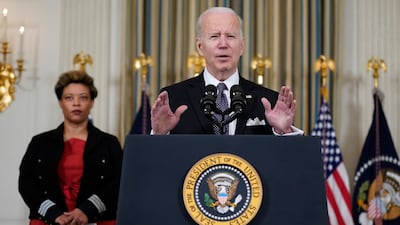
President Joe Biden said that he is not advocating for regime change in Moscow after saying Russian counterpart Vladimir Putin "cannot remain in power." AP Photo -

Firefighters work to extinguish a fire at a warehouse after it was hit by Russian shelling in Kharkiv, Ukraine. More than half of Kharkiv's 1.4 million people have fled the city since Russia's invasion on February 24. Getty Images -
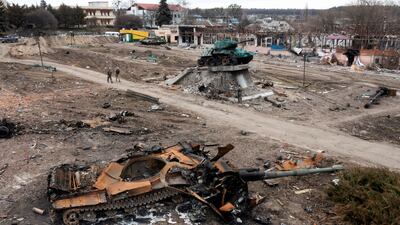
Local residents pass by a destroyed Russian tank in the town of Trostyanets, east of capital Kyiv, Ukraine. The monument to the Second World War is seen in background. AP Photo -
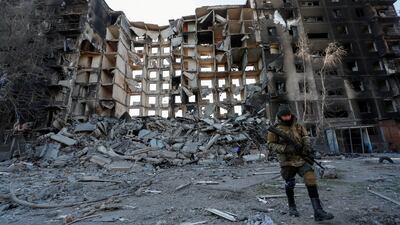
A pro-Russian troop service member walks near a destroyed apartment building in the besieged southern port city of Mariupol. Reuters -
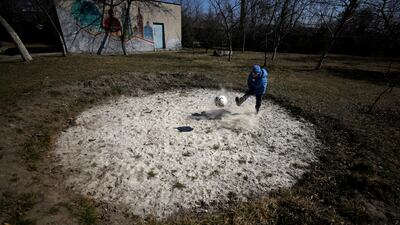
Mykhaylo, 8, who was taken away from his widowed mother along with his 9-year-old brother and 16-year-old sister, plays with a ball in the garden of a state shelter in Lviv. Reuters -

Halyna Falko, 52, talks to reporters while looking at the destruction caused after a Russian attack inside her house near Brovary, on the outskirts of Kyiv. AP Photo -
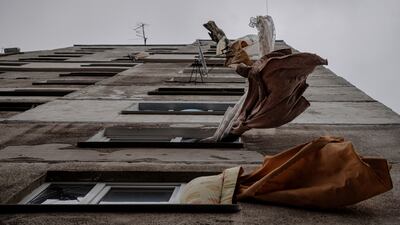
Curtains flutter in the wind at a building that was damaged by shelling in a neighbourhood that has been largely abandoned and left without water, gas and heating, as Russia's attack on Ukraine continues, in Kharkiv, Ukraine. Reuters -

People, mainly women and children, arrive at Przemysl on a train from Odesa in war-torn Ukraine in Przemysl, Poland. The Polish government has said it may spend €24 billion this year hosting refugees fleeing the war in Ukraine, and is seeking more support from the European Union. Getty Images -
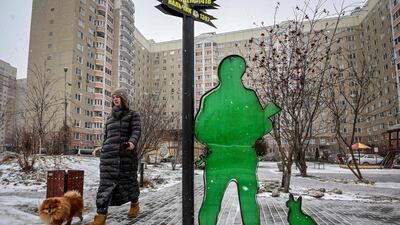
A woman walks a dog past the so-called "people's installation to a Russian soldier" nicknamed the "polite people" created by residents in the backyard of their apartment building in the town of Podolsk, outside Moscow. AFP


But that appears to have been a sham, as it was in the Cold War. “I witnessed the Soviet Army in the 1980s in East Germany where they were a pretty ramshackle bunch when everyone thought they were Superman,” said Col Kemp, a former British Army commander in Afghanistan. “They were widely feared but actually, when you saw them up close the vehicles were rusting, improperly maintained and the soldiers were undisciplined. I'm guessing that that's continued.”
However, all might not be lost for the generals. After the D-Day landings in 1944 – possibly the most intricately planned military operation – it took seven weeks for the Allies to break out of Normandy.
“Two things could happen,” said Brig Barry. “If the Russians gain air superiority that would make life very difficult for movement of Ukraine’s supplies. And what if President [Volodymyr] Zelenskyy is killed? His leadership is a public projection of determination and the national will alongside a very savvy social media operation like that of music stars Rihanna or Adele.”
But it may also be that the two generals, working with the security services, decide that Putin’s time is over. “It’s a question then of someone putting the knife in first,” said Prof Clarke. “Then it will be like the Julius Caesar scenario – once one person has stabbed him politically, everybody else will pile in quickly.”
Mr Putin, though, has not survived in the Kremlin for four decades without a well-refined instinct. It could be that the generals receive the blade first.
“My hunch is they take responsibility for this,” said Prof Clarke.
Previous victories in Ukraine, Syria and perhaps Libya might also have convinced the high command of their superiority.
Or they may just have been set an impossible task by Mr Putin, argues Prof Clarke. “They were given the impossible to perform and now they're getting blamed for not doing the impossible.”
That a brigade of paratroopers and Spetsnaz special forces – regarded as equals to Britain and America’s troops – were defeated in the early days suggests dreadful planning and intelligence, he said.

