


Roman Abramovich has been pushed out of peace talks between Russian and Ukraine, the Kremlin has confirmed.
The Chelsea football club owner was involved in the early stages of efforts to broker a ceasefire.
Shortly after Russian President Vladimir Putin ordered his troops into Ukraine, Mr Abramovich’s spokesman said the billionaire was “trying to help” bring an end to the violence.
Ukrainian President Volodymyr Zelenskyy is said to have believed the tycoon could serve as a useful intermediary between Kyiv and Mr Putin’s inner circle, and put pressure on the Biden administration to refrain from imposing sanctions on him.
However, it was not known how influential Mr Abramovich, 55, would be in any negotiations. His mother, Irina, was born in Ukraine and he has close ties to Mr Putin.

The Russian billionaire was approached by Kyiv officials with a request to act as a go-between, his representative said.
On the fifth day of the war, he travelled to Belarus in an “advocacy role” and was praised by a senior Ukrainian politician for his “very positive” intervention.
Dmitry Peskov, the Kremlin’s spokesman, confirmed Mr Abramovich’s role in the early stages of peace talks but said he had been sidelined.
“He did take part at the initial stage,” Mr Peskov said. “[But] now the negotiations are between the two teams, the Russians and Ukrainians.”
More than a month into the conflict, efforts are still continuing to reach a peace settlement as the death toll mounts and western nations ratchet up sanctions against Russia.
Dmitry Medvedev, former president of Russia and deputy head of the Security Council, said it is “foolish” to believe sanctions against businesses in the country could have any effect on the Kremlin.
The sanctions will only bring together Russians and not result in popular discontent with the authorities, Mr Medvedev told Russia's RIA news agency in an interview on Friday.
The West has imposed an array of sanctions on Russia after its invasion of Ukraine, but the Kremlin says it will continue the assault until it accomplishes its goals of Ukraine's “demilitarisation and denazification".
Some of the sanctions have been aimed at billionaire businessmen believed to be close to Mr Putin.
“Let us ask ourselves: can any of these major businessmen have even the tiniest quantum of influence of the position of the country's leadership?” Mr Medvedev said. “I openly tell you: no, no way.”
He claimed opinion polls showed three quarters of Russians supported the Kremlin's decision to send troops into Ukraine and even more supported Mr Putin.
-
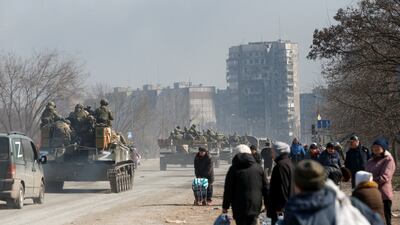
Pro-Russian troops drive armoured vehicles past local residents in the besieged Ukrainian port city of Mariupol. Reuters -
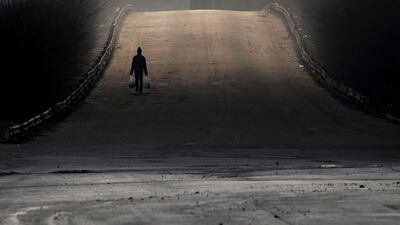
Heavy smoke from a warehouse destroyed by Russian troops casts a shadow on a road outside Kyiv. AP -
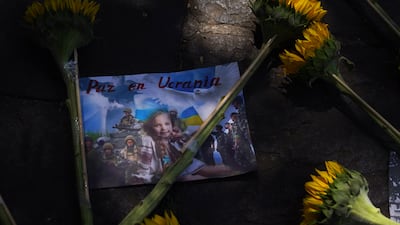
Sunflowers and an image with a message in Spanish that reads 'Peace in Ukraine' placed outside the Russian embassy in Mexico City by demonstrators during a protest against Moscow's invasion of Ukraine. AP -
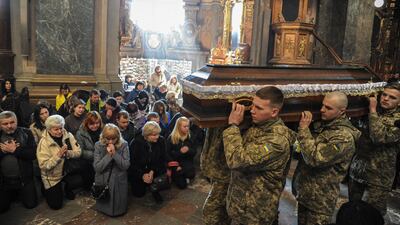
Ukrainians pay their respects during the funeral Senior Lt Igor Fedorchik in Lviv. The Ukrainian officer was killed when Russian forces shelled the town of New Kahovka. EPA -
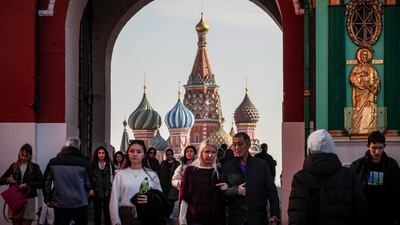
St Basil's Cathedral, as viewed from the Red Square in Moscow. EPA -
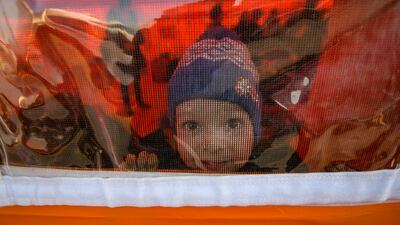
A young Ukrainian refugee looks out of a tent after crossing the border by ferry into Romania on March 24, 2022. AP -
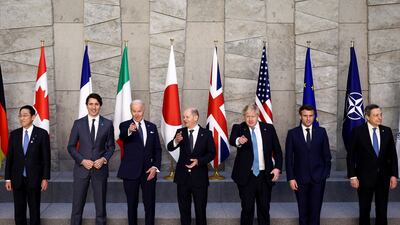
From left, Japanese Prime Minister Fumio Kishida, Canadian Prime Minister Justin Trudeau, US President Joe Biden, German Chancellor Olaf Scholz, British Prime Minister Boris Johnson, French President Emmanuel Macron and Italian Prime Minister Mario Draghi pose for a family photo during the G7 summit in Brussels, Belgium. Reuters -

Smoke billows from a fire on what the Ukrainian Ministry of Defence says is a Russian warship at the port of Berdiansk, Ukraine. Reuters -

Yurii, brother of Ihor Fedorchyk, 38, a soldier killed by Russian shelling in the town of New Kahovka, hugs his mother, Myroslava, as they mourn during his funeral at the Lychakiv cemetery in Lviv, Ukraine. Reuters -
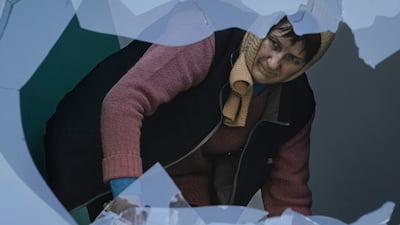
A woman cleans broken glass from a staircase in an apartment building damaged by bombing in Kyiv, Ukraine. AP -
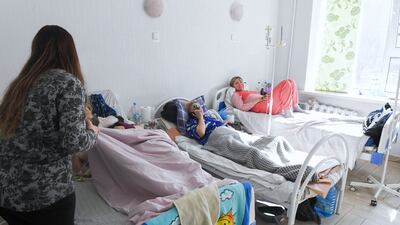
Civilian victims of Russian bombings are treated in a hospital in Kharkiv, Ukraine. EPA -
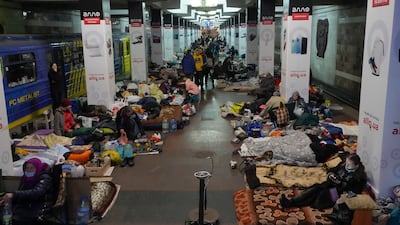
People rest with their belongings in a city subway being used as a bomb shelter in Kharkiv, Ukraine. AP -
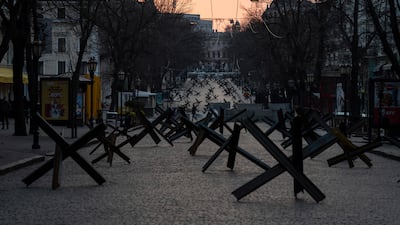
Anti-tank barricades are placed on a street in preparation for a possible Russian offensive in Odesa, Ukraine. AP -
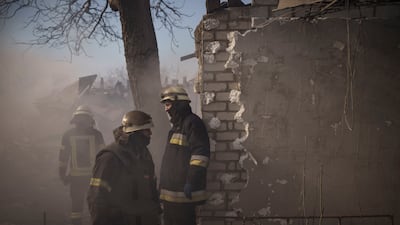
Firefighters work to extinguish a fire at a house destroyed in a Russian attack in Kharkiv, Ukraine. AP -
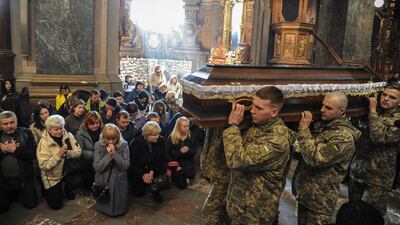
Ukrainian servicemen carry a coffin during a funeral in Lviv, Ukraine. EPA -
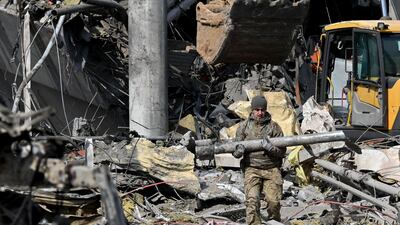
A Ukrainian serviceman carries a fragment of a rocket outside a building in Kyiv that was destroyed by Russian shelling. AFP -
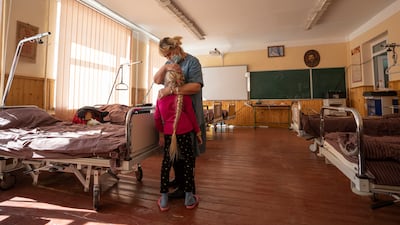
Nadia holds her 10-year-old granddaughter, Zlata Moiseinko, who suffers from a chronic heart condition, as she receives treatment at a schoolhouse that has been converted into a field hospital in Mostyska, western Ukraine. AP -

A neighbour walks on the debris of a burning house destroyed in a Russian attack in Kharkiv, Ukraine. AP


He lashed out at Russians who spoke against the invasion while staying outside Russia.
“You can be dissatisfied with some of the authorities' decisions, criticise the authorities — this is normal,” he said. “But you cannot take a stand against the state in such a difficult situation, because this is treason.”
Thousands of people were detained earlier this month across Russia during protests against Moscow’s invasion of Ukraine, according to an independent protest monitoring group.

