


Live updates: follow the latest news on Russia-Ukraine
Ukraine is battling tanks and trucks with drone strikes while Russia’s air force remains notable by its absence, military analysts have said.
Ukrainian commanders are also considering how to attack the huge armoured convoy, which by Tuesday afternoon was about 25 kilometres from Kiev.
But despite the early successes of Ukraine’s drone force, destroying a number of crucial supply trucks, the country is urgently requesting more unmanned attack aircraft to hold off the Russian advance.
Its drone force was meant to have been wiped out by Russia’s electronic warfare devices, air defences and fighter jets in opening battles, but still it remains a threat.

While Ukraine has a variety of its own drone manufacturers, it is relying heavily on the Turkish-built Bayraktar TB2s that have proven their effectiveness against Russian hardware in Syria, Libya and Nagorno-Karabakh.
The TB2s carry four guided anti-tank missiles, fly at a maximum speed of 220kph and have an endurance of 27 hours.
The unmanned aircraft have destroyed three SAM missile systems and four 152mm artillery pieces, along with more than 10 trucks and several tanks, according to evidence provided to the London-based Rusi think tank.
However, the TB2s navigate by GPS sending out a strong radio signal making them easy to track and destroy if Russia chooses to concentrate on them.
Ukraine possesses at least 12 and on Tuesday the country’s ambassador to Britain, Vadym Prystaiko, called for more aircraft. Ukrainian military personnel were also being trained in Turkey on how to operate drones as not enough people know how to use the devices effectively, he said.
That the drones have been able to fly is partly due to the failure of the Russia air force, the VKS, to dominate the skies.

Its absence over Ukraine has baffled military observers. When the opening barrage of missiles took out much of Ukraine’s early warning radar, rendering its air defences blind, it was a given that Russia’s armada of 300 modern warplanes, all within striking range, would immediately follow.
The force includes 80 advanced Su-35S air superiority fighters and 110 multirole Su-30SM, all capable of firing precision-guided missiles.
Close air support is a vital aspect of modern warfare with land units usually advancing only when the skies are secured.
However, it is possible that many of the VKS’s precision bombs have been fired during fighting in Syria and as yet the Russians are unwilling to drop “dumb” bombs for fear of causing mass civilian casualties.
An apparent overreliance on their fabled ground-based air defence might have meant fewer VKS warplanes overhead to avoid blue-on-blue incidents.
Ironically, a number of SAM systems mounted on tracked vehicles have been destroyed while caught in columns.
VKS pilots have less flying training compared to their Western counterparts, averaging about 100 hours a year while US and UK fighter pilots receive up to 240 hours, said the Rusi report, The Mysterious Case of the Missing Russian Air Force.
“Despite an impressive modernisation programme that has seen the acquisition of around 350 new modern combat aircraft over the past decade, VKS pilots struggle to effectively employ many of the theoretical capabilities of their aircraft in the complex and contested air environment of Ukraine,” said Justin Bronk, the report’s author and an airpower expert at Rusi.

The air failures have also been highlighted in an intelligence report by the UK Ministry of Defence. “Russia has failed to gain control of the airspace over Ukraine prompting a shift to night operations in an attempt to reduce their losses," it said.
This could mean that Russia’s T-90 and T-72B3M tanks, equipped with modern thermal-imaging sights supplied by a French firm, will now fight at night.
Failure to control the skies has caused other issues. The Ukrainians have been able to shoot down both attack and transport helicopters using western-supplied Stinger missiles. This prevented a swift airborne assault taking place for a decapitation operation on Kiev.
The sight of their own fighter jets in the air above Kiev has also proven a major morale boost for the population, spurring on their defences.
With the 64-kilometre armoured column bearing down on Kiev, it is thought the Ukrainian military might deploy tanks, artillery and other weapons that they have not yet been committed to the battle.
These arms can probably be used only once before they suffer significant losses but that moment might be now as Kiev faces being surrounded by a ring of Russian steel.
How the Ukrainians use their offensive weapons has to be balanced carefully. “With artillery there's this concept called 'unmasking', which basically means once you open fire, the clock starts on how long that artillery is going to be alive,” said Sam Cranny-Evans, a Russia military expert at Rusi. “Usually that will be about four minutes unless they move position. So they have to be careful about when they are unmask their various resources as they will probably only have one chance to deploy it.”

Questions have been raised over whether Russia has changed tactics and is driving straight down major roads seemingly without their flanks secured.
“It really depends on how the Russians fight,” Mr Cranny-Evans said. “They can continue driving down roads without any real creativity. If the Ukrainians are able to bring enough forces into place with anti-tank and Stinger anti-aircraft missiles they could severely maul that column.”
The war may well move on to a more brutal phase with the Russians willing to resort to tactics used in Homs and Aleppo of surrounding a city and using the bludgeon of airpower and artillery to take out strong points, regardless of civilian casualties.
Tuesday’s attack on Kharkiv was a clear assault on non-military targets using cluster weapons, although it is not yet clear if thermobaric vacuum bombs have been used.
Western officials have made it clear that any human rights violations will be investigated, with President Vladimir Putin held to account.
-
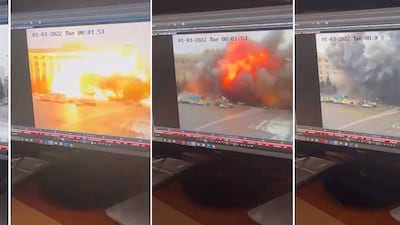
A monitor displays a projectile striking the regional state administration building in Kharkiv, as the Russian invasion continues. Reuters -
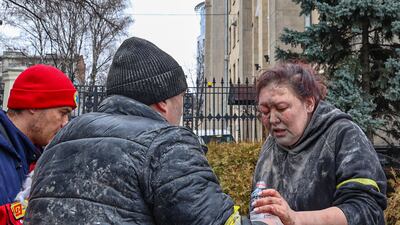
People help a wounded woman in the aftermath of Russian shelling in Kharkiv. EPA -

Ukrainian emergency service personnel carry the body of a victim following shelling in Kharkiv. AP -
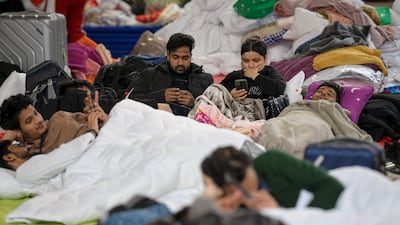
Students who fled the conflict rest in a refugee camp in Voluntari, Romania. AP -
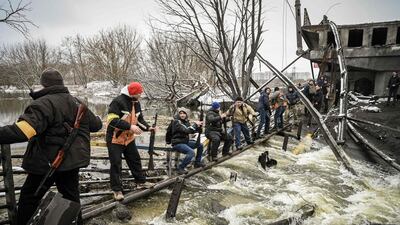
Members of an Ukrainian civil defence unit pass new assault rifles to the opposite side of a blown-up bridge on Kiev’s northern front. AFP -
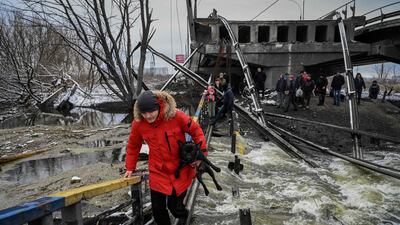
Civilians cross a river on Kiev's northern front. AFP -
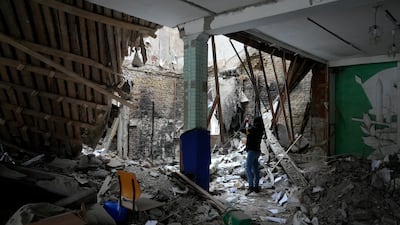
A woman takes photos of a destroyed accommodation building near a checkpoint in Brovary, outside Kiev. AP -
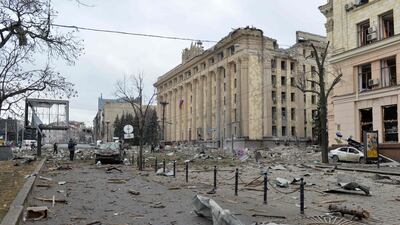
The city hall of Kharkiv, damaged by Russian shelling. AFP -
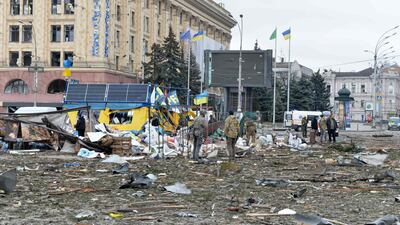
Debris litters the square outside the damaged Kharkiv city hall. AFP -

A Ukrainian woman sleeps on the floor of the railway station in Zahonyi close to the Hungary/Ukraine border. AFP -

A medical worker attends to wounded man at a hospital in Brovary, outside Kiev. AP -
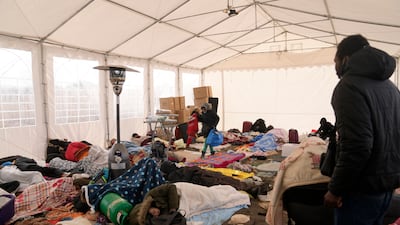
Refugees from Ukraine in a tent at the Medyka border crossing, Poland. AP -
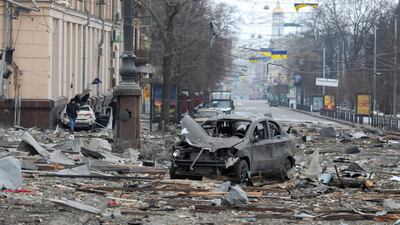
Debris outside the regional administration building, which city officials said was hit by a missile, in Kharkiv. Reuters -
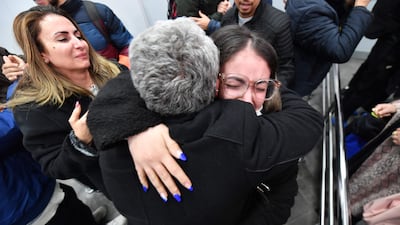
A student evacuated from Ukraine is embraced by her family after arriving at Tunis-Carthage International Airport in Tunisia. AFP -
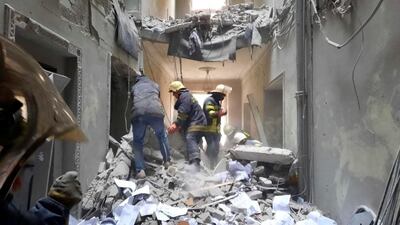
Rescuers in a building damaged by a missile in central Kharkiv. Reuters -
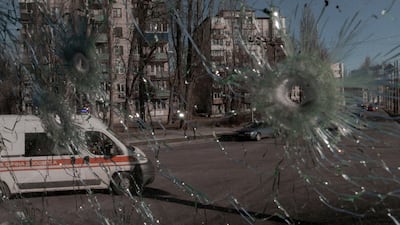
An ambulance is visible through the damaged window of a vehicle hit by bullets in Kiev, Ukraine. Reuters -
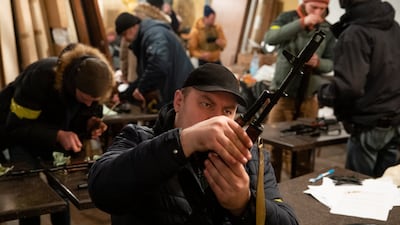
Territorial defence members prepare to head out on patrol in Kiev. EPA -
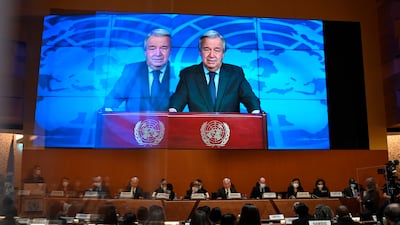
UN Secretary General Antonio Guterres delivers a speech on screen during the opening of the 49th session of the UN Human Rights Council in Geneva, Switzerland. AP -
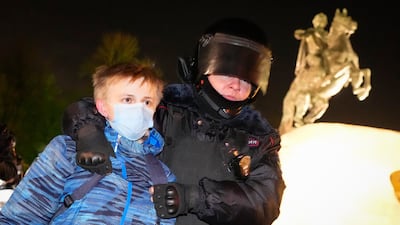
A policeman detains a young demonstrator during a protest against Russia's attack on Ukraine in St Petersburg, Russia. AP -
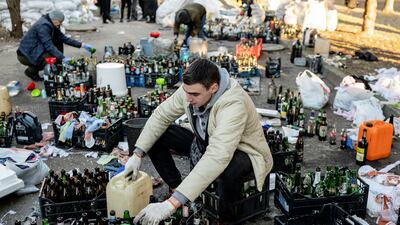
Local residents in Zhytomyr, Ukraine, prepare Molotov cocktails. Reuters -

Residents clean a bomb shelter under an out-of-service cinema in central Zhytomyr. Reuters -
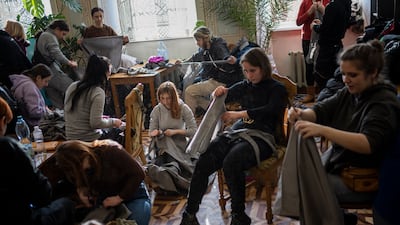
Ukrainian volunteers tear cloth into strips to make camouflage nets in Lviv, western Ukraine. AP -
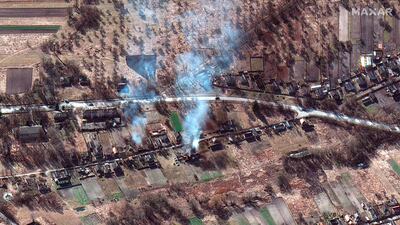
Part of the military convoy north-west of Invankiv, Ukraine. AP -
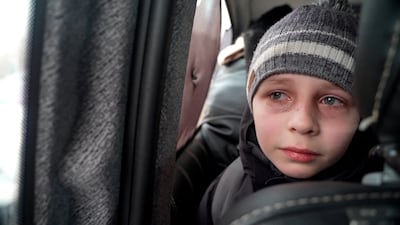
Mark Goncharuk, a young boy from Kiev, leaves his father behind as he travels with the rest of his family towards the border. Reuters -
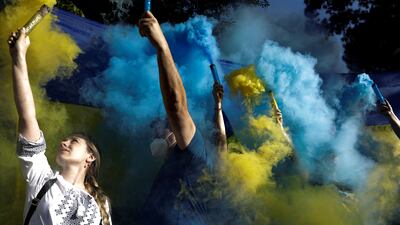
People hold an anti-war protest outside the Russian Embassy in Mexico City, Mexico. Reuters -
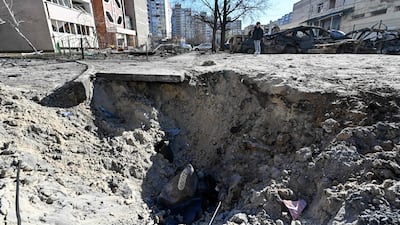
A crater caused by shelling on the outskirts of Kiev. AFP -
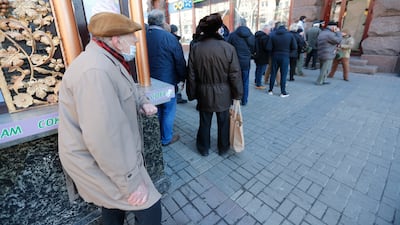
People queue outside a grocery store in the Ukrainian capital. EPA -

Ukrainian soldiers stand at Maidan Nezalezhnosti, or Independence Square, in Kiev. EPA -
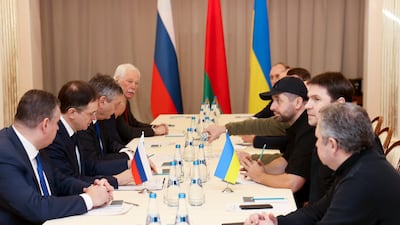
Vladimir Medinsky, the head of the Russian delegation, second left, and Davyd Arakhamia, faction leader of the Servant of the People party in the Ukrainian Parliament, third right, attend the peace talks in the Gomel region of Belarus. AP -
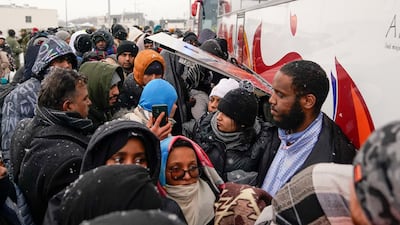
People who have fled the Russian invasion in Ukraine, clamour to board a bus bound for a refugee centre established in Przemysl, Poland. Reuters -
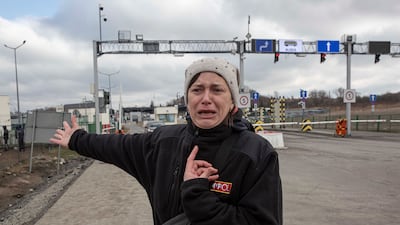
Hanna Pavlovna Lukasz, from Mirhord, Ukraine, said her sons, aged 12 and 8, and her 66-year-old mother had been waiting on the Ukrainian side of the border crossing with Medyka, Poland, for four days. AP -

A volunteer from Kiev prepares a rear post with trenches in the city. AFP -

A child being treated for cancer rests in the bomb shelter of the oncology ward at a hospital in Kiev. Getty -

Police officers check occupants of a suspicious car in Kiev, as Russia's invasion of Ukraine continues. Reuters -
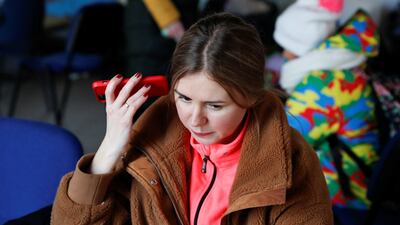
A woman from Ukraine uses a phone to listen to a speech by President Volodymyr Zelenskyy at a refugee shelter in Beregsurany, Hungary. Reuters -

Shelves empty of bread after a curfew was lifted as Russia's invasion of Ukraine continues, in Kiev. Reuters -

Ukrainian Defence Minister Oleksii Reznikov, left, and President Zelenskyy. AFP -
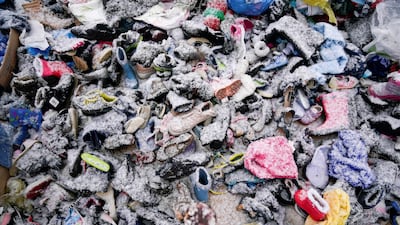
Snow-covered shoes donated for those fleeing the Russian invasion of Ukraine at the border crossing in Medyka, Poland. Reuters -
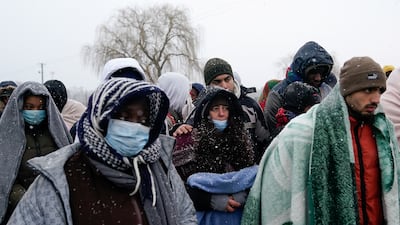
People who have fled Ukraine wait for a bus to transport them away from the border crossing in Medyka. Reuters -
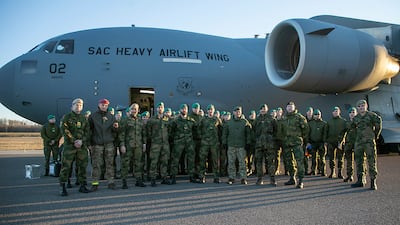
Norwegian soldiers of the Nato-enhanced forward presence battalion pose at a military plane as they arrive at an airport in Kaunas, Lithuania. AP -

A person fleeing Ukraine sits during snowfall at a temporary camp in Przemysl, Poland. Reuters -
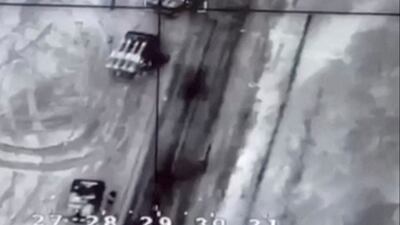
Footage reportedly of Russian Buk missile system vehicles on a road before a drone strike near Malyn, Ukraine. Reuters -
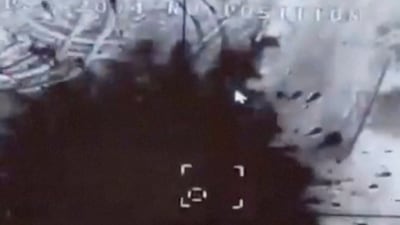
An explosion after what are said to be Russian Buk missile system vehicles on a road are struck by a drone. Reuters -
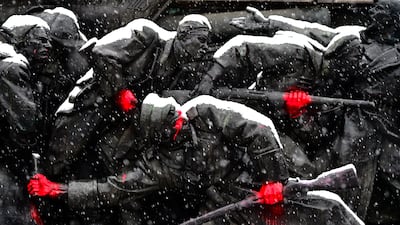
The monument to Russian troops from the Second World War, after the figures’ hands were painted red, at the Red Army memorial in Sofia, Bulgaria. EPA -
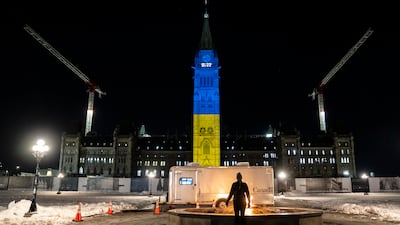
The Peace Tower on Parliament Hill in Ottawa, Canada, is lit up with the colours of Ukraine’s national flag in a show of support. AP -
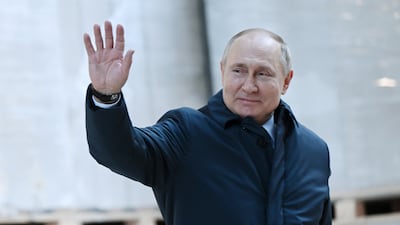
Russian President Vladimir Putin visits the construction site of the National Space Agency on the premises of the Khrunichev State Research and Production Space Centre, in Moscow. EPA -

A man looks out from a train, at the railway station in Lviv, Ukraine. The UN has estimated the conflict could produce as many as four million refugees. AP -
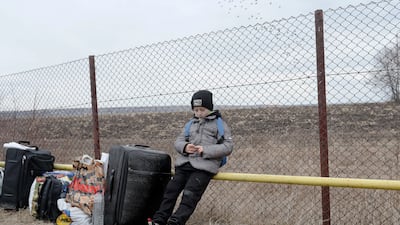
A Ukrainian boy waits for his mother after passing the border crossing point in Siret, northern Romania. EPA -

Russian policemen detain a demonstrator in St Petersburg, during a protest against the country's military actions in Ukraine. EPA -
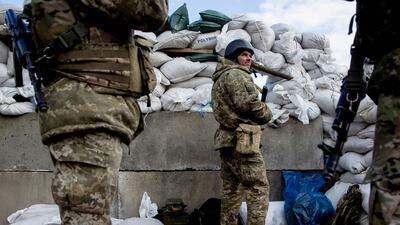
Ukrainian soldiers at a check point in the city of Zhytomyr. Reuters -
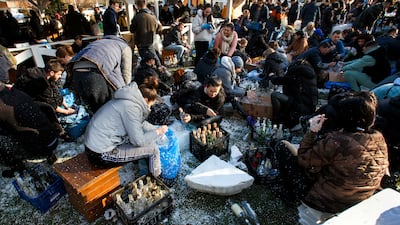
Residents prepare petrol bombs to defend the city, in Uzhhorod, Ukraine. Reuters -
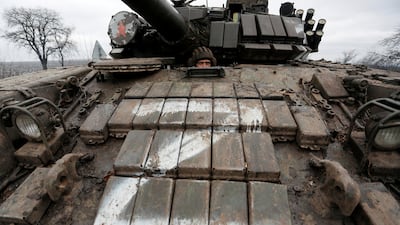
A pro-Russian fighter sits inside a tank in the separatist self-proclaimed Luhansk People's Republic, in the Luhansk region, Ukraine. Reuters -
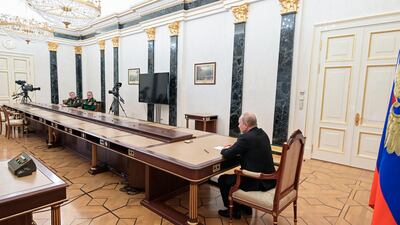
Russian President Vladimir Putin, right, speaks to Defence Minister Sergei Shoigu, second left, and Head of the General Staff of the Armed Forces and First Deputy Defence Minister Valery Gerasimov, left, during their meeting in Moscow. AP -
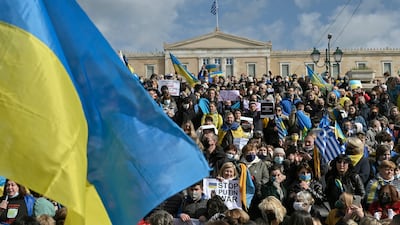
Ukrainians and supporters gather during a demonstration in front of the Greek Parliament in Athens against the Russian military's operation in Ukraine. AFP -
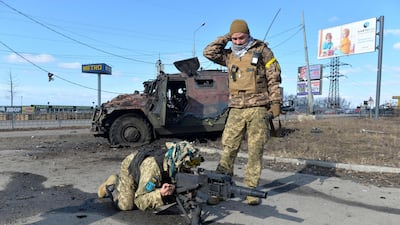
Ukrainian Territorial Defence fighters test an automatic grenade launcher taken from a destroyed Russian infantry mobility vehicla after a battle in Kharkiv. AFP


Particular concern is focused on the TOS-1A thermobaric weapon that fires 24 rockets, creating an indiscriminate firestorm effect. “This is a subject that we will keep under close observation,” one western official said. “I think we will be very attentive of and alert to war crimes or breaches of international humanitarian law in this conflict.”
Western officials are also concerned that once Russia irons out its flaws, it will persevere.
“There is a likelihood that they will then be able to bring more of the firepower and then manoeuvre forces to bear into combat with Ukrainian fighters,” a security official said. “I think we will then see an attempt by Russia to achieve its original objectives Kiev and the Donbas.”
However, the Russians have already suffered “significant numbers of casualties” that they will not be able to hide from the people "back home”, the official said.

