An Iron Age coin found at an HS2 archaeological dig near Aylesbury, Buckinghamshire. PA

More than 400 bodies exhumed from UK Roman cemetery during HS2 project


Soraya Ebrahimi
  • English
  • Arabic

About 40 beheaded skeletons are among the 425 bodies exhumed by HS2 Ltd archaeologists in a large Roman cemetery discovered on the route of the high-speed railway in the UK.

The 50-member team uncovered the remains at a cemetery in Fleet Marston near Aylesbury, Buckinghamshire, HS2 Ltd said.

About 10 per cent were decapitated, with several instances of the head being placed between the legs or next to the feet.

HS2 Ltd said this could be due to the people buried being “criminals or a type of outcast”, although decapitation was a “normal, albeit marginal” part of burial during the late Roman period, towards the end of 410 AD.

The cemetery is the largest of its kind in Buckinghamshire.

The bodies will be held in storage for further analysis.

HS2 Ltd is not required to rebury them, unlike those exhumed from Christian cemeteries such as St James’s Gardens, north London.

The archaeologists also discovered more than 1,200 coins at Fleet Marston, indicating it was an area of trade and commerce.

Domestic objects including spoons, pins and brooches were found, while gaming dice and bells suggest that gambling and religious activity also occupied people’s time at the site.

The excavation was carried out over more than a year by Cotswold Archaeology and Oxford Archaeology (Copa), working on behalf of an HS2 Ltd contractor.

“The excavation is significant in both enabling a clear characterisation of this Roman town but also a study of many of its inhabitants," said Richard Brown, senior project manager at Copa.

“Along with several new Roman settlement sites discovered during the HS2 works, it enhances and populates the map of Roman Buckinghamshire.”

  • A man looks at the Arch of Sptimus Severus in the ancient Roman city of Leptis Magna near the coastal Libyan city of Al Khums, 120km east of Tripoli. All photos: AFP
    A man looks at the Arch of Sptimus Severus in the ancient Roman city of Leptis Magna near the coastal Libyan city of Al Khums, 120km east of Tripoli. All photos: AFP
  • Once one of the Roman Empire's most beautiful cities, Leptis Magna now lies neglected and shunned by tourists due to a decade of war.
    Once one of the Roman Empire's most beautiful cities, Leptis Magna now lies neglected and shunned by tourists due to a decade of war.
  • Some locals, however, see its potential for rebirth.
    Some locals, however, see its potential for rebirth.
  • Today, only a handful of visitors, almost all Libyans, wander among the imposing ruins at the Unesco World Heritage site – but locals dream of attracting international tourists once more.
    Today, only a handful of visitors, almost all Libyans, wander among the imposing ruins at the Unesco World Heritage site – but locals dream of attracting international tourists once more.
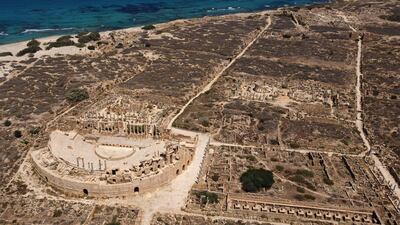
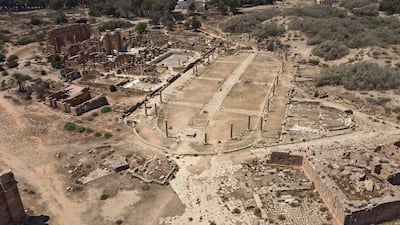
  • The remains of the semi-circular theatre and the Chalcidicum, right, beyond which lie the marketplace, the Severan Forum and Basilica, top right. A year-long lull in violence in Libya has sparked hopes the country can now move on.
    The remains of the semi-circular theatre and the Chalcidicum, right, beyond which lie the marketplace, the Severan Forum and Basilica, top right. A year-long lull in violence in Libya has sparked hopes the country can now move on.
  • Locals hope the ancient ruins will be a huge draw for tourists.
    Locals hope the ancient ruins will be a huge draw for tourists.
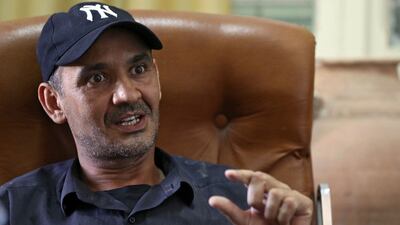
  • Azeddine Al Fakih, head of archaeology for Leptis Magna, believes the area could create thousands of jobs, welcome millions of tourists and bring in billions of dollars.
    Azeddine Al Fakih, head of archaeology for Leptis Magna, believes the area could create thousands of jobs, welcome millions of tourists and bring in billions of dollars.
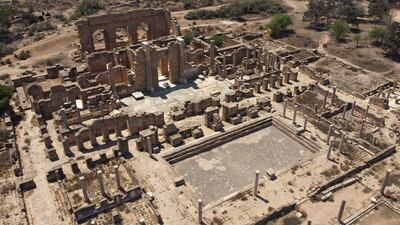
  • The Hadrianic baths are pictured in the centre. Leptis Magna is a treasure trove for history lovers.
    The Hadrianic baths are pictured in the centre. Leptis Magna is a treasure trove for history lovers.
  • There are historic finds to be discovered at every turn in the city. Here, the Palestre (oblong area for physical exercise) is pictured.
    There are historic finds to be discovered at every turn in the city. Here, the Palestre (oblong area for physical exercise) is pictured.
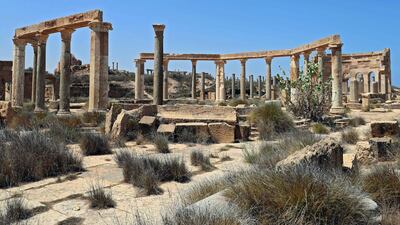
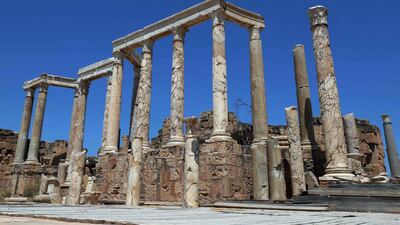
  • Fine marble columns line the theatre stage.
    Fine marble columns line the theatre stage.
  • A carved Gorgon head on arches surrounds the Severin forum.
    A carved Gorgon head on arches surrounds the Severin forum.
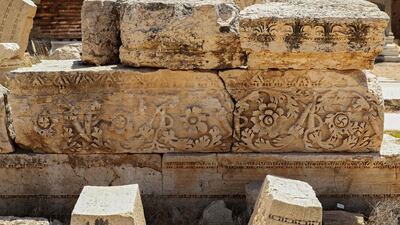
  • Beautiful, intricate detail can be found on buildings throughout the city.
    Beautiful, intricate detail can be found on buildings throughout the city.

Fleet Marston is one of more than 100 archaeological sites examined by HS2 Ltd since 2018 on the route of the first phase of the railway between London and Birmingham.

“The HS2 archaeology programme has enabled us to learn more about our rich history in Britain," said Helen Wass, HS2 Ltd’s head of heritage.

“The large Roman cemetery at Fleet Marston will enable us to gain a detailed insight into the residents of Fleet Marston and the wider Roman Britain landscape.

“All human remains uncovered will be treated with dignity, care and respect and our discoveries will be shared with the community.”


Price, base / as tested From Dh173,775 (base model)
Engine 2.0-litre 4cyl turbo, AWD
Power 249hp at 5,500rpm
Torque 365Nm at 1,300-4,500rpm
Gearbox Nine-speed auto
Fuel economy, combined 7.9L/100km

Profile

Co-founders of the company: Vilhelm Hedberg and Ravi Bhusari

Launch year: In 2016 ekar launched and signed an agreement with Etihad Airways in Abu Dhabi. In January 2017 ekar launched in Dubai in a partnership with the RTA.

Number of employees: Over 50

Financing stage: Series B currently being finalised

Investors: Series A - Audacia Capital 

Sector of operation: Transport

Ten tax points to be aware of in 2026

1. Domestic VAT refund amendments: request your refund within five years

If a business does not apply for the refund on time, they lose their credit.

2. E-invoicing in the UAE

Businesses should continue preparing for the implementation of e-invoicing in the UAE, with 2026 a preparation and transition period ahead of phased mandatory adoption. 

3. More tax audits

Tax authorities are increasingly using data already available across multiple filings to identify audit risks. 

4. More beneficial VAT and excise tax penalty regime

Tax disputes are expected to become more frequent and more structured, with clearer administrative objection and appeal processes. The UAE has adopted a new penalty regime for VAT and excise disputes, which now mirrors the penalty regime for corporate tax.

5. Greater emphasis on statutory audit

There is a greater need for the accuracy of financial statements. The International Financial Reporting Standards standards need to be strictly adhered to and, as a result, the quality of the audits will need to increase.

6. Further transfer pricing enforcement

Transfer pricing enforcement, which refers to the practice of establishing prices for internal transactions between related entities, is expected to broaden in scope. The UAE will shortly open the possibility to negotiate advance pricing agreements, or essentially rulings for transfer pricing purposes. 

7. Limited time periods for audits

Recent amendments also introduce a default five-year limitation period for tax audits and assessments, subject to specific statutory exceptions. While the standard audit and assessment period is five years, this may be extended to up to 15 years in cases involving fraud or tax evasion. 

8. Pillar 2 implementation 

Many multinational groups will begin to feel the practical effect of the Domestic Minimum Top-Up Tax (DMTT), the UAE's implementation of the OECD’s global minimum tax under Pillar 2. While the rules apply for financial years starting on or after January 1, 2025, it is 2026 that marks the transition to an operational phase.

9. Reduced compliance obligations for imported goods and services

Businesses that apply the reverse-charge mechanism for VAT purposes in the UAE may benefit from reduced compliance obligations. 

10. Substance and CbC reporting focus

Tax authorities are expected to continue strengthening the enforcement of economic substance and Country-by-Country (CbC) reporting frameworks. In the UAE, these regimes are increasingly being used as risk-assessment tools, providing tax authorities with a comprehensive view of multinational groups’ global footprints and enabling them to assess whether profits are aligned with real economic activity. 

Contributed by Thomas Vanhee and Hend Rashwan, Aurifer

Saudi Cup race day

Schedule in UAE time

5pm: Mohamed Yousuf Naghi Motors Cup (Turf), 5.35pm: 1351 Cup (T), 6.10pm: Longines Turf Handicap (T), 6.45pm: Obaiya Arabian Classic for Purebred Arabians (Dirt), 7.30pm: Jockey Club Handicap (D), 8.10pm: Samba Saudi Derby (D), 8.50pm: Saudia Sprint (D), 9.40pm: Saudi Cup (D)

Meatless Days
Sara Suleri, with an introduction by Kamila Shamsie
​​​​​​​Penguin 

Updated: February 05, 2022, 12:01 AM