


The government has been accused of “headline-chasing” following reports officials had investigated using powerful sonic devices to turn around migrant boats in the Channel.
Reports from The Sun and Sky News stated that No 10 policy officials wanted to use Long-Range Acoustic Devices (LRADs) - used to disperse crowds in the US - to deter migrants from making the dangerous crossing.
The Ministry of Defence purchased the LRADs, which emit pain-inducing tones, for security purposes at the 2012 London Olympics.
Now it has been reported that Downing Street officials have looked into deploying them off Dover, but they have met fierce resistance from the Home Office.
Sources say devices are already fitted on two Border Force vessels but are only currently being used as loud hailers. The No10 Policy Unit, however, has looked at going further.
Some versions of the LRAD are capable of producing deafening sound levels of up to 150 decibels.
The piercing beam of sound is highly directional and could be aimed at a small boat.
The Home Office has rejected the idea of using them to try to turn people smugglers' vessels around, but said it would “continue to test a range of safe and legal options to stop small boats making this dangerous and unnecessary journey".
The row comes as defence officials were drafted to gain control over small boat crossings after years of dither.
“The [prime minister] has asked the armed forces to take command of channel security and to ensure that we make a step change in the control of illicit movements,” a defence source said.
-
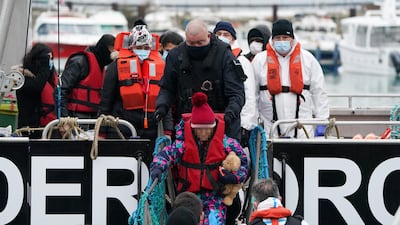
A child clutching a teddy steps ashore in Dover, Kent, southern England, accompanied by Border Force officers after being rescued from a small boat trying to cross the English Channel. PA -
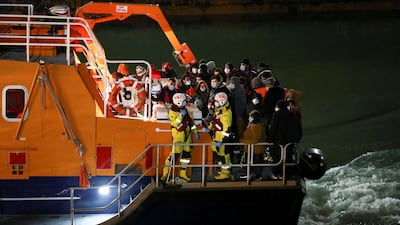
Migrants arrive at Dover on a Royal National Lifeboat Institution vessel, after being rescued while crossing the English Channel. Despite it being midwinter, migrant crossings resumed this week after a period of bad weather led to a pause. Reuters -
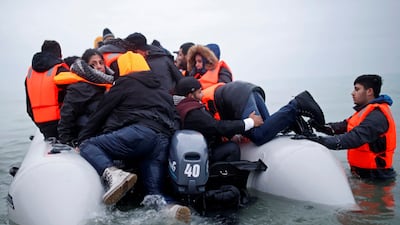
Migrants clamber aboard a flimsy inflatable dinghy as they prepare to leave Wimereux, near Calais, north France, heading for England. Reuters -

A group of people, thought to be migrants, at Dungeness lifeboat station, Kent. AP Photo -
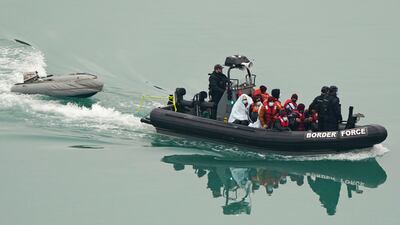
More than 26,000 people have made the dangerous journey from France to England in 2021, three times more than in 2020. In November, 27 people were drowned when a migrant boat sunk during the crossing. AP Photo -
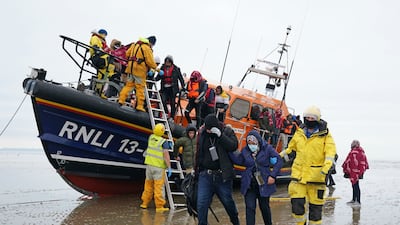
Migrants are brought in to Dungeness, Kent, by the RNLI. AP Photo -
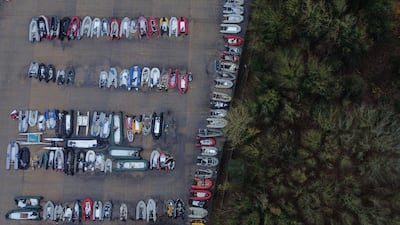
Inflatable boats, believed to have been used by migrants who crossed the English Channel from France, stored near Dover. Reuters -
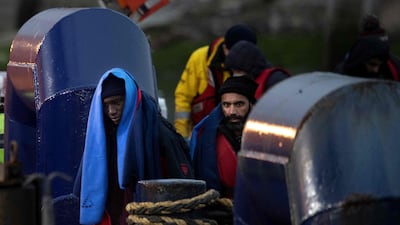
Migrants disembark from an RNLI lifeboat on arrival in Dover, after being picked up at sea. AFP -
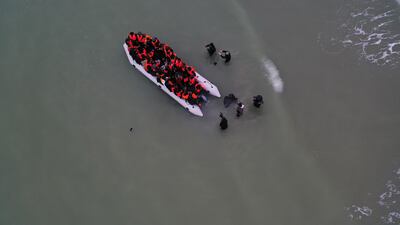
A group of migrants prepare to launch an overcrowded inflatable dinghy from the French coast, near Calais, heading for England. Reuters


Rear Admiral Mike Utley has been appointed to co-ordinate and command all government assets in the Channel.
But Border Force boats will continue operating the day-to-day policing of the crossings and no military personnel will engage in “maritime tactics".
“Unacceptable numbers of people continue to make the dangerous Channel crossings and last November’s tragic deaths serve as the strongest reminder of the need to stop them,” said a Ministry of Defence representative.
“The government is exploring every avenue to prevent further crossings and details of how that can be achieved will be made known in due course.”
“As part of our ongoing operational response and to prevent further loss of life at sea, we continue to test a range of safe and legal options to stop small boats making this dangerous and unnecessary journey,” a government spokesman said.
“However, we have no plans to use ‘sonic devices’ to deter migrants and to suggest otherwise is wrong and misleading.”

