



Liz Truss became the third woman to enter Downing Street as British Prime Minister on September 6 after running a more successful campaign for Conservative leadership than Rishi Sunak.
The victory, by 81,326 votes from party members to Mr Sunak's 60,399, put her in the footsteps of Margaret Thatcher and Theresa May.
Ms Truss, 47, became a strong contender to replace Boris Johnson early in the race, thanks to her public image as a Brexit-supporting libertarian who opposes high taxes and wasteful spending.
But after taking the reins, she has faced immediate difficulties. Queen Elizabeth II died two days later, beginning a period of mourning and frustrating Ms Truss's ability to plan for the early days of her term in office.
Racing to catch up, she sent Chancellor Kwasi Kwarteng to announce a radical shake-up of the economy to fuel growth but in doing so sent the pound tumbling, rocked the FTSE and handed a record poll lead to the Labour opposition.
Her first Conservative party conference has been riddled with ill-discipline and there are already rebellions from within and outside her Cabinet. Some suggest they would consider another leadership change if matters do not improve quickly.
Early years
Born in Oxford to a maths professor father and a teacher mother, Ms Truss came from a Labour-leaning family.
During her younger years, she joined her parents on anti-Thatcher demonstrations and as a teenager progressed to the Liberal Democrats' youth and student wing, frequently taking part in protests.
The politically minded and ambitious Ms Truss became president of the Oxford University Lib Dems then joined the Conservatives after she graduated.
She spent more than a decade in the private sector, primarily as a management accountant and then as deputy director at the right-wing think tank Reform.

She is married to accountant Hugh O'Leary and the couple have two daughters, Frances and Liberty.
Ms Truss spent two years as a Conservative councillor for Greenwich borough in south-east London before being elected as MP for South-West Norfolk in 2010.
She lives with her husband and children in a three-bedroom detached home in the market town of Thetford in her constituency. She frequently stays at her second home in Greenwich.
From Remainer to Brexiteer
Ms Truss voted “remain” in the 2016 Brexit referendum, only to later advocate the UK leaving the EU.
Promoting herself as prime ministerial material, Ms Truss took to Twitter to say she had a clear vision for Britain and possessed “the experience and resolve to deliver it”.
Her zeal for limited government resulted in her pledge during the early stages of her campaign to “start cutting taxes from day one” and reverse a planned National Insurance increase.
-
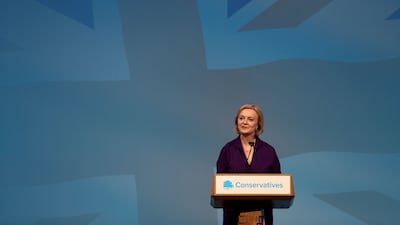
New Conservative Party leader and Britain's Prime Minister-elect Liz Truss delivers a speech after being announced the winner of the Tory Party leadership contest in central London on September 5, 2022. Ms Truss is the UK's third female prime minister following Theresa May and Margaret Thatcher. AFP -
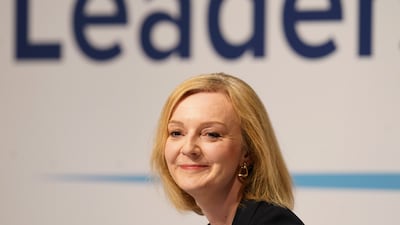
Liz Truss during a hustings event in Darlington in August 2022. Ms Truss and Rishi Sunak are awaiting the results of a poll of Conservative Party members deciding which of them has been selected as the new party leader, and next prime minister. PA -

Liz Truss playing pool during a visit to the Onside Future Youth Zone in London in August 2022. PA -
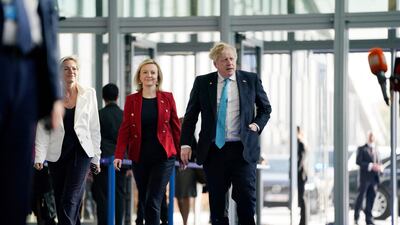
Boris Johnson and Ms Truss arriving for an extraordinary summit at Nato headquarters in Brussels, in March 2022. AFP -
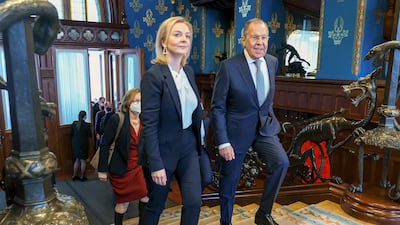
Russian Foreign Minister Sergey Lavrov and Ms Truss arrive for talks in Moscow in February 2022. AP -
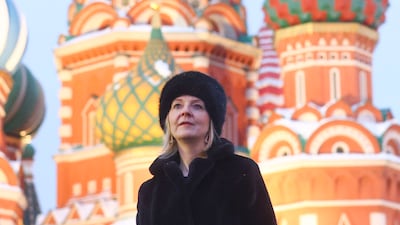
Ms Truss in Red Square during a visit to Moscow in February 2022. Photo: No. 10, Downing Street -
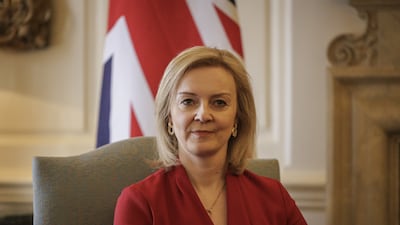
Ms Truss meeting European Commission vice-president Maros Sefcovic (not seen) for talks in central London on the Northern Ireland Protocol on 11th February 2022. PA -
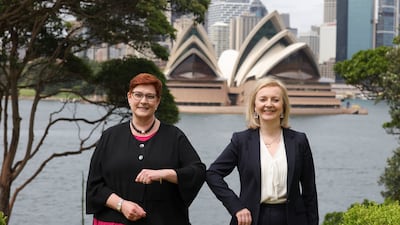
Ms Truss with Marise Payne, the Australian minister of foreign affairs, at Government House in Sydney, Australia, in January 2022. Photo: No. 10, Downing Street -
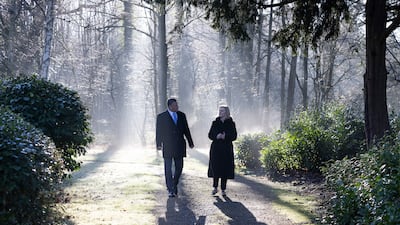
Liz Truss hosts Vice President of the European Commission Maros Sefcovic at Chevening House in January 2022 to discuss the Northern Ireland protocol. Photo: No. 10, Downing Street -
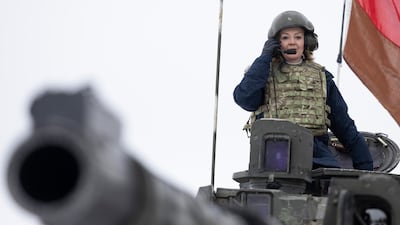
Ms Truss visits British troops in Estonia as they operate alongside other Nato troops in Tapa in November 2021. Photo: No. 10, Downing Street -

Liz Truss walks through the old town in Tallinn, Estonia, in November 2021. Photo: No. 10, Downing Street -
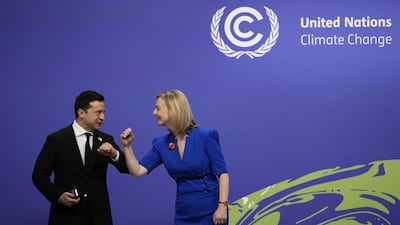
Ms Truss greeting Ukraine's President Volodymyr Zelenskyy at the Cop26 summit in Glasgow, in November 2021. PA -
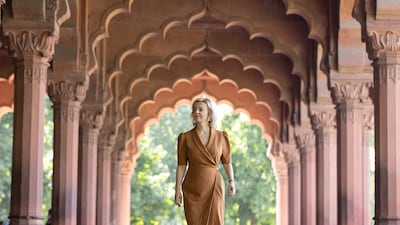
Ms Truss at the Red Fort in New Delhi during a trip to India in October 2021. Photo: No. 10, Downing Street -
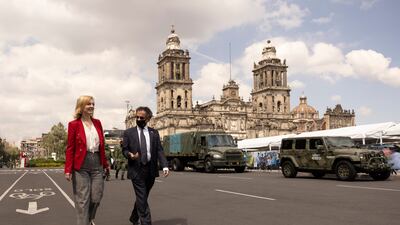
The British foreign secretary on the Plaza de la Constitucion in Mexico City, during a trip to Mexico in September 2021. Photo: No. 10, Downing Street -
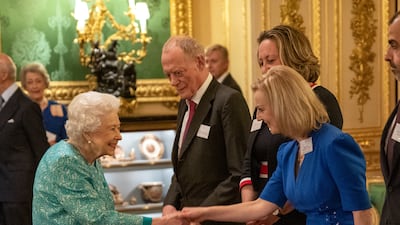
Queen Elizabeth II greeting Ms Truss at a reception for international business and investment leaders at Windsor Castle in October 2021. PA -
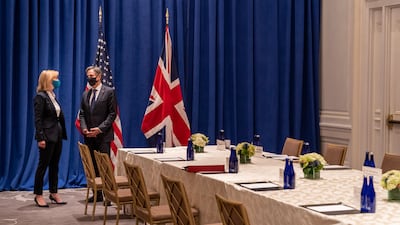
Liz Truss with Antony Blinken, the US secretary of state, in New York, in September 2021. Photo: No. 10, Downing Street -
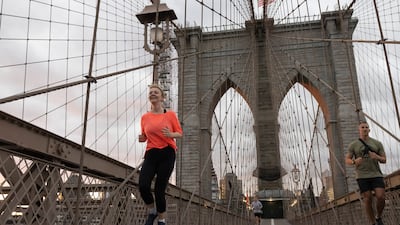
Ms Truss on a morning jog over Brooklyn Bridge in New York in September 2021. Photo: No. 10, Downing Street -
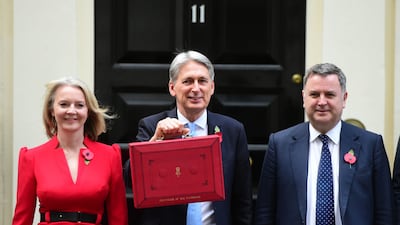
Former Chancellor Philip Hammond, centre, holding his red ministerial box outside 11, Downing Street, flanked by Treasury colleagues Ms Truss and Mel Stride in October 2018. PA -
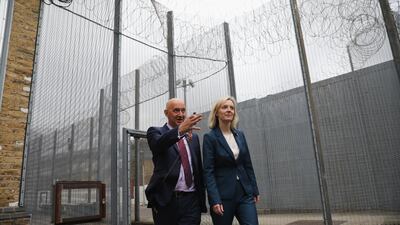
Ms Truss, then secretary of state for justice, being escorted around HMP Brixton by prison governor David Bamford in November 2016. PA -
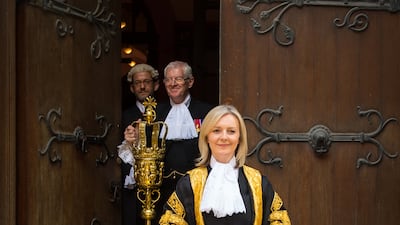
Ms Truss as she became the first woman ever to hold the role of Lord Chancellor, arriving at the Royal Courts of Justice before being installed in July 2016. PA -
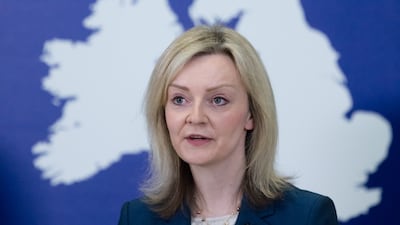
In April 2016, the former environment secretary Liz Truss listening to former chancellor of the exchequer George Osborne (not seen) during his speech at the National Composites Centre in Bristol. PA -
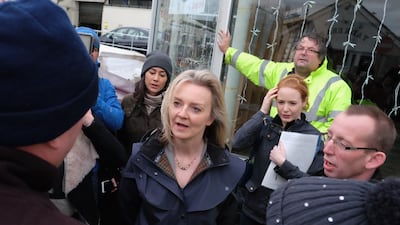
When she was environment minister, Ms Truss visited the bridge over the River Wharfe in Tadcaster, which collapsed after heavy flooding in December 2015. Getty Images -
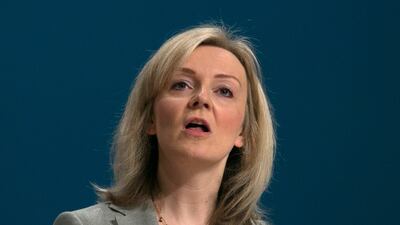
Addressing the Conservative party conference in Birmingham in 2014 when she was secretary of state for environment, food and rural affairs. Getty Images -
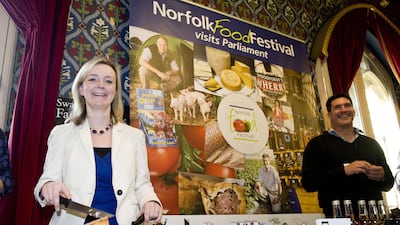
Mr Truss on the Sawnnington Farm to Fork stand at the Norfolk Food Festival at the Houses Of Parliament in October 2011. PA -
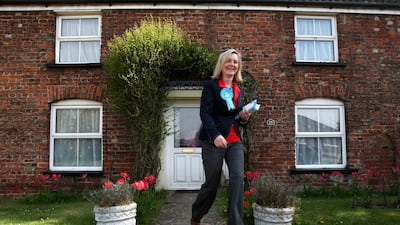
Conservative Parliamentary candidate for South-West Norfolk Elizabeth Truss, while canvassing in the village of West Walton during the 2010 General Election campaign. PA -
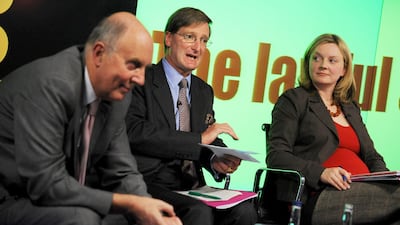
The former Conservative Shadow Home Secretary, Dominic Grieve, centre, speaking at the launch Reform's Lawful Society report on the nature of crime and the incentives in the criminal justice system while Ms Truss looks on, in September 2008. PA -
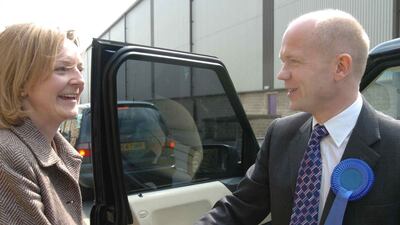
Former Conservative Leader William Hague meeting conservative candidate for Calder valley Ms Truss, during the General Election Campaign for 2005. PA


That stance played well with the Conservative party base but raised eyebrows among others, who feared such promises would make the party seem naive on fiscal matters.
She has served under three prime ministers — David Cameron, Mrs May and Mr Johnson.
The latter found a staunch ally in Ms Truss and, in September 2021, rewarded her for her loyalty with a promotion from international trade secretary to foreign secretary.
New PM's tough stance on Russia
Since being appointed to head the Foreign, Commonwealth and Development Office, Ms Truss's outspoken stance against Russia's invasion of Ukraine has been seen as an example of her no-nonsense approach to challenging issues on the international stage.
A few weeks before Russian troops entered Ukraine, Ms Truss arrived in Moscow for crisis talks with her counterpart Sergey Lavrov.
Before the summit, she posted a tweet demanding Russia withdraw more than 100,000 troops from the boundaries with Ukraine “or face severe consequences”, and said an incursion would be “a huge mistake”.
Her combative nature and warning about the possibility of a conflict between Russia and the West after the February 24 invasion of Ukraine landed her in hot water.
Kremlin spokesman Dmitry Peskov condemned what he called “absolutely unacceptable” remarks about possible “clashes” between Nato and Russia.
He said comments by Ms Truss and others had fuelled Moscow's decision to put its nuclear arsenal on a “special regime of combat duty”.

Channelling Margaret Thatcher
Echoing her political idol Thatcher, Ms Truss has stressed the need to support democracies and said the West must “face down global aggressors” such as China and Russia.
She has, time and again, been compared to Thatcher. She has been emulated her staged photo opportunities by posing with a calf, riding in a tank and wearing a fur hat during a diplomatic trip to Moscow.
Mr Kwarteng was among the first Tory MPs to publicly back Ms Truss's bid for No 10. Tipped to become chancellor of the exchequer in her Cabinet, he said her libertarian stance was one of the reasons he decided to support her.
“Liz’s basic instinct on tax is right … She doesn’t think people should be paying increasingly higher taxes to pay for higher spending”, Mr Kwarteng said.
Culture Secretary Nadine Dorries and Brexit Opportunities Minister Jacob Rees-Mogg also backed Ms Truss's campaign, cementing her position as the arch-Brexiteers' candidate of choice.
In the past, she has put forward her Brexit credentials, looking ahead to a “confident, outward-looking, patriotic and positive” future for the UK.

