Emily Mennie and Owen Hancock were forced to spend thousands on hotel quarantine after visiting South Africa. PA

UK government’s hotel quarantine rule ‘breaches human rights’


Laura O'Callaghan
  • English
  • Arabic

The UK government is facing a legal challenge over its mandatory hotel quarantine policy which critics say constitutes a “fundamental breach of human rights”.

The strict rules ushered in for travellers arriving from red list countries after the emergence of the Omicron Covid-19 variant have added thousands of pounds in costs for Britons holidaying abroad or people wishing to visit Britain.

The law firm PGMBM will on Thursday ask the High Court for a judicial review of the policy, arguing double vaccinated people who have tested negative for the coronavirus should not be forced to fork out £2,285 ($3,023) each for 10 days in quarantine.

One couple from south London who were on holiday in South Africa when ministers in Britain changed the rules said they have been left with credit card bills topping £4,000.

Owen Hancock, 35, and his girlfriend Emily Mennie, 30, had been visiting her family in South Africa for the first time since the start of the pandemic when their travel plans were disrupted.

The pair, both from Tooting, south London, were forced to reschedule their return flights and PCR tests due to a lack of space in quarantine hotels.

Spurred on by frustration over the rules, they set up an online petition calling on the government to fund hotel costs for travellers who were already abroad when the changes were made. More than 40,000 people have signed the petition.

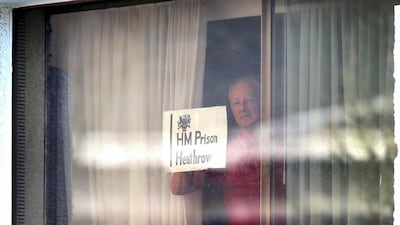
  • A man holds a sign against a window at the Renaissance London Heathrow Hotel, reading "HM Prison Heathrow".
    A man holds a sign against a window at the Renaissance London Heathrow Hotel, reading "HM Prison Heathrow".
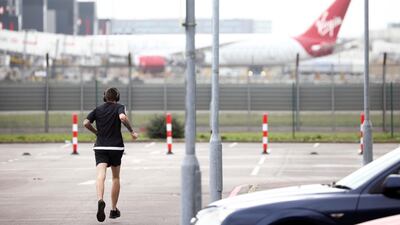
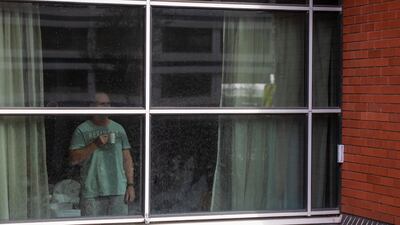
  • A man exercises under supervision of security in the car park of Renaissance London Heathrow Hotel at Heathrow Airport.
    A man exercises under supervision of security in the car park of Renaissance London Heathrow Hotel at Heathrow Airport.
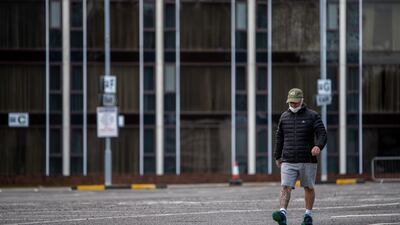
  • Hotel guests exercise in the car park of the Radisson Blu hotel as they continue their quarantine.
    Hotel guests exercise in the car park of the Radisson Blu hotel as they continue their quarantine.
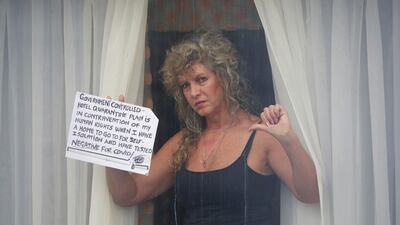
  • A quarantined traveller holds a sign up to the window of her room at the Radisson Blu Edwardian hotel.
    A quarantined traveller holds a sign up to the window of her room at the Radisson Blu Edwardian hotel.
  • Travellers from three dozen "red list" countries who arrived in England as of February 15 were forced to quarantine in hotels near major airports, such as Heathrow.
    Travellers from three dozen "red list" countries who arrived in England as of February 15 were forced to quarantine in hotels near major airports, such as Heathrow.
  • Guests exercise in the car park of the Radisson Blu hotel.
    Guests exercise in the car park of the Radisson Blu hotel.
  • A sign stuck to the window reads "I love isolation, wifes @ home" at the Renaissance London Heathrow hotel.
    A sign stuck to the window reads "I love isolation, wifes @ home" at the Renaissance London Heathrow hotel.
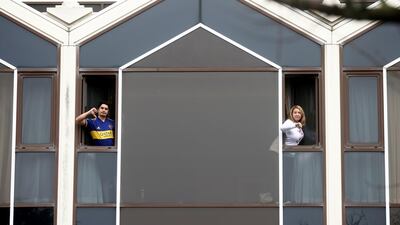
  • People gesture from windows at the Radisson Blu Hotel.
    People gesture from windows at the Radisson Blu Hotel.
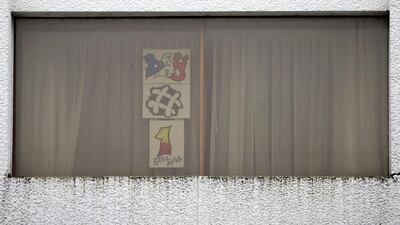
  • A sign on a window at the Renaissance London Heathrow Hotel reads "Day #1".
    A sign on a window at the Renaissance London Heathrow Hotel reads "Day #1".

“This ridiculous and unjustifiable policy was reintroduced with no prior warning, no ability for us to get home, and then to add insult to injury, we were unable to get a room,” said Ms Mennie.

“The government’s handling of this has been shambolic and that’s evident from the number of people who have signed our petition and called on the prime minister to rethink.”

Mr Hancock said it was “utterly unfair and unreasonable” for the government to expect British travellers to pay for mandatory hotel quarantine upon return if it was not the policy when they jetted off on a trip.

The couple said they had complied with all guidance and every restriction since the pandemic began.

At a two-hour High Court hearing on Thursday, PGMBM will present evidence before a judge seeking a judicial review of the quarantine rules.

Tom Goodhead, managing partner at PGMBM, said while he and his colleagues appreciated the seriousness of the Omicron variant, they did not believe the government was right in imposing travel restrictions.

He said the rules represented “extraordinary violations of traditional liberties and human rights” and he called on ministers to rethink their strategy.

Kate Freed and her husband Alex Freed, who were on their honeymoon in South Africa, were forced to use the government's hotel quarantine scheme on their return. PA

“Hotel quarantine is a fundamental breach of people’s human rights,” said Mr Goodhead. “Law-abiding citizens who have been double vaccinated and tested negative should be free from hotel quarantine. The idea that they need to pay for the privilege of their own imprisonment is outrageous.

“It is for this reason that we are taking the UK government to court. If we are successful, people like Owen and Emily could eventually be entitled to compensation.”

A government representative said ministers were “determined to protect our country” and the progress made by the vaccination programme.

“We make no apology for taking decisive action at the border and introducing hotel quarantine,” the representative said. “Every essential check has strengthened our defences against the risk of new coronavirus variants such as Omicron.”

Another couple caught up in the rules change were Alex and Kate Freed, who were honeymooning in South Africa when the government made its decision.

Kate Freed took this picture of the room she shared with her husband Alex in hotel quarantine at the Holiday Inn Express at Heathrow Terminal 4. PA

Speaking to the PA news agency from their quarantine hotel in London, Mr Freed, 30, and Mrs Freed, 29, described being thrown into an “unorganised mess” after flying to Heathrow Airport on December 2.

“They put us on to a bus for the 30-second journey, but we were on the bus for three hours”, Mr Freed said. “We were on a bus full of people, no ventilation.

“It was the most unorganised mess ever. People were crying. It just seemed like something from a film, it was a bit mad.”

He said he asked family members to deliver food to the hotel for him and his new wife because the hotel food was inedible.

“You’re paying serious money and … it’s not substantial meals. Half the time it’s cold, half the time it’s just inedible”, he said.

Speaking to reporters during an early morning visit to Merseyside on Monday, British Prime Minister Boris Johnson rejected scientists’ criticism of his response to Omicron, insisting he had not been too slow to act on Omicron.

Prof Mark Woolhouse, a member of the Sage group of experts advising ministers on Covid, had earlier told the BBC that new rules had come “too late” to make a “material difference”.

From Tuesday, everyone arriving in the UK will have to take a pre-departure lateral flow or PCR test in the 48 hours prior to arrival. Day 2 PCR tests are also back on the cards for incoming travellers who have to self-isolate until they receive a negative result.

“No, I think what we’re doing is responding to the pandemic,” said Mr Johnson.

“We were the first country in the world to take decisive measures to tackle Omicron. We put about 10 countries automatically, immediately, on to the red list and we said that anybody coming from any country in the world would have to quarantine for a couple of days.

“We’re now going further and toughening those measures up as we see the spread of Omicron around the world.

“I don’t think we need to change the overall guidance and advice we’re giving about Omicron in this country. We’re still waiting to see exactly how dangerous it is, what sort of effect it has in terms of deaths and hospitalisations.”


Stree

Producer: Maddock Films, Jio Movies
Director: Amar Kaushik
Cast: Rajkummar Rao, Shraddha Kapoor, Pankaj Tripathi, Aparshakti Khurana, Abhishek Banerjee
Rating: 3.5

Ten tax points to be aware of in 2026

1. Domestic VAT refund amendments: request your refund within five years

If a business does not apply for the refund on time, they lose their credit.

2. E-invoicing in the UAE

Businesses should continue preparing for the implementation of e-invoicing in the UAE, with 2026 a preparation and transition period ahead of phased mandatory adoption. 

3. More tax audits

Tax authorities are increasingly using data already available across multiple filings to identify audit risks. 

4. More beneficial VAT and excise tax penalty regime

Tax disputes are expected to become more frequent and more structured, with clearer administrative objection and appeal processes. The UAE has adopted a new penalty regime for VAT and excise disputes, which now mirrors the penalty regime for corporate tax.

5. Greater emphasis on statutory audit

There is a greater need for the accuracy of financial statements. The International Financial Reporting Standards standards need to be strictly adhered to and, as a result, the quality of the audits will need to increase.

6. Further transfer pricing enforcement

Transfer pricing enforcement, which refers to the practice of establishing prices for internal transactions between related entities, is expected to broaden in scope. The UAE will shortly open the possibility to negotiate advance pricing agreements, or essentially rulings for transfer pricing purposes. 

7. Limited time periods for audits

Recent amendments also introduce a default five-year limitation period for tax audits and assessments, subject to specific statutory exceptions. While the standard audit and assessment period is five years, this may be extended to up to 15 years in cases involving fraud or tax evasion. 

8. Pillar 2 implementation 

Many multinational groups will begin to feel the practical effect of the Domestic Minimum Top-Up Tax (DMTT), the UAE's implementation of the OECD’s global minimum tax under Pillar 2. While the rules apply for financial years starting on or after January 1, 2025, it is 2026 that marks the transition to an operational phase.

9. Reduced compliance obligations for imported goods and services

Businesses that apply the reverse-charge mechanism for VAT purposes in the UAE may benefit from reduced compliance obligations. 

10. Substance and CbC reporting focus

Tax authorities are expected to continue strengthening the enforcement of economic substance and Country-by-Country (CbC) reporting frameworks. In the UAE, these regimes are increasingly being used as risk-assessment tools, providing tax authorities with a comprehensive view of multinational groups’ global footprints and enabling them to assess whether profits are aligned with real economic activity. 

Contributed by Thomas Vanhee and Hend Rashwan, Aurifer

How to help

Send “thenational” to the following numbers or call the hotline on: 0502955999
2289 – Dh10
2252 – Dh 50
6025 – Dh20
6027 – Dh 100
6026 – Dh 200

UAE currency: the story behind the money in your pockets
The biog

Name: Fareed Lafta

Age: 40

From: Baghdad, Iraq

Mission: Promote world peace

Favourite poet: Al Mutanabbi

Role models: His parents 

Chatham House Rule

A mark of Chatham House’s influence 100 years on since its founding,  was Moscow’s formal declaration last month that it was an “undesirable
organisation”. 


The depth of knowledge and academics that it drew on
following the Ukraine invasion had broadcast Mr Putin’s chicanery.  


The institute is more used to accommodating world leaders,
with Nelson Mandela, Margaret Thatcher among those helping it provide
authoritative commentary on world events. 


Chatham House was formally founded as the Royal Institute of
International Affairs following the peace conferences of World War One. Its
founder, Lionel Curtis, wanted a more scientific examination of international affairs
with a transparent exchange of information and ideas.  


That arena of debate and analysis was enhanced by the “Chatham
House Rule” states that the contents of any meeting can be discussed outside Chatham
House but no mention can be made identifying individuals who commented.  


This has enabled some candid exchanges on difficult subjects
allowing a greater degree of free speech from high-ranking figures.  


These meetings are highly valued, so much so that
ambassadors reported them in secret diplomatic cables that – when they were
revealed in the Wikileaks reporting – were thus found to have broken the rule. However,
most speeches are held on the record.  


Its research and debate has offered fresh ideas to
policymakers enabling them to more coherently address troubling issues from climate
change to health and food security.   

 
A little about CVRL

Founded in 1985 by Sheikh Mohammed bin Rashid, Vice President and Ruler of Dubai, the Central Veterinary Research Laboratory (CVRL) is a government diagnostic centre that provides testing and research facilities to the UAE and neighbouring countries.

One of its main goals is to provide permanent treatment solutions for veterinary related diseases. 

The taxidermy centre was established 12 years ago and is headed by Dr Ulrich Wernery. 

Updated: December 06, 2021, 10:41 AM