

Pope Francis is calling on political leaders heading to Cop26 to urgently tackle the climate crisis to give “concrete hope to future generations”.
He said “radical decisions” are needed as the world faces a “succession of crises” in health care, the environment, food supplies and the economy.
In a special Thought for the Day message for BBC Radio 4’s Today programme, the leader of the world’s Catholics cautioned against countries taking an isolationist approach, and called for a “renewed sense of shared responsibility for our world”.
His comments come as world leaders prepare to travel to Glasgow for the climate summit, where countries are under pressure to increase their ambition to tackle the greenhouse gas emissions driving climate change. He will meet Joe Biden in Rome today ahead of the G20 summit before the US president moves on to Glasgow.
Action already pledged by nations to curb emissions in the next decade leave the world well short of what is needed to limit global warming to 1.5ºC above pre-industrial times, beyond which increasingly severe effects will be felt.
The Pope told Today: “We have lost our sense of security and are experiencing a sense of powerlessness and loss of control over our lives.”
He said the crises faced “forecast a perfect storm” but also provide opportunities.
Francis said: “These crises present us with the need to take decisions, radical decisions that are not always easy. At the same time, moments of difficulty like these also present opportunities. Opportunities that we must not waste.
“The political decision makers who will meet at Cop26 in Glasgow are urgently summoned to provide effective responses to the present ecological crisis and in this way to offer concrete hope to future generations.
“And it is worth repeating that each of us – whoever and wherever we may be – can play our own part in changing our collective response to the unprecedented threat of climate change and the degradation of our common home,” he said.
The two-week climate conference is being seen as key to increasing action on cutting emissions to deliver on the pledges in the global Paris Agreement to limit temperature rises to “well below” 2ºC, and try for the safer 1.5ºC goal.
-

An aerial view of the Scottish Events Centre in Glasgow, where the Cop26 Summit will take place from Sunday, October 31, until Friday, November 12. Getty Images -
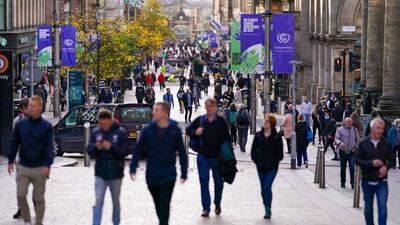
Banners advertising the upcoming Cop26 Summit line a street in Glasgow. Glasgow was chosen to host the summit in 2019. Ministers described it as one of the UK’s most sustainable cities and a showcase for “diverse culture and world-leading innovation”. Bloomberg -

Workers erect a fence at the Scottish Events Centre. Cop26 was initially due to take place in 2020 but was postponed by a year because of the pandemic. Getty Images -
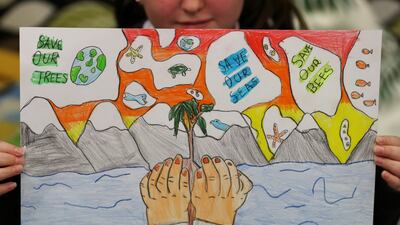
A pupil holds a poster at St Convals Primary School in Glasgow while learning about climate change ahead of Cop26. About 25,000 people are expected to attend the summit. Reuters -
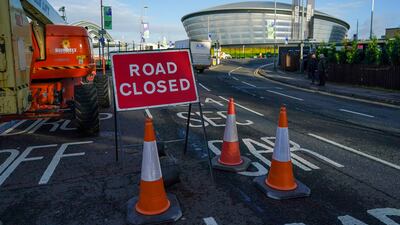
Road closures are in place around the SEC in Glasgow. There have been 25 Conference of the Parties (or 'Cop') summits so far, making this year's event 'Cop26'. Bloomberg -
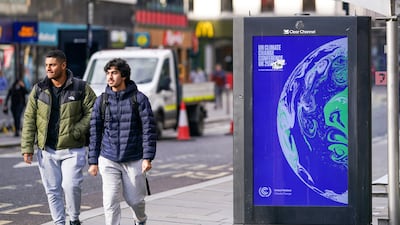
An electronic poster advertising the Cop26 summit. World leaders will kick off the summit by setting 'high-level ambition' for climate action, the UK government says. Bloomberg -
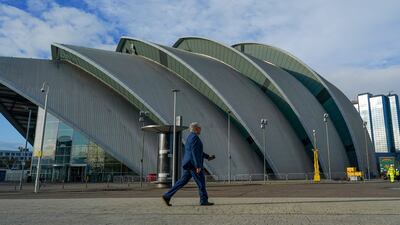
The Armadillo building forms part of the SEC, the location for the summit. Bloomberg -

Artists paint a mural on a a wall next to the Clydeside Expressway near the SEC. Getty Images -

Police Scotland mounted officers patrol near the SSE Hydro venue in Glasgow. As part of the summit, world leaders are holding talks on November 1 and 2. Prime Minister Boris Johnson will represent Britain and US President Joe Biden will be there. AFP -
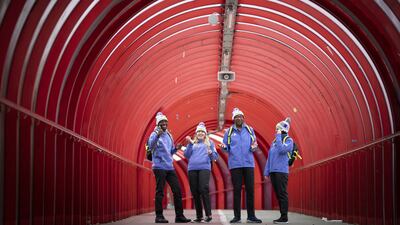
Volunteers model the official uniforms that will be worn by about 1,000 volunteers at Cop26. PA


Leaders of major economies will go to Scotland from a G20 meeting in Rome where climate is expected to dominate the agenda, although key heads of state, including China’s Xi Jinping and Russia’s Vladimir Putin, are not scheduled to attend either event.
Countries – in particular major emitters – are facing calls from across society, from UN chiefs to religious leaders and campaigners, to increase action to keep the 1.5ºC goal in reach and avoid catastrophic climate effects.
There will also be pushes to phase out coal power, boost electric vehicles and protect forests, while developed countries also need to deliver finance for poorer nations to develop cleanly and cope with the inevitable conditions in a warming world.
In an interview for BBC Radio 4’s 39 Ways To Save The Planet, Hollywood star, former California governor and climate campaigner Arnold Schwarzenegger said everyone has to work together to tackle the issue.
He said it is “great when leaders get together every year and talk about what they can do”, but he also said he is not a big fan of making everything rest on the annual “Cop” conferences.
Schwarzenegger said: “It’s very important that we have a positive attitude, that we can see it and we all work together, because not one person can deal with it themselves. It’s a huge undertaking.
“It takes the political arena, it takes the public sector, the private sector, the non-profit sector, the academic sector, ordinary folks. And then I think we can do it.”
He pointed to California’s successful economy, green job creation and the US’s strictest environmental laws, and said: “All of those countries that come and give speeches that say ‘we’re not going to go and lose jobs because of going green’, they’re liars. Or they’re just stupid and they don’t know how to do it.”

