The number of petrol stations closed because of fuel shortages has halved in the space of four days in tentative signs the crisis is easing, a government minister has said.
Chief Secretary to the Treasury Simon Clarke said the situation is “moving in the right direction” a week after the crisis was sparked by the leaking of a confidential document.
He said there were little more than a quarter of sites empty of fuel on Wednesday, down from 60 per cent over the weekend.
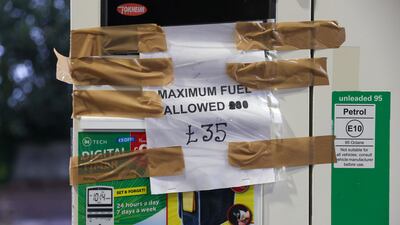
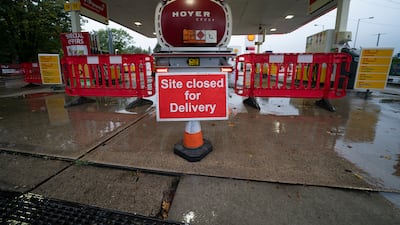
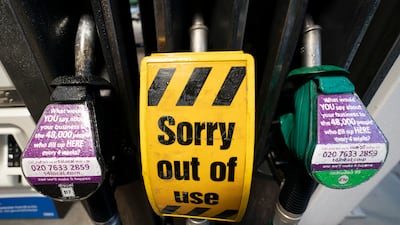
However, many stations across the country were empty on Thursday morning as they awaited their next fuel delivery after running dry.
Drivers continued to queue to fill up their tanks at stations that had fuel after days of panic buying.
Mr Clarke was pressed on the government’s muddled response to the crisis after ministers had planned to use soldiers to drive tankers before taking a step back from the plan.
He said military personnel were “on standby” and would be called upon if needed.
He also said fuel deliveries were on the increase, after Business Secretary Kwasi Kwarteng’s announcement that 80 government-owned tanks had been used.
“We’re in a situation now where there is more fuel being delivered to petrol stations than is being sold, which is great,” Mr Clark told BBC Radio 4’s Today programme.
“The army is on standby to help support the commercial operations and, of course, we’ve seen some changes, including, notably, allowing some MoD driving instructors to help boost the number of tankers,” he said.
“There’re 150 drivers on standby to help support operations as required.
“This is designed to help buttress the commercial operation, which is driving down the pressures that we’ve seen on forecourts.
“We are confident that things will normalise really quickly if we can just avoid the panic buying, which has exacerbated the situation very severely,” he said.
He refuted the claim that Brexit has led to shortages of qualified HGV drivers in the UK.
He said any claim that Brexit is to blame is an attempt to revert to a “negative conversation about opportunities foregone”.
He pointed out that the EU countries are also experiencing shortages of lorry drivers.
Speaking to Sky News, he said the panic buying must stop and offered hope to drivers with the latest figures.
“We are in a situation where the data is clearer on this, over the weekend 60 per cent of petrol stations were out of fuel – that was down to 27 pe rcent as of yesterday [so] the numbers are really moving in the right direction,” he said.
The government-owned fuel tankers were due to be on the roads by Wednesday afternoon to restock pumps that had run dry.
“The trucks are driven by civilians and will provide additional logistical capacity to the fuel industry,” Mr Kwarteng said.
His announcement came as the Petrol Retailers Association said that about 27 per cent of its members’ sites had run dry on Wednesday.
This figure was down from 37 per cent on Tuesday and the estimated 50 per cent to 90 per cent of stations on Sunday and Monday.
The body represents the independent retailers that make up about two thirds of the UK’s 8,000 petrol stations.

How%20to%20avoid%20getting%20scammed
%3Cul%3E%0A%3Cli%3ENever%20click%20on%20links%20provided%20via%20app%20or%20SMS%2C%20even%20if%20they%20seem%20to%20come%20from%20authorised%20senders%20at%20first%20glance%3C%2Fli%3E%0A%3Cli%3EAlways%20double-check%20the%20authenticity%20of%20websites%3C%2Fli%3E%0A%3Cli%3EEnable%20Two-Factor%20Authentication%20(2FA)%20for%20all%20your%20working%20and%20personal%20services%3C%2Fli%3E%0A%3Cli%3EOnly%20use%20official%20links%20published%20by%20the%20respective%20entity%3C%2Fli%3E%0A%3Cli%3EDouble-check%20the%20web%20addresses%20to%20reduce%20exposure%20to%20fake%20sites%20created%20with%20domain%20names%20containing%20spelling%20errors%3C%2Fli%3E%0A%3C%2Ful%3E%0A
Mercer, the investment consulting arm of US services company Marsh & McLennan, expects its wealth division to at least double its assets under management (AUM) in the Middle East as wealth in the region continues to grow despite economic headwinds, a company official said.
Mercer Wealth, which globally has $160 billion in AUM, plans to boost its AUM in the region to $2-$3bn in the next 2-3 years from the present $1bn, said Yasir AbuShaban, a Dubai-based principal with Mercer Wealth.
“Within the next two to three years, we are looking at reaching $2 to $3 billion as a conservative estimate and we do see an opportunity to do so,” said Mr AbuShaban.
Mercer does not directly make investments, but allocates clients’ money they have discretion to, to professional asset managers. They also provide advice to clients.
“We have buying power. We can negotiate on their (client’s) behalf with asset managers to provide them lower fees than they otherwise would have to get on their own,” he added.
Mercer Wealth’s clients include sovereign wealth funds, family offices, and insurance companies among others.
From its office in Dubai, Mercer also looks after Africa, India and Turkey, where they also see opportunity for growth.
Wealth creation in Middle East and Africa (MEA) grew 8.5 per cent to $8.1 trillion last year from $7.5tn in 2015, higher than last year’s global average of 6 per cent and the second-highest growth in a region after Asia-Pacific which grew 9.9 per cent, according to consultancy Boston Consulting Group (BCG). In the region, where wealth grew just 1.9 per cent in 2015 compared with 2014, a pickup in oil prices has helped in wealth generation.
BCG is forecasting MEA wealth will rise to $12tn by 2021, growing at an annual average of 8 per cent.
Drivers of wealth generation in the region will be split evenly between new wealth creation and growth of performance of existing assets, according to BCG.
Another general trend in the region is clients’ looking for a comprehensive approach to investing, according to Mr AbuShaban.
“Institutional investors or some of the families are seeing a slowdown in the available capital they have to invest and in that sense they are looking at optimizing the way they manage their portfolios and making sure they are not investing haphazardly and different parts of their investment are working together,” said Mr AbuShaban.
Some clients also have a higher appetite for risk, given the low interest-rate environment that does not provide enough yield for some institutional investors. These clients are keen to invest in illiquid assets, such as private equity and infrastructure.
“What we have seen is a desire for higher returns in what has been a low-return environment specifically in various fixed income or bonds,” he said.
“In this environment, we have seen a de facto increase in the risk that clients are taking in things like illiquid investments, private equity investments, infrastructure and private debt, those kind of investments were higher illiquidity results in incrementally higher returns.”
The Abu Dhabi Investment Authority, one of the largest sovereign wealth funds, said in its 2016 report that has gradually increased its exposure in direct private equity and private credit transactions, mainly in Asian markets and especially in China and India. The authority’s private equity department focused on structured equities owing to “their defensive characteristics.”
Key recommendations
- Fewer criminals put behind bars and more to serve sentences in the community, with short sentences scrapped and many inmates released earlier.
- Greater use of curfews and exclusion zones to deliver tougher supervision than ever on criminals.
- Explore wider powers for judges to punish offenders by blocking them from attending football matches, banning them from driving or travelling abroad through an expansion of ‘ancillary orders’.
- More Intensive Supervision Courts to tackle the root causes of crime such as alcohol and drug abuse – forcing repeat offenders to take part in tough treatment programmes or face prison.
RESULTS
6.30pm: Handicap (rated 95-108) US$125,000 2000m (Dirt).
Winner: Don’t Give Up, Gerald Mosse (jockey), Saeed bin Suroor (trainer).
7.05pm: Handicap (95 ) $160,000 2810m (Turf).
Winner: Los Barbados, Adrie de Vries, Fawzi Nass.
7.40pm: Handicap (80-89) $60,000 1600m (D).
Winner: Claim The Roses, Mickael Barzalona, Salem bin Ghadayer.
8.15pm: UAE 2000 Guineas Trial (Div-1) Conditions $100,000 1,400m (D)
Winner: Gold Town, William Buick, Charlie Appleby.
8.50pm: Cape Verdi Group 2 $200,000 1600m (T).
Winner: Promising Run, Patrick Cosgrave, Saeed bin Suroor.
9.25pm: UAE 2000 Guineas Conditions $100,000 1,400m (D).
Winner: El Chapo, Luke Morris, Fawzi Nass.
Dengue%20fever%20symptoms
%3Cp%3EHigh%20fever%20(40%C2%B0C%2F104%C2%B0F)%3Cbr%3ESevere%20headache%3Cbr%3EPain%20behind%20the%20eyes%3Cbr%3EMuscle%20and%20joint%20pains%3Cbr%3ENausea%3Cbr%3EVomiting%3Cbr%3ESwollen%20glands%3Cbr%3ERash%26nbsp%3B%3C%2Fp%3E%0A
Jetour T1 specs
Engine: 2-litre turbocharged
Power: 254hp
Torque: 390Nm
Price: From Dh126,000
Available: Now