


British companies are putting policies in place to prevent staff going abroad on holiday as constantly changing restrictions could force them into quarantine on their return.
Experts say employees going into a 10-day quarantine after a trip would create an issue for employers if they were required to work on site. This would hit some sectors hard at a time when staff shortages are a challenge amid a hiring surge in the country.
Employers are already struggling with mixed messages from the government over how to encourage staff back to the office. Some even fear legal challenges if there is a Covid-19 outbreak at work, as employment claims linked to the pandemic increase. Monday, July 19, has been called "Freedom Day" by some as Covid-19 restrictions are dropped.
If employees do decide to spend their holiday time abroad, “it could be hugely problematic for certain businesses”, David Morel, chief executive of Tiger Recruitment, told The National.
Aleksandra Traczyk, a solicitor at Winckworth Sherwood, said employers worried about staff shortages or absent workers can use policies to discourage staff from taking overseas holidays.
“Employers cannot dictate what staff do in their private time but can put in place policies discouraging staff from travelling abroad such as making it clear that they will not be paid if they have to quarantine on return,” Ms Traczyk told The National.
Guidance replaces rules
Under the government's latest workplace guidelines, from Monday employers will no longer need to implement social distancing and should plan a gradual return to offices over the summer as the message on working from home if possible is ditched.
Sinead Casey, a partner in Linklater's employment and incentives practice, said the removal of most of the legal coronavirus restrictions and a new emphasis on personal discretion, either at an individual level or for businesses, raises many challenges for employers as they plan how to run their businesses.
Employers will still have to comply with health and safety obligations and consider which measures are still needed, such as social distancing, additional cleaning, mask wearing and ventilation.
-

People celebrate as they queue to enter a nightclub in Leeds after the final legal coronavirus restrictions were lifted in England at midnight. -
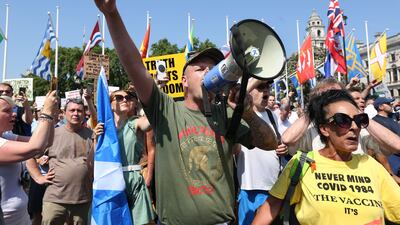
Protesters shout anti-government slogans at the Houses of Parliament from Parliament Square at an anti-lockdown protest in London. -
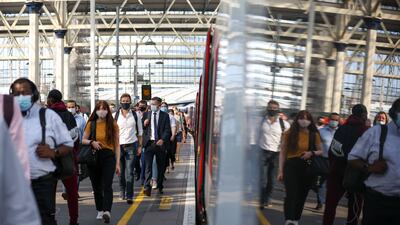
Commuters arrive at London Waterloo railway station. Most coronavirus restrictions ended in England on Monday. -
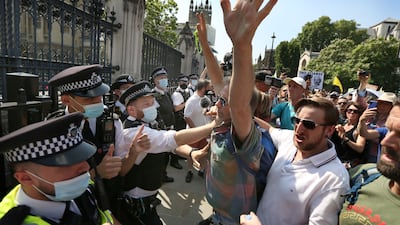
Protesters confront a police line outside the House of Commons during a freedom protest in London. -
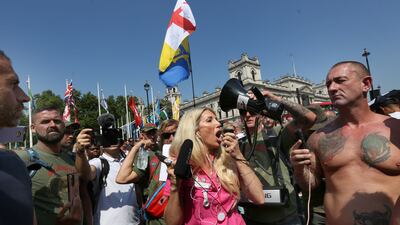
Kate Shemirani addresses protesters through a megaphone in Parliament Square as part of the protest. -

Mayor of London Sadiq Khan wears a mask at Bond Street underground station in central London. He said that passengers on the capital’s buses and trains must continue to wear face masks. -

On what some have called 'Freedom Day', marking the end of coronavirus restrictions in England, people walk over London Bridge during the morning rush hour. -

Pedestrians without face masks shop on Oxford Street in central London. -
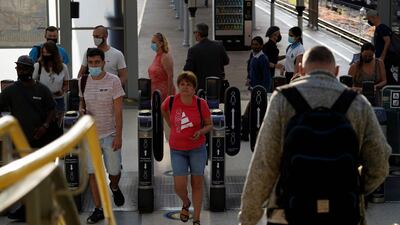
Commuters with and without masks board trains at Richmond station in south-west London. -
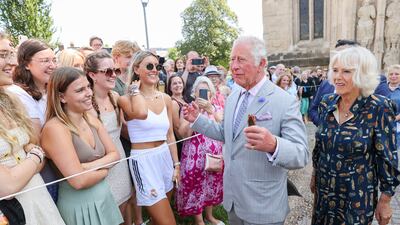
Prince Charles and Camilla meet a group of young people during a visit to Exeter Cathedral. -
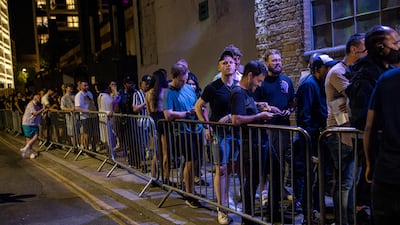
People queue outside a London nightclub in the early hours of this morning. -

Commuters walk through Waterloo station during the morning rush hour. British Prime Minister Boris Johnson has called for caution as restrictions are lifted in England. -
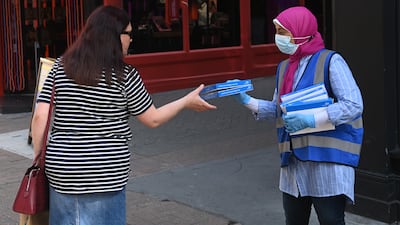
A worker offers free Rapid Antigen tests to members of the public in Carnaby Street in London. -

A Yeoman Warder gestures as he leads the first 'Beefeater' tour of the Tower of London in 16 months. -
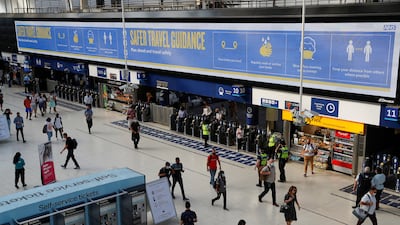
A travel guidance sign at Waterloo station in London. -
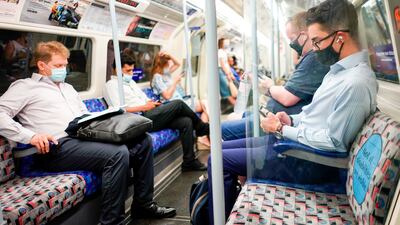
People wear masks on an Underground train in London. -

A live band performs during a "00:01" event organised by a nightclub in London.


"A thorough and well-documented risk assessment and communication of it to employees will be critical in dealing with any issues that may arise if employees refuse to return to work due to concerns about their health and safety, or if an employee does return to work and subsequently claims that they have contracted Covid-19 (or long Covid) in the workplace," Ms Casey said.
Ms Casey said several employment tribunal claims linked to Covid-19 and unfair dismissal have already been filed in the UK, with more to come.
"While the current backlog means these cases are taking a while to be heard and for decisions to be issued, we are aware of four cases reported since April in relation to unfair dismissal claims as a result of refusal to return to the workplace," she said.
"One case was reported in May in relation to refusal to accept a Covid-19 related pay reduction and one case was reported back in February in relation to a dismissal for refusal to wear a mask in the workplace. It is highly likely that we will see a significant further number of cases coming through the tribunal in the coming months."
With the government urging employees to make a gradual return over the summer, Ms Casey said employers may harden their position and start to move away from persuasion and towards instruction to return.
"As a result we may well see grievances and complaints about the lack of protections and the behaviour of fellow employees; a lot of uncertainty about what, if any, measures the employer can or should put in place; and a lot of non-compliance with requests to return from employees who think it is all too early to be safe," she said.
Meanwhile, with UK quarantine restrictions changing all the time, employees planning to head overseas on holiday run the risk that regulations governing the destination they travel to may alter while they are away. This may lead to either a 10-day isolation at home on their return, or worse, quarantine in a hotel.
"There is no guarantee that an amber list country will not be put on a red list," Ms Traczyk said.
Travel rules
Foreign holidays were banned for UK residents until May 17 when the government unveiled its traffic light system to resume travel, with the UK urging holidaymakers not to head to red or amber list countries.
While initially, holidaymakers could travel to only a handful of green list countries without having to isolate on return, the government changed tack last week, allowing holidays to amber list countries without quarantine for fully vaccinated people.
However, France was put on an 'amber-plus' status over the weekend, dismissing the waiver for fully vaccinated people. Spain's Balearic Islands were returned to the amber list last week, sparking a rush to return home before Monday's deadline.
Mr Morel acknowledged that staff burnout is a “a very real issue”, as many Britons have delayed booking a holiday until travel restrictions ease. But for businesses in sectors that rely on staff working on their premises, such as manufacturing and retail, workers going overseas poses a problem.
Tiger Recruitment
“Take the hospitality sector, for example, which is already suffering from acute staffing shortages due to the pandemic and Brexit,” Mr Morel said.
“While exemption from quarantine for the double-jabbed is welcome, it won’t extend to its largely young, as-yet-to-be vaccinated workforce. How can it afford to have any staff out of action for 10 days on top of their holiday time?”
Staff shortages have become a growing issue for companies in recent weeks, partly because many casual workers from the EU have now left the country due to Covid-19 lockdowns and also because many workers are being asked to self-isolate by the government’s track-and-trace system. More than a million people have been 'pinged' and forced to stay home amid claims that the rules are too stringent.
One in five high street workers are self-isolating due to government pandemic tracing rules, according to trade body UK Hospitality. There are fears that the situation could worsen.
Debi Jones who runs domestic cleaning company Miss Mop in Pulborough, Sussex, in the South of England, said 20 per cent of her 170 cleaners are isolating at home after being alerted by the track-and-trace system, putting the company in a worse position than last year.
"Most of these people are physically well but they're not able to go out and earn any money, which is compromising us as an employer," she said.
"It's paralysing us because we have no notice. People are being pinged by the app or the schools are calling and requiring children to be picked up and kept at home for 10 days. Sixty per cent of our workforce have children of school or nursery age, so they are massively impacted by their children being sent home."
Britain’s biggest business lobby, the Confederation of British Industry, urged the government to drop self-isolation rules when other Covid-19 restrictions end, as it looks to inject confidence into the push to get workers back to offices.
While the work-from-home recommendation expires on Monday, self-isolation rules for fully vaccinated contacts of those who have tested positive for the coronavirus will stay in place until August 16.
The CBI wants the government to reduce the impact of self-isolation on staff shortages by bringing that date forward to align with so-called "Freedom Day", as the UK economy slowly recovers from the economic hit from Covid-19.
“Learning to live and work with the virus is the right strategy,” CBI Director General Tony Danker said. “But we need to ensure this is a confident not an anxious transition, otherwise it won’t work.”
Employers are also wary about staff going overseas as they run the risk of being caught out if the situation changes during their trip.
Annual leave cancelled
Those concerned about sufficient cover during the summer months can refuse a holiday request, said Ms Traczyk, “as long as the refusal is given as many calendar days before the date on which the employee’s requested leave is due to start as the number of days which the employer is refusing”.
“For example, if an employer is refusing five days of a six day request, it must give notice at least five calendar days before the leave was due to start,” she said.
Employers can also cancel any period of holiday by giving notice of at least twice the length of the leave before it is due to start, she added.
This is also a concern for the self-employed, with former Dubai resident and business owner Emma White nervous about a trip to France in August to see her father after almost two years due to the pandemic.
Ms White, who runs personal training business bactive.me from her home in Penarth, Wales, said a sudden change in rules that puts her into quarantine could see her lose up to two weeks of face-to-face personal training sessions.
“I’ve chosen to go in mid-August because at that time of year most of my clients would be on holiday themselves but I do run the risk of losing some income if I have to quarantine,” said Ms White, who relocated from the UAE to the UK last summer.
Ms White is already losing income this week after being forced into isolation by the UK’s trace-and-trace system after the came into contact with a Covid-positive patient. Plus with her journey to France going via Geneva International Airport, she has to make sure her journey complies with all the regulations there.
For this reason, her husband, who works on-site for a property firm, has decided not to join the trip to France to ensure his work is not disrupted.
“The trip would be too much risk for him so he is not going,” Ms White said.
Susannah Streeter, senior investment and markets analyst at Hargreaves Lansdown, said worries will persist that although British travellers might have a freer pass to travel, the spread of the Delta variant may lead to other countries imposing tougher quarantine rules on visitors.
The Tony Blair Institute warned last week that "confusion reigns" for travellers across the globe because of a lack of uniformity on which vaccines are accepted as valid by certain countries.
"Clarity is also missing both on travel testing and the framework for a global digital health ID, showing someone’s Covid status," former UK prime minister Tony Blair said.
Mr Blair urged the World Health Organisation to bring uniformity to these areas of vaccines, testing and travel credentials.
“The world cannot begin to recover from Covid without people being able to move around again. This can only be done through a common global solution. Such a strategy is urgent and this paper offers such a way forward," he said.
Holidaymakers may face long queues if they choose to travel overseas, even having to wait inside their aircraft after landing to prevent overcrowding at border control.
“Testing requirements are also likely to continue to be a headache and an added expense for tourists, so could dampen demand a little," said Ms Streeter.
Mr Morel said the quarantine challenges are less of a problem for office-based businesses that are broadly set up to deal with the Government’s changing travel advice.
“If one of their employees has to quarantine after a trip or the rules change at short notice, they have the flexibility to let them work from home,” he said.
However, those forced to quarantine by changing rules may lose out on pay if that penalty was agreed before they went on the trip, Ms Traczyk warned.
Employers should also be wary of penalising staff in relation to any illnesses, particularly if they are long-term, she said.
“Depending on the symptoms suffered and how long they last for, long Covid may potentially amount to a disability under the Equality Act 2010 in which case any penalties imposed on the employee could amount to disability discrimination,” Ms Traczyk said.
“If the employee is off sick, provided that they have complied with the relevant notification requirements, they are entitled to statutory sick pay or sometimes contractual sick pay under the employer’s policy.”
Ultimately, until the quarantine requirement for international travellers comes to an end, “some businesses are caught in an impossible situation” said Mr Morel.

