At least 120 killed and hundreds more missing in European flood disaster


  • English
  • Arabic

The death toll from the devastating floods in western Europe reached 128 on Friday with many more missing after the worst weather disaster to hit the region in 80 years.

Record rainfall caused rivers to burst their banks, catching residents off guard and leaving a trail of destruction and despair.

Entire towns and villages lay in ruins in the hardest-hit German states of Rhineland-Palatinate and North Rhine-Westphalia, where at least 1,300 people were reported missing.

After days of heavy rain, 108 people were confirmed dead in Germany alone, the largest number killed in a natural disaster in the country in almost 60 years.

Unsuspecting residents were caught completely off guard by the torrent dubbed the "flood of death" by German newspaper Bild.

In Belgium, which has declared a day of mourning on Tuesday, officials said there were at least 20 dead and another 20 missing. More than half of the 53 counties in North Rhine-Westphalia state were affected by the floods, which damaged hundreds of buildings.

One of the villages left devastated by the floodwaters was Gemünd, where residents spent the day trying to remove the mud and debris left by the raging torrents.

The village has two rivers running through it: the Olef, which has its mouth on the Urft and both rivers burst their banks after heavy summer rainstorms.

Federal and state officials have pledged financial aid to the affected areas of Germany, which also include the state of Rhineland-Palatinate.

In all, 63 people perished in Rhineland-Palatinate, including 12 residents of an assisted living facility for disabled people.

The death toll in neighbouring North Rhine-Westphalia stood at 43, but officials warned that it could increase.

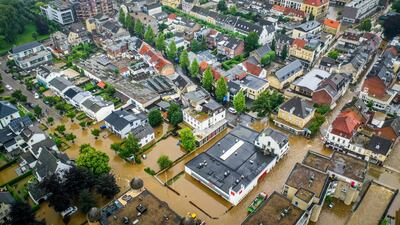
  • The flooded streets of Valkenburg, the Netherlands.
    The flooded streets of Valkenburg, the Netherlands.
  • Destruction in Erftstadt-Blessem in Germany after heavy rains triggered severe flooding. At least 81 people were killed and hundreds more are missing.
    Destruction in Erftstadt-Blessem in Germany after heavy rains triggered severe flooding. At least 81 people were killed and hundreds more are missing.
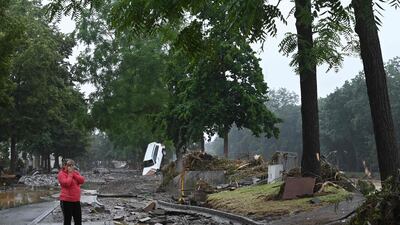
  • A woman assesses the damage caused by the flooding in Bad Neuenahr-Ahrweiler, Germany.
    A woman assesses the damage caused by the flooding in Bad Neuenahr-Ahrweiler, Germany.
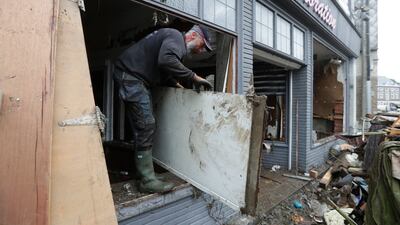
  • Residents clean up after heavy rains caused severe flooding in Ensival, Verviers, Belgium.
    Residents clean up after heavy rains caused severe flooding in Ensival, Verviers, Belgium.
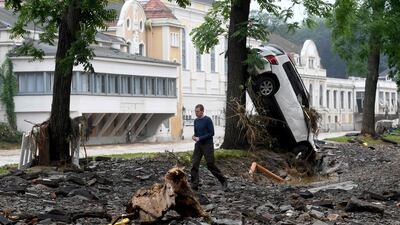
  • A car was washed away and and came to rest against a tree in Bad Neuenahr-Ahrweiler, western Germany.
    A car was washed away and and came to rest against a tree in Bad Neuenahr-Ahrweiler, western Germany.
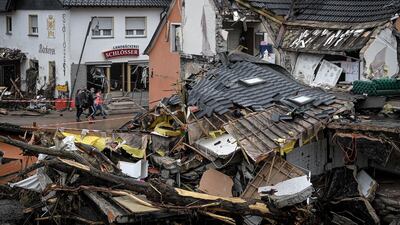
  • Buildings are destroyed in the village of Schuld after heavy flooding of the River Ahr in Germany.
    Buildings are destroyed in the village of Schuld after heavy flooding of the River Ahr in Germany.
  • Another image of Schuld shows the levels of destruction.
    Another image of Schuld shows the levels of destruction.
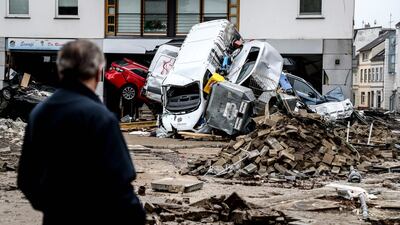
  • Torrents of water threw vehicles into a heap in Bad Neuenahr-Ahrweiler, Germany.
    Torrents of water threw vehicles into a heap in Bad Neuenahr-Ahrweiler, Germany.
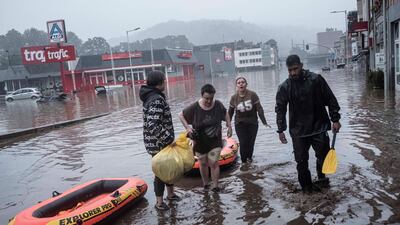
  • Rubber dinghies come in handy after the River Meuse burst its banks in Liege, Belgium..
    Rubber dinghies come in handy after the River Meuse burst its banks in Liege, Belgium..
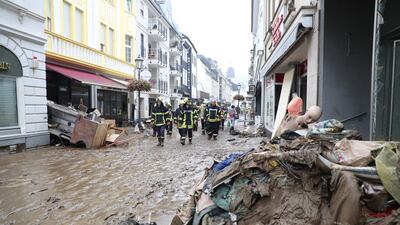
  • Members of the fire department wade through the water to inspect the damage in Bad Neuenahr-Ahrweiler, Germany.
    Members of the fire department wade through the water to inspect the damage in Bad Neuenahr-Ahrweiler, Germany.
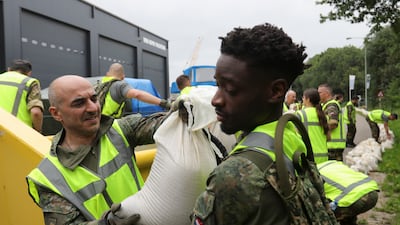
  • Dutch National Reserve Corps stack bags of sand to build a barrier against the floods in Wessem, the Netherlands.
    Dutch National Reserve Corps stack bags of sand to build a barrier against the floods in Wessem, the Netherlands.
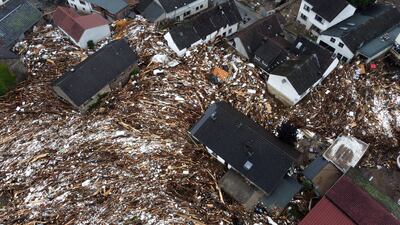
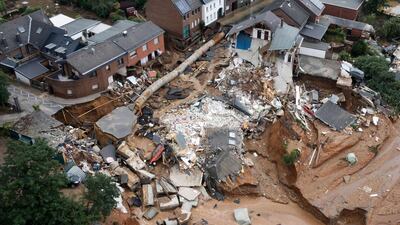
  • An aerial view shows an area completely destroyed by the floods in the Blessem district of Erftstadt, western Germany.
    An aerial view shows an area completely destroyed by the floods in the Blessem district of Erftstadt, western Germany.
  • A woman is carried through a flooded street in Angleur, Belgium.
    A woman is carried through a flooded street in Angleur, Belgium.
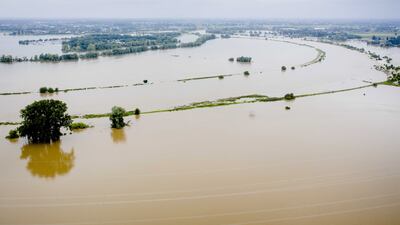
  • Substantial flooding near the Limburg hamlet of Aasterberg, the Netherlands, after water levels of the River Meuse rose.
    Substantial flooding near the Limburg hamlet of Aasterberg, the Netherlands, after water levels of the River Meuse rose.
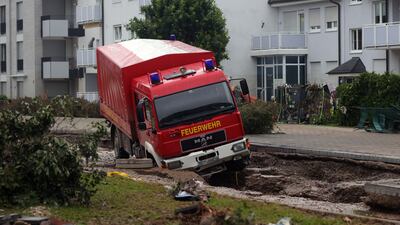
  • A fire department vehicle is stuck in a damaged street in Bad Neuenahr-Ahrweiler, Germany.
    A fire department vehicle is stuck in a damaged street in Bad Neuenahr-Ahrweiler, Germany.
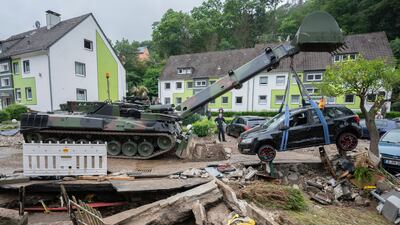
  • A damaged car is hoisted during the clean-up operation in Hagen, Germany..
    A damaged car is hoisted during the clean-up operation in Hagen, Germany..

As the floodwaters began to ebb, shocked residents surveyed what was left of their homes and neighbourhoods.

Despair was written over their faces.

"It was terrible not to able to help people," said local man Frank Thel.

"They were waving at us from windows. Houses were collapsing to the left and right of them and in the house between they were waving. We were lucky, we survived."

German Chancellor Angela Merkel told victims the government would not "leave you alone in this difficult, terrible hour".

"I fear that we will only see the full extent of the disaster in the coming days," she said.

Ursula von der Leyen, the European Commission President, said the area was bearing the brunt of climate change and its effect on the planet.

"These are these are horrible events, the flooding events we see in Germany, the Netherlands, Belgium, Luxembourg," she said. "Our thoughts are with the victims, their families and their loved ones. The commission has already activated the mechanisms to support and help those member states in this very, very difficult, catastrophic scenario. Science tells us that with climate change, we see more and more extreme weather phenomenons that last longer.

Twelve of the dead were residents of a home for disabled people in Sinzig, south of Cologne, who were surprised by the flash floods during the night.

Across the border in Belgium, most of the drowned were found around Liege, where the rains hit hardest.

At least 12 people were killed there, with thousands of homes still without electricity on Friday in several border towns, but hopes were rising that the worst of the calamity was over.

Belgian Prime MinisterAlexander De Croo said the flood disaster was "unprecedented" as he declared July 20 a national day of mourning.

"We are still waiting for the final toll, but this could be the most catastrophic flooding our country has ever seen," he said.

Luxembourg and the Netherlands were also severely affected by the torrents of water, with thousands evacuated in the Dutch city of Maastricht.

But Germany's toll was by far the highest, and likely to rise with the large numbers of people still missing.

There are fears for people living below the Steinbach reservoir, which is overflowing and could burst. More rain in the west of Germany is threatening to raise the Rhine to dangerous levels.

Armin Laschet, the premier of North Rhine-Westphalia, blamed the extreme weather on global warming during a visit to a hard-hit area.

"We will be faced with such events over and over, and that means we need to speed up climate protection measures ... because climate change isn't confined to one state," he said.

Malu Dreyer, the premier of Rhineland-Palatinate, said: “Climate change isn’t abstract anymore. We are experiencing it up close and painfully."

German MP Stephan Mayer said he was "deeply convinced" the severity and scale of the flooding.

"[Some German states] are used to flooding and they’ve had flooding in the past … but we haven't experienced such an event like this one," he told the BBC's Radio 4 Today programme on Friday.

"Small creeks, small streams developed within a few minutes into strong streams and rivers. The people couldn’t prepare for that, they couldn’t escape."

Mobile phone networks collapsed in some of the flood-stricken regions, leaving family and friends unable to track down loved ones.

Desperate residents sought refuge on the roofs of their homes as rescue helicopters circled overhead.

Looking out at her flooded garden and garage from her balcony, Annemarie Mueller, 65, said her town of Mayen was completely unprepared for the destruction.

“Where did all this rain come from? It's crazy,” she said.

Debris of houses destroyed by the floods in Schuld near Bad Neuenahr, western Germany. AFP

“It made such a loud noise and given how fast it came down, we thought it would break the door down.”

About 1,000 soldiers were deployed to help with rescue operations and rubble-clearing in affected towns and villages.

Streets and houses under water, overturned cars and uprooted trees were seen once floodwaters started to recede, while some districts were cut off by landslides.

In Ahrweiler, a rural district south of Bonn, several houses collapsed completely, leaving the impression the town had been struck by a tsunami.

At least 20 people were confirmed dead in Euskirchen.

Its normally smart centre was turned into a heap of rubble, with house facades torn off by the rushing floods. A nearby dam remains at risk of giving way.

"My empathy and my heart go out to all of those who in this catastrophe lost their loved ones, or who are still worrying about the fate of people still missing," Ms Merkel said.

The UAE's President Sheikh Khalifa sent messages of condolence to German President Frank-Walter Steinmeier and Ms Merkel. Sheikh Mohammed bin Rashid, UAE Vice President and Ruler of Dubai, and Sheikh Mohamed bin Zayed, Crown Prince of Abu Dhabi and Deputy Supreme Commander of the UAE Armed Forces, also dispatched similar messages to the German leaders.

At least on Friday five people were still missing in Belgium where the Army was sent to four of the country's 10 provinces to help with rescue and evacuation.

With homes under water since Wednesday, people from resort town Spa were being put up in tents.

The swollen Meuse river burst its banks and spilled into the city of Liege, with a population of 200,000.

Rescue workers begin the search for missing people in Bad Neuenahr, Germany. EPA

The storms put climate change back at the centre of Germany's election campaign before the parliamentary poll on September 26 marks the end of Ms Merkel's 16 years in power.

Germany "must prepare much better" because "this extreme weather is a consequence of climate change", Interior Minister Horst Seehofer said.

Because a warmer atmosphere holds more water, climate change increases the risk and intensity of flooding from extreme rainfall.

In urban areas with poor drainage and buildings located in flood zones, the damage can be severe.




The Buckingham Murders

Starring: Kareena Kapoor Khan, Ash Tandon, Prabhleen Sandhu

Director: Hansal Mehta

Rating: 4 / 5

AI traffic lights to ease congestion at seven points to Sheikh Zayed bin Sultan Street

The seven points are:

Shakhbout bin Sultan Street

Dhafeer Street

Hadbat Al Ghubainah Street (outbound)

Salama bint Butti Street

Al Dhafra Street

Rabdan Street

Umm Yifina Street exit (inbound)

COMPANY%20PROFILE
%3Cp%3E%3Cstrong%3EName%3A%3C%2Fstrong%3E%20SupplyVan%3Cbr%3E%3Cstrong%3EBased%3A%3C%2Fstrong%3E%20Dubai%2C%20UAE%3Cbr%3E%3Cstrong%3ELaunch%20year%3A%3C%2Fstrong%3E%202017%3Cbr%3E%3Cstrong%3ENumber%20of%20employees%3A%3C%2Fstrong%3E%2029%3Cbr%3E%3Cstrong%3ESector%3A%3C%2Fstrong%3E%20MRO%20and%20e-commerce%3Cbr%3E%3Cstrong%3EFunding%3A%3C%2Fstrong%3E%20Seed%3C%2Fp%3E%0A
Ten tax points to be aware of in 2026

1. Domestic VAT refund amendments: request your refund within five years

If a business does not apply for the refund on time, they lose their credit.

2. E-invoicing in the UAE

Businesses should continue preparing for the implementation of e-invoicing in the UAE, with 2026 a preparation and transition period ahead of phased mandatory adoption. 

3. More tax audits

Tax authorities are increasingly using data already available across multiple filings to identify audit risks. 

4. More beneficial VAT and excise tax penalty regime

Tax disputes are expected to become more frequent and more structured, with clearer administrative objection and appeal processes. The UAE has adopted a new penalty regime for VAT and excise disputes, which now mirrors the penalty regime for corporate tax.

5. Greater emphasis on statutory audit

There is a greater need for the accuracy of financial statements. The International Financial Reporting Standards standards need to be strictly adhered to and, as a result, the quality of the audits will need to increase.

6. Further transfer pricing enforcement

Transfer pricing enforcement, which refers to the practice of establishing prices for internal transactions between related entities, is expected to broaden in scope. The UAE will shortly open the possibility to negotiate advance pricing agreements, or essentially rulings for transfer pricing purposes. 

7. Limited time periods for audits

Recent amendments also introduce a default five-year limitation period for tax audits and assessments, subject to specific statutory exceptions. While the standard audit and assessment period is five years, this may be extended to up to 15 years in cases involving fraud or tax evasion. 

8. Pillar 2 implementation 

Many multinational groups will begin to feel the practical effect of the Domestic Minimum Top-Up Tax (DMTT), the UAE's implementation of the OECD’s global minimum tax under Pillar 2. While the rules apply for financial years starting on or after January 1, 2025, it is 2026 that marks the transition to an operational phase.

9. Reduced compliance obligations for imported goods and services

Businesses that apply the reverse-charge mechanism for VAT purposes in the UAE may benefit from reduced compliance obligations. 

10. Substance and CbC reporting focus

Tax authorities are expected to continue strengthening the enforcement of economic substance and Country-by-Country (CbC) reporting frameworks. In the UAE, these regimes are increasingly being used as risk-assessment tools, providing tax authorities with a comprehensive view of multinational groups’ global footprints and enabling them to assess whether profits are aligned with real economic activity. 

Contributed by Thomas Vanhee and Hend Rashwan, Aurifer

Two-step truce

The UN-brokered ceasefire deal for Hodeidah will be implemented in two stages, with the first to be completed before the New Year begins, according to the Arab Coalition supporting the Yemeni government.

By midnight on December 31, the Houthi rebels will have to withdraw from the ports of Hodeidah, Ras Issa and Al Saqef, coalition officials told The National. 

The second stage will be the complete withdrawal of all pro-government forces and rebels from Hodeidah city, to be completed by midnight on January 7.

The process is to be overseen by a Redeployment Co-ordination Committee (RCC) comprising UN monitors and representatives of the government and the rebels.

The agreement also calls the deployment of UN-supervised neutral forces in the city and the establishment of humanitarian corridors to ensure distribution of aid across the country.

What are the influencer academy modules?
  1. Mastery of audio-visual content creation. 
  2. Cinematography, shots and movement.
  3. All aspects of post-production.
  4. Emerging technologies and VFX with AI and CGI.
  5. Understanding of marketing objectives and audience engagement.
  6. Tourism industry knowledge.
  7. Professional ethics.
Barbie
%3Cp%3E%3Cstrong%3EDirector%3A%3C%2Fstrong%3E%20Greta%20Gerwig%3Cbr%3E%3Cstrong%3EStars%3A%3C%2Fstrong%3E%20Margot%20Robbie%2C%20Ryan%20Gosling%2C%20Will%20Ferrell%2C%20America%20Ferrera%3Cbr%3E%3Cstrong%3ERating%3A%3C%2Fstrong%3E%204%2F5%3Cbr%3E%3C%2Fp%3E%0A
Fixtures

Wednesday

4.15pm: Japan v Spain (Group A)

5.30pm: UAE v Italy (Group A)

6.45pm: Russia v Mexico (Group B)

8pm: Iran v Egypt (Group B)

Timeline

2012-2015

The company offers payments/bribes to win key contracts in the Middle East

May 2017

The UK SFO officially opens investigation into Petrofac’s use of agents, corruption, and potential bribery to secure contracts

September 2021

Petrofac pleads guilty to seven counts of failing to prevent bribery under the UK Bribery Act

October 2021

Court fines Petrofac £77 million for bribery. Former executive receives a two-year suspended sentence 

December 2024

Petrofac enters into comprehensive restructuring to strengthen the financial position of the group

May 2025

The High Court of England and Wales approves the company’s restructuring plan

July 2025

The Court of Appeal issues a judgment challenging parts of the restructuring plan

August 2025

Petrofac issues a business update to execute the restructuring and confirms it will appeal the Court of Appeal decision

October 2025

Petrofac loses a major TenneT offshore wind contract worth €13 billion. Holding company files for administration in the UK. Petrofac delisted from the London Stock Exchange

November 2025

180 Petrofac employees laid off in the UAE

Leaderboard

15 under: Paul Casey (ENG)

-14: Robert MacIntyre (SCO)

-13 Brandon Stone (SA)

-10 Laurie Canter (ENG) , Sergio Garcia (ESP)

-9 Kalle Samooja (FIN)

-8 Thomas Detry (BEL), Justin Harding (SA), Justin Rose (ENG)

Men from Barca's class of 99

Crystal Palace - Frank de Boer

Everton - Ronald Koeman

Manchester City - Pep Guardiola

Manchester United - Jose Mourinho

Southampton - Mauricio Pellegrino

What can victims do?

Always use only regulated platforms

Stop all transactions and communication on suspicion

Save all evidence (screenshots, chat logs, transaction IDs)

Report to local authorities

Warn others to prevent further harm

Courtesy: Crystal Intelligence

Mercer, the investment consulting arm of US services company Marsh & McLennan, expects its wealth division to at least double its assets under management (AUM) in the Middle East as wealth in the region continues to grow despite economic headwinds, a company official said.

Mercer Wealth, which globally has $160 billion in AUM, plans to boost its AUM in the region to $2-$3bn in the next 2-3 years from the present $1bn, said Yasir AbuShaban, a Dubai-based principal with Mercer Wealth.

Within the next two to three years, we are looking at reaching $2 to $3 billion as a conservative estimate and we do see an opportunity to do so,” said Mr AbuShaban.

Mercer does not directly make investments, but allocates clients’ money they have discretion to, to professional asset managers. They also provide advice to clients.

“We have buying power. We can negotiate on their (client’s) behalf with asset managers to provide them lower fees than they otherwise would have to get on their own,” he added.

Mercer Wealth’s clients include sovereign wealth funds, family offices, and insurance companies among others.

From its office in Dubai, Mercer also looks after Africa, India and Turkey, where they also see opportunity for growth.

Wealth creation in Middle East and Africa (MEA) grew 8.5 per cent to $8.1 trillion last year from $7.5tn in 2015, higher than last year’s global average of 6 per cent and the second-highest growth in a region after Asia-Pacific which grew 9.9 per cent, according to consultancy Boston Consulting Group (BCG). In the region, where wealth grew just 1.9 per cent in 2015 compared with 2014, a pickup in oil prices has helped in wealth generation.

BCG is forecasting MEA wealth will rise to $12tn by 2021, growing at an annual average of 8 per cent.

Drivers of wealth generation in the region will be split evenly between new wealth creation and growth of performance of existing assets, according to BCG.

Another general trend in the region is clients’ looking for a comprehensive approach to investing, according to Mr AbuShaban.

“Institutional investors or some of the families are seeing a slowdown in the available capital they have to invest and in that sense they are looking at optimizing the way they manage their portfolios and making sure they are not investing haphazardly and different parts of their investment are working together,” said Mr AbuShaban.

Some clients also have a higher appetite for risk, given the low interest-rate environment that does not provide enough yield for some institutional investors. These clients are keen to invest in illiquid assets, such as private equity and infrastructure.

“What we have seen is a desire for higher returns in what has been a low-return environment specifically in various fixed income or bonds,” he said.

“In this environment, we have seen a de facto increase in the risk that clients are taking in things like illiquid investments, private equity investments, infrastructure and private debt, those kind of investments were higher illiquidity results in incrementally higher returns.”

The Abu Dhabi Investment Authority, one of the largest sovereign wealth funds, said in its 2016 report that has gradually increased its exposure in direct private equity and private credit transactions, mainly in Asian markets and especially in China and India. The authority’s private equity department focused on structured equities owing to “their defensive characteristics.”

What is blockchain?

Blockchain is a form of distributed ledger technology, a digital system in which data is recorded across multiple places at the same time. Unlike traditional databases, DLTs have no central administrator or centralised data storage. They are transparent because the data is visible and, because they are automatically replicated and impossible to be tampered with, they are secure.

The main difference between blockchain and other forms of DLT is the way data is stored as ‘blocks’ – new transactions are added to the existing ‘chain’ of past transactions, hence the name ‘blockchain’. It is impossible to delete or modify information on the chain due to the replication of blocks across various locations.

Blockchain is mostly associated with cryptocurrency Bitcoin. Due to the inability to tamper with transactions, advocates say this makes the currency more secure and safer than traditional systems. It is maintained by a network of people referred to as ‘miners’, who receive rewards for solving complex mathematical equations that enable transactions to go through.

However, one of the major problems that has come to light has been the presence of illicit material buried in the Bitcoin blockchain, linking it to the dark web.

Other blockchain platforms can offer things like smart contracts, which are automatically implemented when specific conditions from all interested parties are reached, cutting the time involved and the risk of mistakes. Another use could be storing medical records, as patients can be confident their information cannot be changed. The technology can also be used in supply chains, voting and has the potential to used for storing property records.

The specs: 2018 Audi Q5/SQ5

Price, base: Dh183,900 / Dh249,000
Engine: 2.0L, turbocharged in-line four-cylinder /  3.0L, turbocharged V6
Gearbox: Seven-speed automatic / Eight-speed automatic
Power: 252hp @ 5,000rpm / 354hp @ 5,400rpm
Torque: 370Nm @ 1,600rpm / 500Nm @ 1,370rpm
Fuel economy: combined 7.2L / 100km / 8.3L / 100km

Updated: July 17, 2021, 6:08 AM