



The Covid-19 pandemic has caused the number of people suffering from severe food insecurity to double.
The warning was issued by David Beasley, head of the World Food Programme, who said 270 million people were “marching towards starvation".
The Covid-related economic deterioration and ensuing ripples on the supply chain have led to a “perfect storm crisis”, he said.
The pandemic compounded the problems caused by conflict and climate change.
When Mr Beasley took charge of the UN agency in March 2017 about million 80 million people around the world were on the brink of starvation.
But before the pandemic began in early 2020, that figure had surged to 135 million, worsening as Covid-19 spread around the world.
“If we don’t do anything about it then you will have mass famine, destabilisation of nations and mass migration,” Mr Beasley told an online seminar organised by the Chatham House think tank in London.
He said he told world leaders in private that not enough was being done to solve the world’s conflicts.
“Man-made conflict is driving the hunger rates up," he said.
He emphasised the importance of tackling the root causes of hunger rather than waiting to act “after the fact", which was often much more expensive.
“I think the Europeans learnt that lesson very clearly in the Syrian conflict. We could feed a Syrian in the middle of a war for about 50 cents per person, and that’s more than normal, but when you’re moving supplies through a war zone it costs more money," Mr Beasley said.
“But that same Syrian ends up in, let’s say, Brussels or Berlin, instead of 50 cents it’s 50 to 100 Euros per person per day for the humanitarian support package.”
-
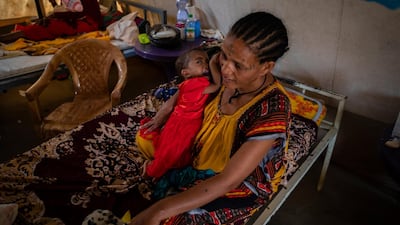
Mother Roman Kidanemariam, 35, holds her malnourished daughter, Merkab Ataklti, 22 months old, in the treatment tent of a medical clinic in the town of Abi Adi, in the Tigray region of northern Ethiopia. AP Photo -
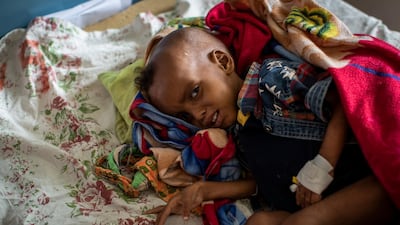
Gebre Kidan Gebrehiwet, 2, is treated for malnutrition after fleeing from the town of Abi Adi with his mother, Abeba Tesfay, at the Ayder Referral Hospital in Mekele, in the Tigray region of northern Ethiopia. AP Photo -
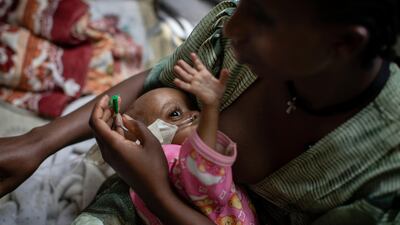
Birhan Etsana, 27, from Dengelat, uses a nasogastric tube to feed her malnourished baby, Mebrhit, who at 17 months old weighs just 5.2 kilograms (11 pounds and 7 ounces), at the Ayder Referral Hospital in Mekele, in the Tigray region of northern Ethiopia. AP Photo -
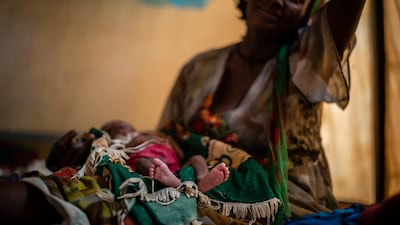
Abeba Gebru, 37, from the village of Getskimilesley, sits with her malnourished daughter, Tigsti Mahderekal, 20 days old, in the treatment tent of a medical clinic in the town of Abi Adi, in the Tigray region of northern Ethiopia. AP Photo -

An Ethiopian woman scoops up portions of yellow split peas to be allocated to waiting families after it was distributed by the Relief Society of Tigray in the town of Agula, in the Tigray region of northern Ethiopia. AP Photo -
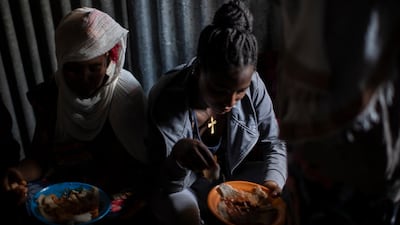
Displaced Tigrayan women sit in a metal shack to eat food donated by local residents at a reception center for the internally displaced in Mekele, in the Tigray region of northern Ethiopia. AP Photo -
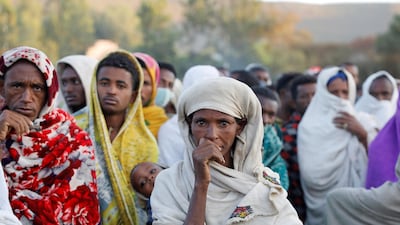
A woman stands in line to receive food donations at the Tsehaye primary school, which was turned into a temporary shelter for people displaced by conflict, in the town of Shire, Tigray region. Reuters -
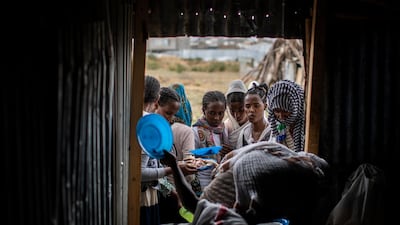
Tigrayans stand in line to receive food donated by local residents at a reception center for the internally displaced in Mekele, in the Tigray region of northern Ethiopia. AP Photo -
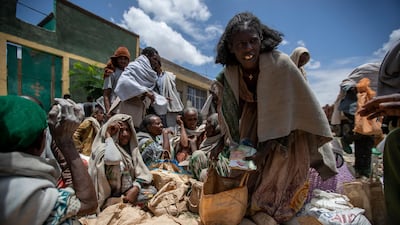
An Ethiopian woman leaves with a portion of yellow split peas after it was distributed by the Relief Society of Tigray in the town of Agula, in the Tigray region of northern Ethiopia. AP Photo -
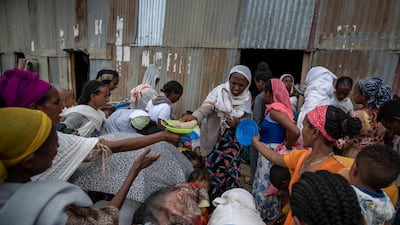
Displaced Tigrayans queue to receive food donated by local residents at a reception center for the internally displaced in Mekele, in the Tigray region of northern Ethiopia. AP Photo


Mr Beasley said the WFP work with displaced people showed that groups affected by conflict “don’t want to leave home”.
“What we saw in Syria is just typical of people in these types of disruptive environments," he said.
"They will move two, three, four, five times in their homeland. They’ll go to their aunts, uncles or grandparents or cousins or friends before they’ll actually leave.
“But if they don’t have food security and some degree of peace, they will do what any of us would do for our children.”
No two countries were the same when it came to the root causes of hunger, Mr Beasley said.
He said that in the Sahel region, the WFP had worked to find long-term sustainable solutions to water shortages.
Child marriages, migration and the recruitment of residents by terrorists groups such as ISIS and Al Qaeda dropped in the areas where the agency's programmes were introduced, he said.
With government funds stretched by the pandemic, he also appealed to the world’s richest people for their financial help, especially after the net worth of so many increased during pandemic.
“I’m saying, 'Hey, give me one day’s worth of your net worth increase. That’s all I need, I’m not going to ask you every year for this,'” he said.

