• A staff member of the World Food Programme checks boxes that arrived, mostly personal protective equipment (PPE), at Ethiopian Airlines' cargo facility at the Bole International Airport in Addis Ababa, Ethiopia, on April 14. Samuel Habtab / AFP
    A staff member of the World Food Programme checks boxes that arrived, mostly personal protective equipment (PPE), at Ethiopian Airlines' cargo facility at the Bole International Airport in Addis Ababa, Ethiopia, on April 14. Samuel Habtab / AFP
  • A girl waits outside her home in Cairo to see if she and her family will get a carton filled with food from the non-governmental organisation Resala Nour Ala Nour. Nariman El-Mofty / AFP
    A girl waits outside her home in Cairo to see if she and her family will get a carton filled with food from the non-governmental organisation Resala Nour Ala Nour. Nariman El-Mofty / AFP
  • An Egyptian worker distributes food boxes by the Egyptian Food Bank to people who have lost their jobs due to the pandemic, in New Cairo, Egypt. Khaled Elfiqi / EPA
    An Egyptian worker distributes food boxes by the Egyptian Food Bank to people who have lost their jobs due to the pandemic, in New Cairo, Egypt. Khaled Elfiqi / EPA
  • A security force member stands guard as women line up to receive rations distributed by the World Food Programme in Herat, Afghanistan, 31 March. Jalil Rezayee / EPA
    A security force member stands guard as women line up to receive rations distributed by the World Food Programme in Herat, Afghanistan, 31 March. Jalil Rezayee / EPA
  • Rohingya refugees at the Kutupalong refugee camp in Cox’s Bazar, Bangladesh. Aid workers are bracing for a possible outbreak of coronavirus in one of the world's largest refugee camps in Bangladesh. Officials warn that containing the disease among more than one million tightly packed Rohingya Muslims will be a daunting task. Suzauddin Rubel / AP
    Rohingya refugees at the Kutupalong refugee camp in Cox’s Bazar, Bangladesh. Aid workers are bracing for a possible outbreak of coronavirus in one of the world's largest refugee camps in Bangladesh. Officials warn that containing the disease among more than one million tightly packed Rohingya Muslims will be a daunting task. Suzauddin Rubel / AP
  • Palestinian workers at the United Nation Relief and Works Agency prepare rations for refugee families at Al Shatea refugee camp, Gaza City. Mohammed Saber / EPA
    Palestinian workers at the United Nation Relief and Works Agency prepare rations for refugee families at Al Shatea refugee camp, Gaza City. Mohammed Saber / EPA
  • A volunteer prepares boxes with food and other basic goods at the Montessori School grounds in Nairobi, Kenya. The boxes will be delivered in the slums to people affected by the measures adopted by the Kenyan Government to stop the spread of Covid-19. Luis Tato / AFP
    A volunteer prepares boxes with food and other basic goods at the Montessori School grounds in Nairobi, Kenya. The boxes will be delivered in the slums to people affected by the measures adopted by the Kenyan Government to stop the spread of Covid-19. Luis Tato / AFP
  • Boxes with food and other basic goods that are delivered to people in Nairobi's slums affected by the measures adopted by the Kenyan Government to stop the spread of Covid-19, March 28. Luis Tato / AFP
    Boxes with food and other basic goods that are delivered to people in Nairobi's slums affected by the measures adopted by the Kenyan Government to stop the spread of Covid-19, March 28. Luis Tato / AFP
  • Aid boxes prepared by a volunteer to be delivered in the slums in Nairobi, Kenya on March 28. Luis Tato / AFP
    Aid boxes prepared by a volunteer to be delivered in the slums in Nairobi, Kenya on March 28. Luis Tato / AFP

WFP chief tells Davos private sector has key role in tackling food shortages


Jamie Prentis
  • English
  • Arabic

Greater input from the private sector is crucial in helping to tackle global food shortages but it must be done in a way that does not displace the developing world’s smallholder farmers, the head of the World Food Programme said.

David Beasley told the World Economic Forum’s Davos 2021 that, while previously shunned by the UN, the private sector is now being embraced thanks to an “extraordinary new spirit” and has a major role to play in dealing with global food supply.

“My question is not how can the private sector help the United Nations, but how can the United Nations help the private sector be more strategic, more engaged in countries around the world?” he said.

Mr Beasley is in talks with private sector companies to analyse how they can be better used in developing countries with smallholder farms.

“How can you bring your practices there, integrate but not displace the smallholder farmers but actually integrate them more strategically? Because if we don’t, if we continue the same path we’re going to have destabilisation when we displace workforce.

“We’ve got to be more efficient, but more strategic and politically sensitive at the same time.”

Mr Beasley said the food system “is not broken”, comparing the extreme poverty rates of today to 200 years ago and the progress made since then.

“But try telling that to the 10 per cent that aren’t getting an appreciation of this great asset-sharing. We’ve got to continue to work the system, we’ve got to make certain that we are less vulnerable to Covid-type impacts. There are going to be more of those,” he said.

“If you think you had trouble getting toilet paper in New York because of supply chain disruption, what do you think is happening in Chad, in Niger, in Mali and places like that?”

  • The city of Sanaa, Yemen on November 28. EPA
    The city of Sanaa, Yemen on November 28. EPA
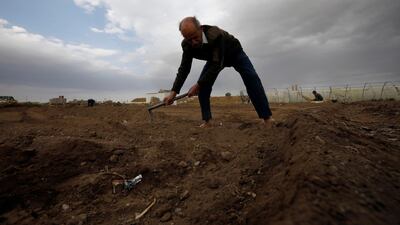
  • Sowing garlic on the outskirts of Sanaa, November 28. More than 40 percent of Yemeni households have lost their primary source of income due to the conflict. An estimated three-quarters of of Yemen's 29 million-population live on less than $2 a day. EPA
    Sowing garlic on the outskirts of Sanaa, November 28. More than 40 percent of Yemeni households have lost their primary source of income due to the conflict. An estimated three-quarters of of Yemen's 29 million-population live on less than $2 a day. EPA
  • A market in the northern district of Abs, in Yemen's Hajjah province, November 30. AFP
    A market in the northern district of Abs, in Yemen's Hajjah province, November 30. AFP
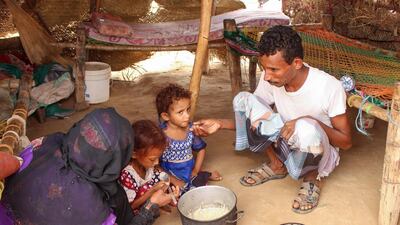
  • Samar Ali Jaidi (second from left), a seven-year-old girl suffering from malnutrition, eats with her family at a make-shift camp for displaced Yemenis, September 28, 2019. AFP
    Samar Ali Jaidi (second from left), a seven-year-old girl suffering from malnutrition, eats with her family at a make-shift camp for displaced Yemenis, September 28, 2019. AFP
  • A child stands outside a cave where a Yemeni family has sought refuge due to poverty and lack of housing, west of the suburbs of Yemen's third-city of Taez on December 2. AFP
    A child stands outside a cave where a Yemeni family has sought refuge due to poverty and lack of housing, west of the suburbs of Yemen's third-city of Taez on December 2. AFP
  • Girls at a public school on December 7. Mona Relief Yemen has distributed school bags to encourage girls to keep attending classes. The number of out-of-school children is estimated more than 2 million. EPA
    Girls at a public school on December 7. Mona Relief Yemen has distributed school bags to encourage girls to keep attending classes. The number of out-of-school children is estimated more than 2 million. EPA
  • A cemetery in Sanaa, December 4. Over 233,000 people in Yemen have been killed over the last six years. EPA
    A cemetery in Sanaa, December 4. Over 233,000 people in Yemen have been killed over the last six years. EPA
  • A cargo plane of the World Food Programme (WFP), carrying humanitarian aid prepares to land over Sanaa, November 30. EPA
    A cargo plane of the World Food Programme (WFP), carrying humanitarian aid prepares to land over Sanaa, November 30. EPA
  • A child suffering from severe malnutrition is measured at a treatment centre in Sanaa on June 22, 2019. AFP
    A child suffering from severe malnutrition is measured at a treatment centre in Sanaa on June 22, 2019. AFP
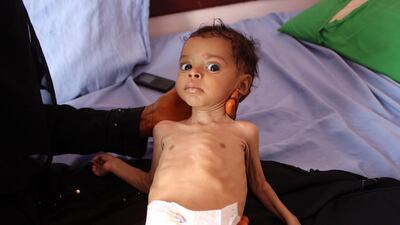
  • A child at a treatment centre for malnutrition in the country's third largest city of Taez, on November 24. AFP
    A child at a treatment centre for malnutrition in the country's third largest city of Taez, on November 24. AFP
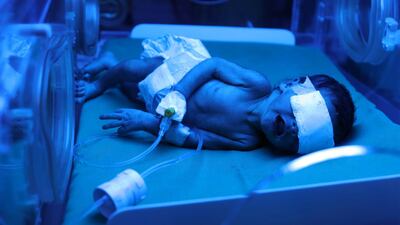
  • A newborn baby under observation in a ward for malnutritioned infants in Taez, November 24. AFP
    A newborn baby under observation in a ward for malnutritioned infants in Taez, November 24. AFP
  • A Yemeni toddler held by a woman at a clinic run by a humanitarian organisation in the port city of Hodeida, November 3, 2019. AFP
    A Yemeni toddler held by a woman at a clinic run by a humanitarian organisation in the port city of Hodeida, November 3, 2019. AFP
  • Malnourished boy Hassan Merzam Muhammad stands on a weight scale at a medical center in Abs district of Hajjah province, November 24. Reuters
    Malnourished boy Hassan Merzam Muhammad stands on a weight scale at a medical center in Abs district of Hajjah province, November 24. Reuters