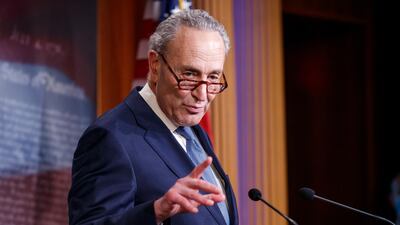
The US Senate on Tuesday unanimously approved $484 billion in additional coronavirus relief for the US economy and hospitals treating people sickened by the pandemic.
The Senate sent the bill to the House of Representatives for final passage this week.
The bill, approved by the Senate on a voice vote in a near-empty chamber, was hurried along shortly after congressional leaders and the Trump administration brokered an agreement.
The House is expected to vote on Thursday on what would be the fourth coronavirus-response law.
Together, the four measures amount to about $3 trillion (Dh11.01tn) in aid since last month to confront a crisis that has killed more than 43,000 Americans.
US President Donald Trump urged Congress to give quick approval to the measure, which mainly expands funding for loans to small businesses harmed by the pandemic, leaving extra aid for state and local governments for a later bill.
Washington earlier provided almost $350bn in loans to small businesses affected by the coronavirus.
The loans can become grants if requirements are met. Those funds were quickly exhausted.
Critics of the programme said too much of the money had gone to larger, better-connected businesses.
Senate Democratic leader Chuck Schumer said that to avoid that happening, $125bn of small business funds in the latest package would go to "mum and dad" and minority-owned stores.
Noting the "crash timeline" for passing the bill, Senate majority leader Mitch McConnell, a Republican, said it was necessary during "unprecedented times for the entire nation".
The deal includes $321bn for a small business lending programme, $60bn for a separate emergency disaster loan programme, also for small businesses, and $75bn for hospitals and $25bn for national coronavirus testing.
Mr Schumer, during a short debate, spoke of the bill's funds for fighting the coronavirus, in addition to the aid for small businesses.
"We can give loans to small businesses but if there's no customers walking the streets to go into their stores, what good is that?" he asked.
Congress already is working on a fifth coronavirus-response bill.
Mr Schumer said it could be "similar in size" to the $2.3tn economic stimulus enacted on March 27.
Washington has been confronted with a deepening crisis that has prompted Republicans and Democrats to work in a mostly bipartisan way to ease the heavy human and economic toll of a pandemic.
The coronavirus has infected more than 800,000 in the US and put more than 22 million people out of work.
The US economy has been battered as businesses closed and residents observed orders to stay at home and minimise the spread of Covid-19.
While Republicans initially insisted the latest bill provide new funding for small businesses only, the Democrats succeeded in broadening it to hospitals and other healthcare centres, and more money for coronavirus testing.
But they were not able to convince the Republicans to increase emergency federal funding for state and local governments reeling from steep revenue losses due to the virus.
They also failed to win funds for infrastructure, which they had been requesting throughout the crisis.
But Mr Trump said in a Twitter post that he would engage in talks on helping state and local governments, and look for ways to include infrastructure investments in the next bill.

