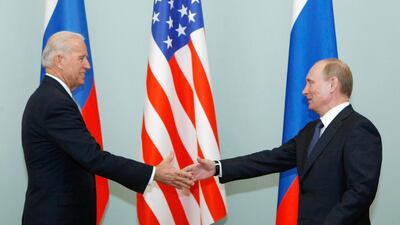
The US and Russia are working to arrange a summit next month between President Joe Biden and President Vladimir Putin in Switzerland, according to officials.
US National Security Adviser Jake Sullivan is meeting his Russian counterpart in Geneva this week to finalise details, according to an American official familiar.
Geneva is now expected to be the choice for Mr Biden's first face-to-face meeting with Mr Putin as president, according to a second official.
The Americans and Russians are aiming to hold the summit on June 15-16. An official announcement is expected in the coming days.
The meeting would come at the end of Mr Biden's first foreign trip as president, a week-long journey to Europe that includes a stop in the UK for a G7 summit and then a visit to the Brussels headquarters of Nato.
The National Security Council said this week's meeting between Mr Sullivan and the Secretary of the Russian Security Council, Nikolay Patrushev, “was an important step in the preparation for a planned US-Russia summit” and deemed the discussions “constructive” despite “outstanding differences".
The Biden administration first called for the summit last month after Russia engaged in a series of confrontational actions: temporarily amassing troops on the Ukrainian border, the SolarWinds hack, reports of bounties placed on US troops in Afghanistan and the poisoning and imprisonment of opposition leader Alexei Navalny.
Russia is also believed to be sheltering the hackers behind a May cyberattack that shut down the Colonial Pipeline, which delivers 45 per cent of the gasoline supply to the east coast of the US.
US Secretary of State Antony Blinken said the administration wants a “predictable, stable relationship” with Russia.
Mr Blinken met last week in Iceland with Russia's long-time Foreign Minister Sergey Lavrov. The two diplomats described their meeting as polite and constructive, even though sharp disagreements persist. Russia proposed a new strategic dialogue, and the US seemed receptive.
“There is a lot of rubble; it’s not easy to rake it up, but I felt that Antony Blinken and his team were determined to do this. It will not be a matter for us,” Mr Lavrov said, according to the news agency Tass.
Mr Biden has taken a very different approach to Russia than his predecessor, former president Donald Trump. Mr Trump's sole summit with Mr Putin, held in July 2018 in Helsinki, was marked by the former US president's refusal to side with US intelligence agencies over Mr Putin’s denials of Russian interference in the 2016 election.
Under Mr Biden, the US has sought to pressure Russia through economic sanctions. It imposed penalties last week on Russian companies and ships for their work on a natural gas pipeline in Europe, though the Biden administration spared the German company overseeing the project, to the frustration of several Republican and Democratic members of Congress.
In April, the administration expelled 10 Russian diplomats and placed sanctions on several dozen companies and people, an attempt to punish the Kremlin for interfering in last year’s presidential election and the SolarWinds hack that breached federal agencies and private companies.
“I was clear with President Putin that we could have gone further, but I chose not to do so – I chose to be proportionate,” Mr Biden said when announcing the sanctions on April 15. “The United States is not looking to kick off a cycle of escalation and conflict with Russia.”
But Mr Biden added that it is his duty as president to respond with further actions if Russia “continues to interfere with our democracy".
Russia responded quickly to the sanctions by ordering 10 US diplomats to leave, blacklisting eight current and former American officials and tightening requirements for US embassy operations with bans on the hiring of Russian citizens and third-country nationals.
Adding another wrinkle to the expected talks: the diversion of a Ryanair flight to Lithuania by Belarus that led to the arrest of an opposition journalist who was a passenger on the flight. President Alexander Lukashenko, Belarus's authoritarian leader, is an ally of Mr Putin's.
White House Press Secretary Jen Psaki said that Mr Sullivan brought up concerns about Belarus's actions in his talks with Mr Patrushev.
The city of Geneva became a leading crossroads of diplomacy in the postwar years of Cold War intrigue.
The city last hosted American and Russian leaders in 1985, when former president Ronald Reagan met Mikhail Gorbachev – a summit considered short on substance but critical in breaking the ice between the two foes and fostering what would become mostly friendly relations between the two men through their tenures.
A Biden-Putin meeting in Geneva could revive the reputation of the city as a hub for international diplomacy, a far cry from the Trump administration – which largely shunned its globalist institutions like the World Trade Organisation and the World Health Organisation. Mr Biden’s administration has re-engaged with both of those organisations.

