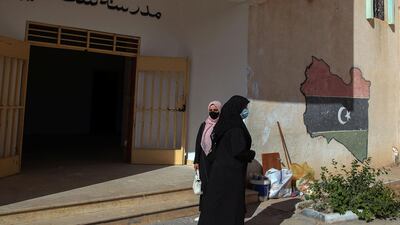
Secretary General Antonio Guterres proposed sending monitors that would oversee the ceasefire in Libya that has held since October. AFP

UN Security Council unanimously approves sending ceasefire monitors to Libya


  • English
  • Arabic

The UN Security Council unanimously voted on Friday to send up to 60 international monitors to Libya and called on its new unity government to plan for free and inclusive elections on December 24.

The council adopted Secretary General Antonio Guterres's proposal to send monitors that would oversee the ceasefire in Libya that has held since October and would join the UN mission in Libya, called UNSMIL.

“The monitors would be deployed to Sirte once all the requirements for a permanent United Nations presence have been met, including security, logistical, medical and operational aspects,” Mr Guterres wrote to the council on April 7.

The war-torn country made an agreement on March 15 to form a unity government between the east and the west. Now the UN is calling for December elections to build on that transition.

The same resolution called for the withdrawal of all foreign forces and mercenaries from Libya “without delay” and demanded full compliance with its arms embargo on Libya.

It calls for the need for constitutional and legislative backing for Libya’s new electoral process to be in place by July and parliamentary and presidential elections to take place on December 24.

Resolution 2570 calls for “full, equal and meaningful participation of women and the inclusion of youth” in the elections.

Speaking to journalists on Friday, UN spokesman Stephane Dujarric said the international body was committed to "helping the political leaders of Libya … what we want to see, is all foreign fighters leave Libya".


%3Cp%3EThe%20Department%20of%20Culture%20and%20Tourism%20-%20Abu%20Dhabi%E2%80%99s%20Arabic%20Language%20Centre%20will%20mark%20International%20Women%E2%80%99s%20Day%20at%20the%20Bologna%20Children's%20Book%20Fair%20with%20the%20Abu%20Dhabi%20Translation%20Conference.%20Prolific%20Emirati%20author%20Noora%20Al%20Shammari%2C%20who%20has%20written%20eight%20books%20that%20%20feature%20in%20the%20Ministry%20of%20Education's%20curriculum%2C%20will%20appear%20in%20a%20session%20on%20Wednesday%20to%20discuss%20the%20challenges%20women%20face%20in%20getting%20their%20works%20translated.%3C%2Fp%3E%0A
The story in numbers

18

This is how many recognised sects Lebanon is home to, along with about four million citizens

450,000

More than this many Palestinian refugees are registered with UNRWA in Lebanon, with about 45 per cent of them living in the country’s 12 refugee camps

1.5 million

There are just under 1 million Syrian refugees registered with the UN, although the government puts the figure upwards of 1.5m

73

The percentage of stateless people in Lebanon, who are not of Palestinian origin, born to a Lebanese mother, according to a 2012-2013 study by human rights organisation Frontiers Ruwad Association

18,000

The number of marriages recorded between Lebanese women and foreigners between the years 1995 and 2008, according to a 2009 study backed by the UN Development Programme

77,400

The number of people believed to be affected by the current nationality law, according to the 2009 UN study

4,926

This is how many Lebanese-Palestinian households there were in Lebanon in 2016, according to a census by the Lebanese-Palestinian dialogue committee

WHAT IS A BLACK HOLE?

1. Black holes are objects whose gravity is so strong not even light can escape their pull

2. They can be created when massive stars collapse under their own weight

3. Large black holes can also be formed when smaller ones collide and merge

4. The biggest black holes lurk at the centre of many galaxies, including our own

5. Astronomers believe that when the universe was very young, black holes affected how galaxies formed

Milestones on the road to union

1970

October 26: Bahrain withdraws from a proposal to create a federation of nine with the seven Trucial States and Qatar. 

December: Ahmed Al Suwaidi visits New York to discuss potential UN membership.

1971

March 1:  Alex Douglas Hume, Conservative foreign secretary confirms that Britain will leave the Gulf and “strongly supports” the creation of a Union of Arab Emirates.

July 12: Historic meeting at which Sheikh Zayed and Sheikh Rashid make a binding agreement to create what will become the UAE.

July 18: It is announced that the UAE will be formed from six emirates, with a proposed constitution signed. RAK is not yet part of the agreement.

August 6:  The fifth anniversary of Sheikh Zayed becoming Ruler of Abu Dhabi, with official celebrations deferred until later in the year.

August 15: Bahrain becomes independent.

September 3: Qatar becomes independent.

November 23-25: Meeting with Sheikh Zayed and Sheikh Rashid and senior British officials to fix December 2 as date of creation of the UAE.

November 29:  At 5.30pm Iranian forces seize the Greater and Lesser Tunbs by force.

November 30: Despite  a power sharing agreement, Tehran takes full control of Abu Musa. 

November 31: UK officials visit all six participating Emirates to formally end the Trucial States treaties

December 2: 11am, Dubai. New Supreme Council formally elects Sheikh Zayed as President. Treaty of Friendship signed with the UK. 11.30am. Flag raising ceremony at Union House and Al Manhal Palace in Abu Dhabi witnessed by Sheikh Khalifa, then Crown Prince of Abu Dhabi.

December 6: Arab League formally admits the UAE. The first British Ambassador presents his credentials to Sheikh Zayed.

December 9: UAE joins the United Nations.