Nasa is set for another first in the coming weeks as it plans to fly a helicopter above the surface of Mars.
If successful, it would be the first powered, controlled flight on another planet, the space agency said on Tuesday
Right now, the ultralight aircraft is fixed to the belly of the Perseverance Mars rover, which touched down on the Red Planet on February 18.

On Sunday, Perseverance dropped the debris shield that had protected Ingenuity during landing, and is making its way to the airfield where the Ingenuity Mars Helicopter will attempt its flights.
Once there, it will have 30 Martian sols – equal to 31 Earth days – to carry out its mission.
"The best guess we have right now is April 8" for the first flight, said Bob Balaram, Mars helicopter chief engineer at the Jet Propulsion Laboratory, although it could be sooner or later by a few days, he said.
Mr Balaram revealed for the first time that Ingenuity is carrying a small piece of cloth that covered one of the wings of the Wright brothers' aircraft that achieved the first powered flight on Earth at Kitty Hawk in 1903, to pay tribute to the milestone.

Ingenuity will be attempting to fly in an atmosphere that is 1 per cent the density of Earth's, which makes achieving lift harder – but will be assisted by a gravity that is one third our planet's.
The first flight will involve climbing at a rate of about one metre per second to a height of about three metres, hovering there for 30 seconds, then descending to the surface.
Ingenuity will be taking high-resolution photographs as it flies.
Before any of this happens, however, Ingenuity needs to be placed at its launching site, and set upright, a process that will take a few more days.
Once Perseverance drops off the helicopter, it needs to drive away about five metres within 25 hours so it does not cast a shadow on Ingenuity.
That is the amount of time Ingenuity's batteries will be able to run a heater without needing to recharge via its solar panels.
This part is critical to surviving the night-time temperatures, which can plunge as low as minus 90°C.
If left unheated, the helicopter's unshielded electrical components will freeze and crack, killing the mission before it even begins.
But if everything goes to plan, Perseverance will take up a position at a distance to record Ingenuity's exploits with its own cameras.
Up to five flights of gradual difficulty are planned over the course of the month.
The 1.8-kilogram rotorcraft cost Nasa about $85 million to develop, and is considered a proof of concept that could revolutionise space exploration.
Future aircraft could cover ground much more quickly than rovers, and explore more rugged terrain.
The next one planned is Dragonfly, a rotorcraft-lander that will launch in 2026 and arrive at Saturn's icy moon Titan in 2034.
-
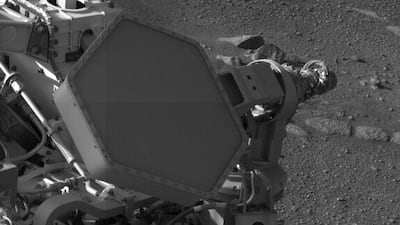
NASA's Mars Perseverance rover as it acquired this image using its onboard Left Navigation Camera (Navcam). AFP -
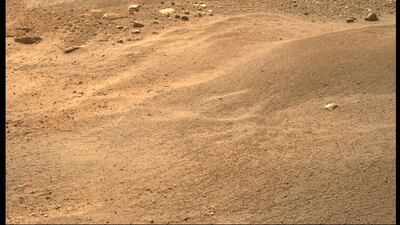
NASA's Mars Perseverance rover using its Left Mastcam-Z camera (a pair of cameras located high on the rover's mast). AFP -
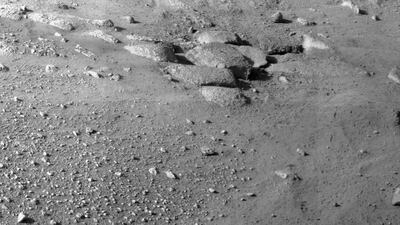
NASA's Mars Perseverance rover as it acquired this image using its onboard Right Navigation Camera (Navcam) on Mars. AFP -
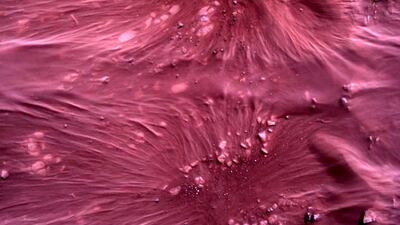
The surface of Mars directly below NASA's Mars Perseverance rover, seen using the rover's down-look camera. Nasa / JPL-Caltech / Reuters -

The surface of Mars directly below Nasa's Mars Perseverance rover, seen using the rover's down-look camera. Nasa / JPL-Caltech / Reuters -
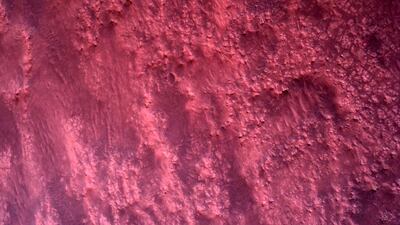
The surface of Mars directly below Nasa's Mars Perseverance rover, seen using the rover's down-look camera. Nasa / JPL-Caltech / Reuters -

The surface of Mars directly below Nasa's Mars Perseverance rover, seen using the rover's down-look camera. Nasa / JPL-Caltech / Reuters -

The surface of Mars directly below Nasa's Mars Perseverance rover, seen using the rover's down-look camera. Nasa / JPL-Caltech / Reuters -
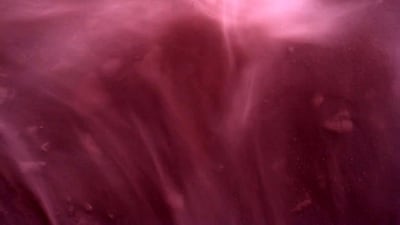
The surface of Mars directly below Nasa's Mars Perseverance rover, seen using the rover's down-look camera. Nasa / JPL-Caltech / Reuters -
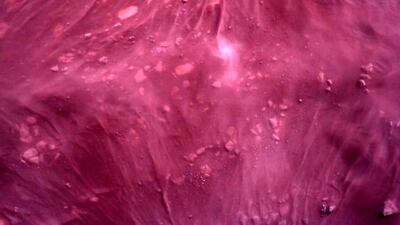
The surface of Mars directly below Nasa's Mars Perseverance rover, seen using the rover's down-look camera. Nasa / JPL-Caltech / Reuters -

The surface of Mars directly below Nasa's Mars Perseverance rover, seen using the rover's down-look camera. Nasa / JPL-Caltech / Reuters -
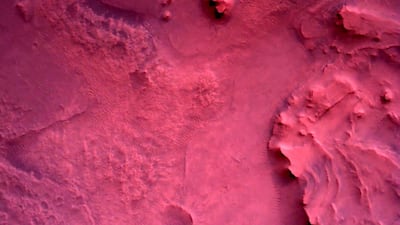
The surface of Mars directly below Nasa's Mars Perseverance rover, seen using rover's down-look camera. Nasa / JPL-Caltech / Reuters -
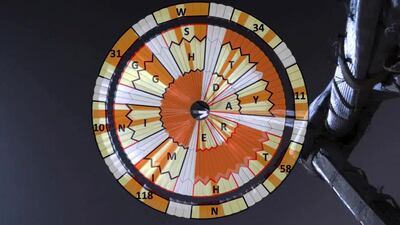
A Nasa illustration shows a diagram added over the 21-metre parachute deployed during the descent of the Perseverance rover to Mars. Systems engineer Ian Clark used binary code to spell out 'Dare Mighty Things' in the orange and white strips. Nasa / JPL-Caltech / AP -
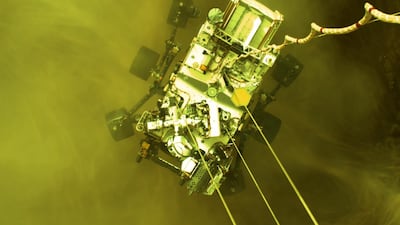
The Perseverance rover descends to the surface of Mars. A key objective of Perseverance's mission on Mars is to search for signs of ancient microbial life. Nasa / JPL-Caltech / EPA -

The heatshield drifts away following separation from Nasa's Perseverence rover, during its descent to Mars. Nasa / JPL-Caltech / EPA -
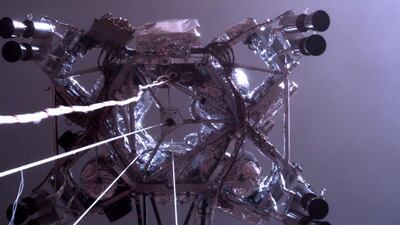
A close-up of Nasa's Perseverance rover during its descent to Mars. The rover will gather data on the planet's geology and past climate, paving the way for human exploration of the Red Planet. Nasa / JPL-Caltech / EPA -
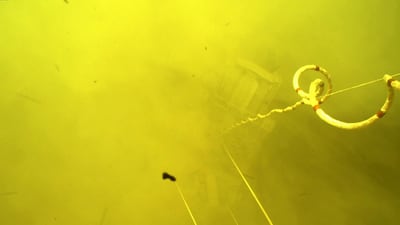
Martian dust swirls up as Nasa's Perseverance rover descends to the surface of the Red Planet. The mission aims to be the first to collect and cache Martian rock and regolith. Nasa / JPL-Caltech / EPA -
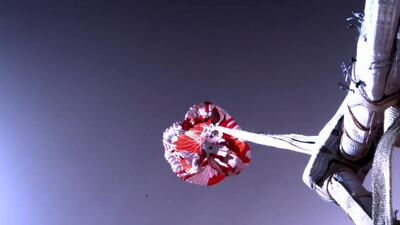
The 21-metre parachute attached to Nasa's Perseverance rover begins to open to slow down the descent to Mars. Nasa / JPL-Caltech / EPA -
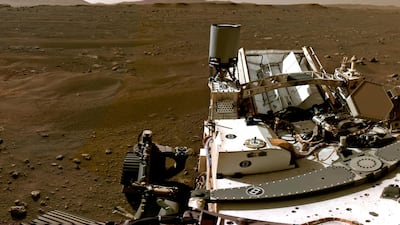
A portion of a panorama made up of individual images taken by the navigation cameras aboard Nasa's Perseverance rover reveal the Martian landscape. Nasa / JPL-Caltech / Reuters



