
The Ingenuity helicopter sent to Mars aboard Nasa's Perseverance rover is scheduled to take its first flight in less than a month.
A flight zone was selected recently, and there the two-kilogram rotor-powered machine will perform test flights in the first week of April.
The Perseverance team will reveal more details during a live media briefing on March 23.
The delicate helicopter shared a ride with the $2.5 billion Perseverance rover, resting in its chassis underneath a protective shield.
Since landing on the Jezero Crater on February 18, the rover has been driving around, capturing images and shooting lasers to study rock structures.
It is the most advanced Mars mission yet and involves breakthrough technology to seek signs that there was once on the Red Planet.
Once Ingenuity is deployed, it will be able to fly up to 300 metres from the rover for environmental monitoring and to capture images.
It can fly three to five metres high for up to 90 seconds, but will climb only one to two metres for the test flights.

Ingenuity has four carbon-fibre blades arranged in two rotors that spin in opposite directions at 2,400 rotations per minute.
The high speed helps generate enough lift to become airborne in the thin Martian atmosphere.
It has six lithium-ion batteries for power and solar panels will keep those charged.
The rover will spend its time on Mars collecting samples, which scientists hope will be returned to Earth through a joint mission by Nasa and the European Space Agency.
Perseverance landed on the Octavia E Butler Landing site, named in honour of the award-winning American science fiction writer.
Scientists chose the Jezero Crater because it is believed the location was once the site of a lake, making it ideal for the hunt of clues to ancient life.
Perseverance rover's first drive on Mars - in pictures
-
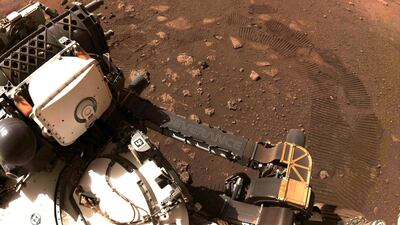
Wheel marks are left in the soil of Jezero Crater on Mars as Nasa's Perseverance rover drives on the Martian surface for the first time. Reuters -
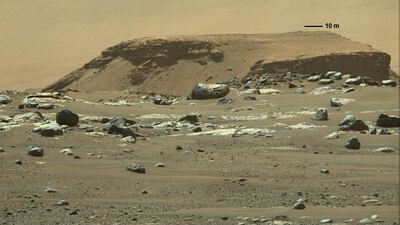
A tall outcropping of rock, with layered deposits of sediments in the distance, marking a remnant of an ancient, long-vanished river delta in Jezero Crater. Reuters -
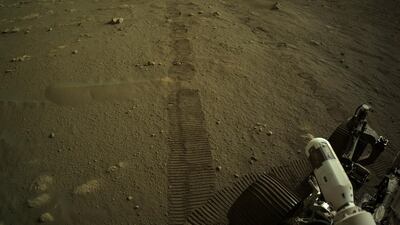
Tyre marks left by the rover as it moved for the first time since landing on Mars on February 18. EPA -

Perseverance's main mission on Mars is astrobiology and the search for signs of ancient microbial life. EPA -
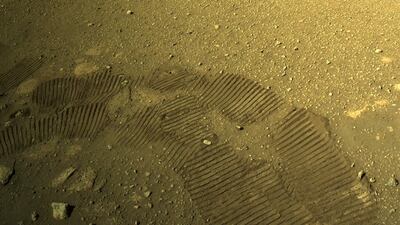
Perseverance is capable of driving 200 metres per day but Nasa engineers have additional equipment checks to run on the rover's many instruments before attempting such a distance. EPA -
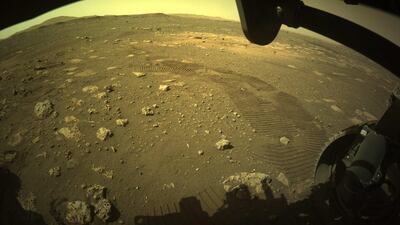
The six-wheeled, car-sized astrobiology probe travelled 6.5 metres during a half-hour test spin within Jezero Crater. EPA



