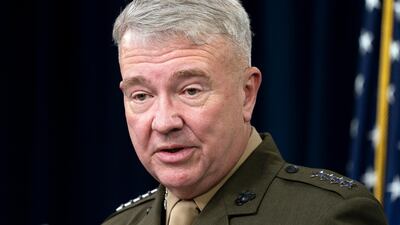
Afghanistan’s military “will certainly collapse” without some continued American support once all US troops are withdrawn, the top US general for the Middle East told Congress on Thursday.
Gen Frank McKenzie said he was also very concerned about the Afghan government’s ability to protect the US embassy in Kabul.
Gen McKenzie, head of US Central Command, said that as the US pulled out all forces, "my concern is the Afghans' ability to hold ground" and whether they could maintain and fly their aircraft without US aid and financial support.
Later, he said the US would look for “some remote, televised way” to help the Afghan security forces perform maintenance on their aircraft without having US personnel there.
“We’re certainly going to try to do everything we can from distant locations to assist the Afghans as they maintain the aircraft and other platforms that will be essential for the fight before them,” Gen McKenzie said.
“We’re going to try all kinds of innovated ways. The one thing I can tell you is, we’re not going to be there on the ground with them.”
In his testimony, he said it would be of paramount importance to protect the US embassy.
“It is a matter of great concern to me whether or not the future government of Afghanistan will be able to do that once we leave," Gen McKenzie said.
He has spent the week detailing to Congress the steep challenges facing the US military as it moves to withdraw all troops from Afghanistan by September 11, as ordered by President Joe Biden last week.
The general has painted a dire picture of the road ahead, while also avoiding any criticism of Mr Biden’s decision.
US officials have made it clear that military commanders did not recommend the full, unconditional withdrawal that Mr Biden has ordered.
Military leaders have consistently argued for a phased withdrawal based on security conditions in the country, saying that pulling troops out by a certain date eliminates pressure on the Taliban and weakens US influence in peace talks with the group.
But Gen McKenzie said the Biden administration’s “deliberate and methodical” withdrawal discussion “was heartening”, implicitly drawing a contrast with former president Donald Trump’s abrupt troop withdrawal decisions, announced on Twitter.
In public and private sessions with Congress members, Gen McKenzie has been pressed about how the US will maintain pressure on the Taliban and stop terrorist groups taking hold in Afghanistan again once the US and its coalition partners leave.
The US has more than 2,500 troops in the country. The Nato coalition has said it will follow the same timetable for withdrawing more than 7,000 allied forces.
Gen McKenzie told the Senate armed service committee on Thursday that once troops leave the country, it will take “considerably longer” than four hours to move armed drones or other aircraft in and out of Afghanistan to provide overhead surveillance or counter-terrorism strikes.
He said it would require far more aircraft than he is using now.
Defence Secretary Lloyd Austin this month told Nato that the US would continue to support the Afghans after the withdrawal.
“We will look to continue funding key capabilities such as the Afghan Air Force and Special Mission Wing, and we will seek to continue paying salaries for Afghan Security Forces,” Mr Austin said.
He and others have said the US will maintain the ability to counter terrorists in Afghanistan, but there are few details and officials say they have not yet received any diplomatic agreements for basing with any of the surrounding nations.
Gen McKenzie has declined to provide details during the public sessions.
-
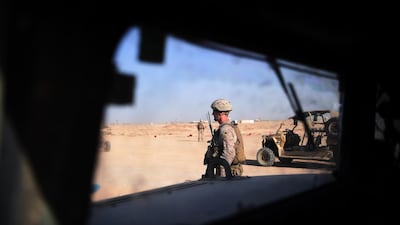
US Marines keep watch as unseen Afghan National Army soldiers participate in an IED (improvised explosive device) training exercise at the Shorab Military Camp in 2017. AFP -
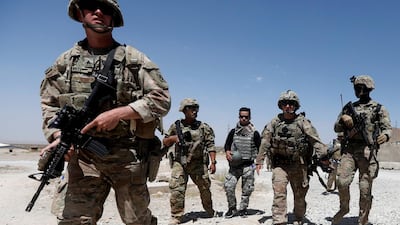
US troops patrol at an Afghan army Base in Logar province on August 7, 2018. Reuters -
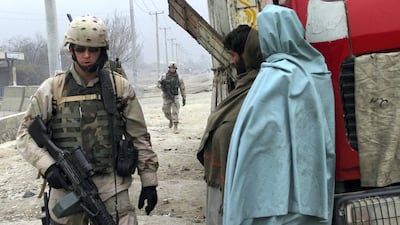
US soldiers patrol a street in central Kabul December 11, 2004. Reuters -
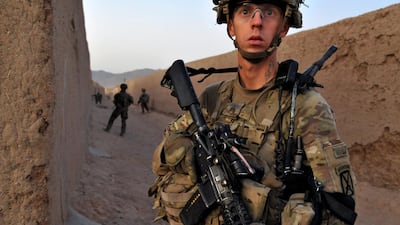
US troops under Afghanistan's International Security Assistance Force, and Afghan National Army soldiers conduct a joint security patrol in the centre of Kandalay village. AFP -
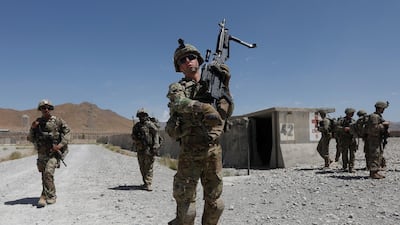
US troops patrol at an Afghan National Army (ANA) base in Logar province, Afghanistan in 2018. Reuters -
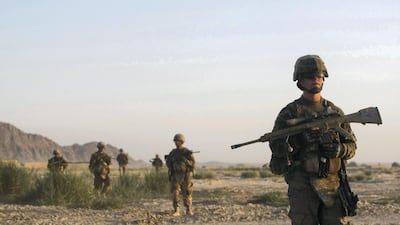
US Army soldiers patrol in the village of Chariagen in the Panjwai district of Kandahar province southern Afghanistan in 2011. Reuters -
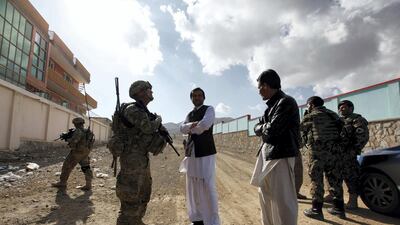
Afghan residents chat with US. Army Lieutenant Steven Gibbs as he patrols with his platoon in Pul-e Alam, a town in Logar province, eastern Afghanistan in 2011. Reuters -
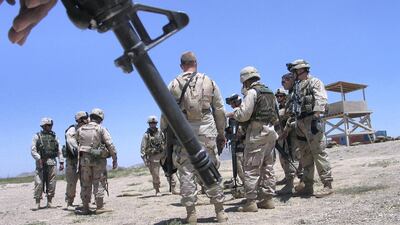
US soldiers gather during an exercise at the Kandahar airbase in Afghanistan in 2005. Reuters -
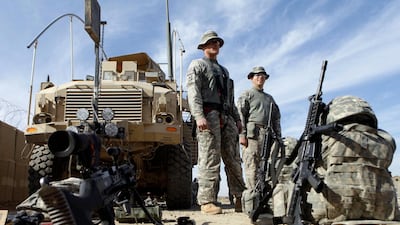
U.S. Army soldiers with 1st Brigade, 1st Cavalry Division stand near their armored vehicles before they start their journey home at Contingency Operating Site Kalsu, south of Baghdad, Iraq. AP -

A handout photo made available by the US Marine Corps shows US Marines inside the perimeter of Al Asad Air Base in Iraq. EPA -
A US soldier is seen during a handover ceremony of Taji military base from US-led coalition troops to Iraqi security forces, in the base north of Baghdad, Iraq August 23, 2020. Reuters -

US soldiers have been in Iraq for nearly two decades. AFP -
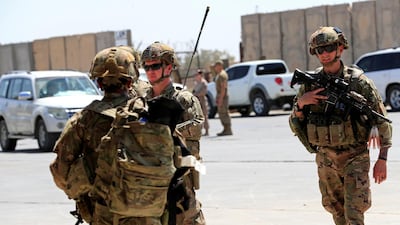
US soldiers are seen during a handover ceremony of Taji military base from US-led coalition troops to Iraqi security forces, in the base north of Baghdad, Iraq on August 23, 2020. Reuters


He said there were no decisions yet on what size of diplomatic contingent will be left at the US embassy in the Afghan capital and whether it will include a security co-operation office.
Gen McKenzie said those decisions could reflect how the US ensured the defence of the embassy. Marines often provide security at other embassies around the world.
The Pentagon has said it was not clear yet whether any US contractors would remain in the country.
The Defence Department said the number of contractors in Afghanistan started to decline over the past year.'
According to the latest numbers, there are close to 17,000 Defence Department-funded contractors in Afghanistan and fewer than a third of those were Americans.
The total included more than 2,800 private security contractors, of which more than 1,500 are armed.
Of those 1,500, about 600 are Americans.

