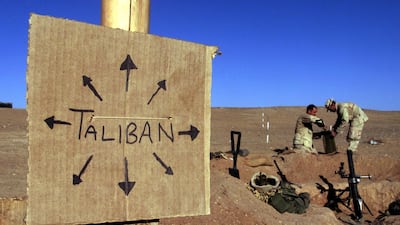
Khushal, an Afghan police officer, could not help but feel disappointed when US President Joe Biden announced the withdrawal of all American forces from Afghanistan by September 11.
“I feel betrayed,” said Khushal, 28, who like many Afghans goes only by his first name.
"They pressured us to release 5,000 Taliban prisoners, which has worsened the situation. We continue to suffer, and now in the middle of this war they are leaving us behind to deal with the mess they made," he told The National.
US and Nato officials confirmed early last week that all foreign forces will leave Afghanistan by September, an extension of five months on the previous withdrawal deadline of May 1 that was agreed to with the Taliban movement as part of their deal reached with the US last year.
-
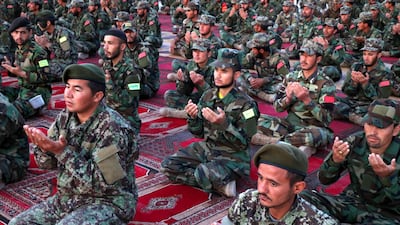
Soldiers of the Afghan National Army pray after breaking the fast during the Muslim holy month of Ramadan in Herat, western Afghanistan. Ramadan is the ninth month in the Islamic calendar and it is believed that the revelation of the first verse of the Quran was made to the Prophet Mohammed during the last 10 nights of the month. EPA -
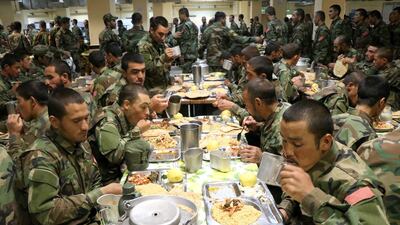
Iftar for soldiers of the Afghan National Army as they break their fast at their base in Herat, western Afghanistan. Muslims celebrate Ramadan with prayer and by abstaining from eating and drinking between sunrise and sunset. EPA -
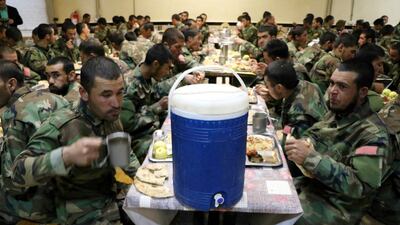
Food and water for troops of the Afghan National Army as they break the Ramadan fast at their base in Herat, western Afghanistan. EPA -
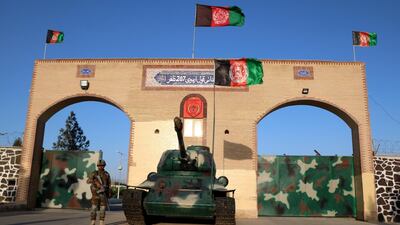
A soldier of the Afghan National Army stands guard outside Herat military base, home of 207th Corps, during the holy month of Ramadan. EPA -
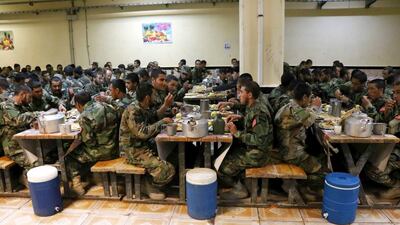
Soldiers of Afghan National Army break the Ramadan fast at their military base in Herat, western Afghanistan. EPA -
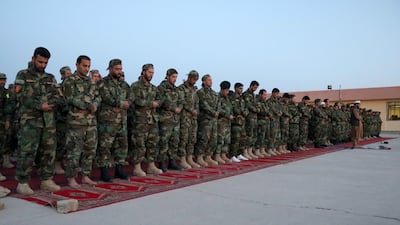
Afghan National Army soldiers pray after breaking the fast during the holy month of Ramadan at their base in Herat, western Afghanistan. EPA -
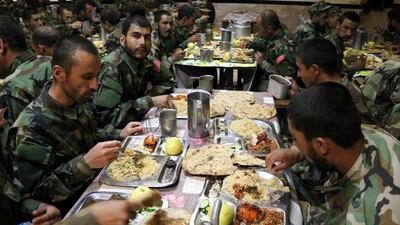
Iftar for Afghan National Army soldiers as they break the Ramadan fast at their base in Herat, western Afghanistan. EPA


The young police officer from Kandahar has been fighting the American war against the Taliban for most of his adult life. Now he fears for the future of his country after the foreign troop withdrawal.
“Sure, they helped us in many ways, but they also contributed to our destruction,” he said.
Many Afghans fear that the full withdrawal of foreign troops will embolden the Taliban and spread instability and chaos in an already fragile country.
“The level of co-operation that the Afghan forces received through the 'training, advise and assist' mission will be reduced. That will impact the Afghan forces,” said Abdul Hai Rauf, the former deputy minister of defence.
Mr Rauf also predicted a massive surge in violence in the coming weeks, which will increase pressure on the forces.
“We saw this in the past as well. This happened when the Russians left and the country went into a civil war. So it is justified for Afghans to worry about similar scenarios,” he said.
But President Ashraf Ghani expressed faith in the capacity of Afghan troops to defend the state after the foreign troop pullout.
“Afghanistan’s proud security and defence forces are fully capable of defending its people and country, which they have been doing all along, and for which the Afghan nation will forever remain grateful,” he said.
His words, however, fail to soothe the concerns of many even within the security ranks, where the withdrawal is likely to affect morale.
“There’s no question that the Afghan forces are capable. In recent years, they have been managing most operations by themselves, and only a few are supported by Nato forces in an advisory capacity,” a senior security official said.
“However, I have serious doubts about Afghan commanders who lack qualities to lead their forces in battle,” the official said.
But some Afghan soldiers are confident they will cope.
-
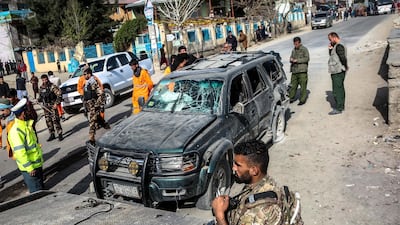
Security officials gather in the aftermath of a bomb explosion in Kabul, Afghanistan, on 18 March 2021. At least four people were killed and eleven others injured after a magnetic improvised explosive device (IED), targeting a minibus carrying employees of the Ministry of Communication and Information Technology, went off in Kabul. Hedayatullah Amid / EPA -
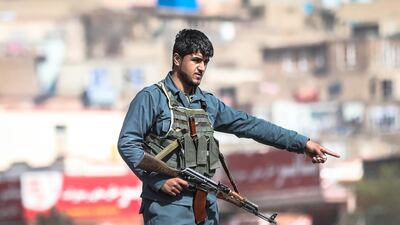
An Afghan security official inspects the scene in the aftermath of a bomb explosion in Kabul, Afghanistan, on 18 March 2021. Hedayatullah Amid / EPA -
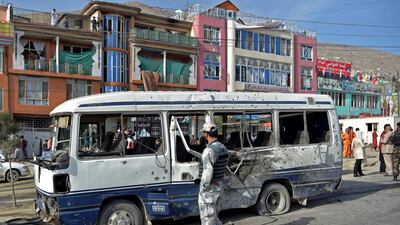
A security worker is seen near a damaged vehicle after a blast in Kabul on March 18, 2021. Wakil Kohsar / AFP -
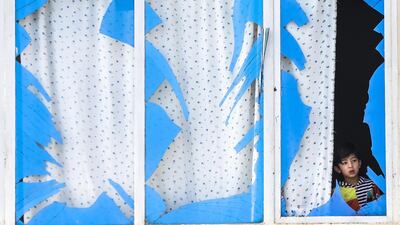
A boy looks out of a shattered window in the aftermath of a bomb explosion in Kabul, Afghanistan, on 18 March 2021. Hedayatullah Amid / EPA -
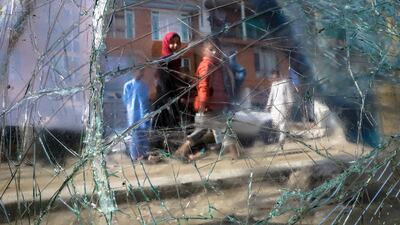
People are seen through a broken car window in the aftermath of a bomb explosion in Kabul, Afghanistan, on 18 March 2021. Hedayatullah Amid / EPA -
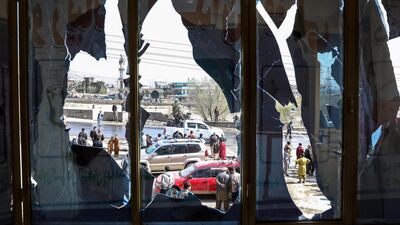
Shattered windows in the aftermath of a bomb explosion in Kabul, Afghanistan, on 18 March 2021. Hedayatullah Amid / EPA -
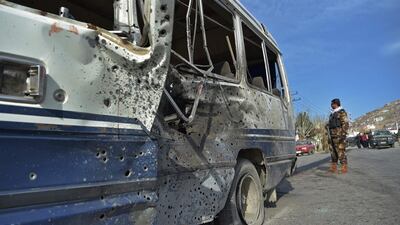
A security worker is seen near a damaged vehicle after a blast in Kabul on March 18, 2021. Wakil Kohsar / AFP -
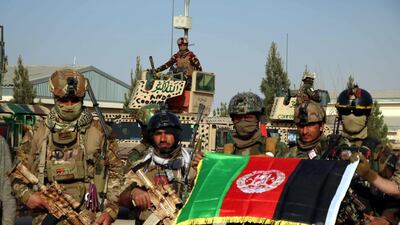
Afghan security officials pose in the Karokh district of Herat after suspected Taliban militants were killed in an attack on Pashtan Dam in Afghanistan on 16 March 2021. At least three Afghan soldiers and eight Taliban militants were killed in the incident. Jalil Rezayee / EPA -
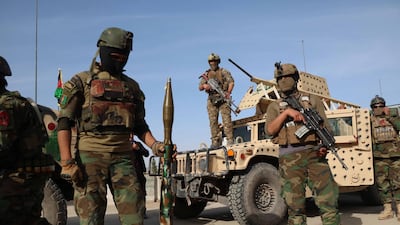
Afghan security officials pose in the Karokh district of Herat, Afghanistan, on 16 March 2021. EPA


“Americans got what they wanted. They killed the Al Qaeda founder and other insurgent leaders. But in that time, they have trained us and I am very confident about inheriting the full responsibility of the war,” said Ahmad Shah, 33, an officer in the 215 Kandahar Corps, a unit of the Afghan army trained by Nato forces.
“Our operations used to be planned by foreign forces but recently we have been planning and conducting them alone. I call on Afghans to continue their daily activities without fear, we are here to defend you,” he said.
Despite the bitterness, Khushal, the police officer, agreed.
“Maybe it is a good opportunity that the US troops are leaving. It will give us the chance to take charge of our country’s security. We have been preparing for this,” he said.

