


The US on Thursday reluctantly announced a court-ordered reimplementation of a Trump-era policy requiring asylum seekers to stay in Mexico as they await immigration hearings.
Formerly known as the Migrant Protection Protocols programme, the “Remain in Mexico” policy will be reinstated along the southern US border beginning next week.
About 70,000 asylum seekers have been subjected to the policy, which former president Donald Trump introduced in January 2019. President Joe Biden suspended it on his first day in office, calling the policy “inhumane".
A lawsuit brought by the US states of Texas and Missouri has forced Mr Biden to put it back into effect.
-

A Honduran migrant boy looks thorugh the fence of a warehouse used as shelter in Piedras Negras, Coahuila, Mexico, on the border with the US. AFP -

A Border Patrol unit drives near a section of reinforced US-Mexico border fence seen from Tijuana, Baja California state, Mexico. AFP -

A dog barks while standing next to the border fence between Mexico and the US. Reuters -

Central American migrants try to cross the Rio Grande, which divides the cities of Eagle Pass, in Texas and Piedras Negras, in Coahuila state, Mexico. AFP -

Members of the Beta group of Mexican National Institute of Migration, dedicated to the protection and defence of human rights of migrants, rescue a Honduran migrant child trying to cross the Rio Grande. AFP -

Honduran migrants try to cross the Rio Grande. AFP -
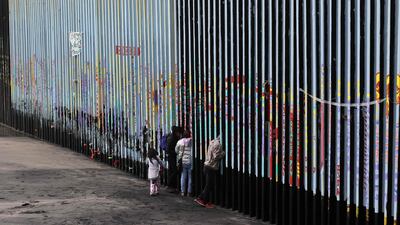
A family of Central American migrants look through the US-Mexico border fence, as seen from Playas de Tijuana. AFP -

Members of the Beta group of Mexican National Institute of Migration, dedicated to the protection and defense of human rights of migrants, rescue a Central American migrant child and a woman trying to cross the Rio Grande. AFP -
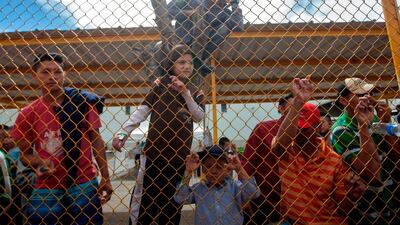
Central American migrants remain at a warehouse used as shelter in Piedras Negras, Coahuila, Mexico. AFP -

Central American migrants remain at a warehouse used as shelter in Piedras Negras, Coahuila, Mexico. AFP -

Central American migrants pass food through the fence. AFP -

A migrant is held by US border patrol agents after climbing the US side of the Rio Grande. -

A Border Patrol unit remains near a section of reinforced US-Mexico border fence seen from Tijuana, Baja California state, Mexico. AFP -

An U.S. Customs and Border Protection van in El Paso. Reuters -

An U.S. Customs and Border Protection van in El Paso. Reuters


The US Department of Homeland Security said it would comply with the court order, but Secretary Alejandro Mayorkas strongly stated that the programme had “endemic flaws, imposed unjustifiable human costs, pulled resources and personnel away from other priority efforts and failed to address the root causes of irregular migration".
The department said the programme will be terminated once the court injunction is lifted.
At a congressional hearing last month, Mr Mayorkas said the country's immigration system was “broken” and criticised Mr Trump's immigration policies. He said he believes the Biden administration has taken steps that reflect America's “values as a nation".
Mr Mayorkas's department announced several changes in the programme, including a commitment to speedier court proceedings, opportunities for those enrolled in the programme to receive legal counsel for non-refoulment interviews and hearings as well as greater access to information about the programme.
The department will also provide Covid-19 vaccinations to those enrolled.
In a press release last week, Mexico said “vulnerable” people — including unaccompanied minors, pregnant women, people with physical or mental illnesses, the elderly and others — should be exempt from the programme.
Illegal border crossings fell sharply after Mexico, when facing Mr Trump’s threat of higher tariffs, acquiesced in 2019 to the policy’s rapid expansion. Asylum seekers are frequent victims of abuse and violence while waiting in Mexico and are forced to navigate a series of legal obstacles, such as access to lawyers and case information.
The Associated Press contributed to this report

