Ethiopian soldiers rest at the 5th Battalion of the Northern Command of the Ethiopian Army in Dansha, Ethiopia. AFP

Sudan blames Ethiopia for civilian deaths amid fears of new conflict


Hamza Hendawi
  • English
  • Arabic

Sudan says government-backed Ethiopian militiamen killed five women and a child during a raid just inside its territory, further fuelling tension in the border region.

On Wednesday, Sudan warned of “dangerous consequences” for bilateral relations after an Ethiopian warplane breached Sudanese airspace in the border area, according to a foreign ministry statement. It did not specify the type of Ethiopian aircraft or say how long it stayed inside Sudanese airspace.

“The Foreign Ministry condemns this escalation by the Ethiopian side and demand that such acts are not repeated in the future,” it said.

Also on Wednesday, a Sudanese military helicopter crashed while attempting to land at an airport in the eastern Qadaref region at the end of what the military said was a reconnaissance mission. The two-man crew, both flight captains, survived the crash, it added without giving more details. It was not immediately clear whether the helicopter crew’s mission was related in any way to the tension on the border with Ethiopia.

Ethiopia’s alleged aerial intrusion came one day after Addis Ababa warned Khartoum that it was running out of patience with its continued military build-up in the border region, an area at the centre of a decades-old territorial dispute.

The two countries have been sharply at odds over a Nile dam being built by Ethiopia.

We ask of Ethiopia to stop attacking Sudanese territory and Sudanese farmers

Ethiopia warned Sudan that it was running out of patience with its continued military build-up in the border region, an area at the centre of a decades-old territorial dispute.

The area in question, Al Fashqa, is within Sudan's international boundaries, but has long been settled by Ethiopian farmers, and late last year suffered weeks of clashes between forces from the two sides.

"The Sudanese side seems to be pushing in so as to inflame the situation on the ground," Ethiopian foreign ministry spokesman Dina Mufti said on Tuesday. "Is Ethiopia going to start a war? Well, we are saying let's work on diplomacy."

On the same day, Sudan's foreign ministry strongly condemned the militia raid in its eastern breadbasket Qadaref region and called on the international community to work for the cessation of such actions.

It blamed the raid on the Al Shifta militia, an outfit widely believed to enjoy the informal backing of the Ethiopian military.

Two Sudanese women were also missing after the Monday raid, the government said.

Monday's raid was the latest in a series of violent incidents in recent weeks in the border region. Sudanese troops moved to retake border areas long held by Ethiopia and defended by government-linked militias, who also allegedly operate smuggling rings.

The fighting in Ethiopia's Tigray region forced at least 50,000 of its residents to flee their homes and seek refuge in Sudan.

Ethiopia accuses the Sudanese military of infiltrating its territory, saying Sudan was seeking to take advantage of the conflict against separatist rebels in Tigray.

A view of the Sudanese village of Um Rakuba, home to over 20,000 Ethiopian refugees, on January 7, 2021. Getty

Sudan’s information minister Faisal Saleh denied the Ethiopian charges.

"We fear that these comments contain a hostile position towards Sudan," Mr Saleh said.

"We ask of Ethiopia to stop attacking Sudanese territory and Sudanese farmers."

He also said late on Tuesday that a joint committee set up last month to resolve differences over the border has so far failed to make any progress.

Sudan and Ethiopia have long had problems along their porous border, whose demarcation was determined in agreements reached early in the last century. The two countries are bound by close cultural ties but, in various conflicts since the 1950s, both sides have supported rebel groups fighting the other’s government.

The latest round of tension on the Sudanese-Ethiopian border, however, comes at a critical time in relations.

Water wars? 

The latest round of tension on the border, however, comes at a critical time in relations.

Sudan is seething over Ethiopia's recent announcement that it would go ahead with a second filling of the water reservoir behind the Grand Ethiopian Renaissance Dam, starting this summer.

According to Addis Ababa, this would happen regardless of whether an agreement on the operation of the dam was reached with downstream Sudan and Egypt. Ethiopia began the initial filling of the dam last summer, without giving prior notice to either Egypt or Sudan.

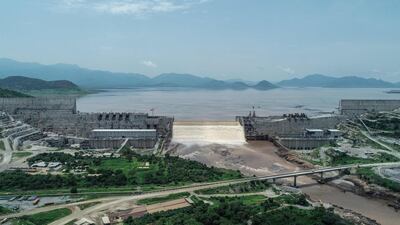
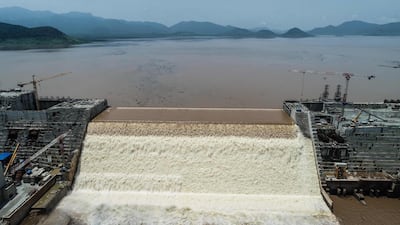
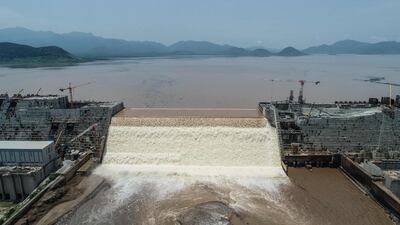
The nearly complete hydroelectric dam, Africa’s largest, is built less than 20 kilometres from the border with Sudan and on completion, is expected to generate 6,000 megawatts of power.

For Sudan, the absence of co-ordination on the operation of the dam could potentially spell disaster for its eastern region, through flooding and the disablement of its own hydroelectric dams on the Nile. For Egypt, the dam could mean a significant reduction in its vital share of the Nile’s waters, something Cairo says it will not tolerate.

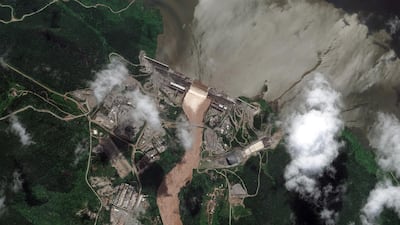
  • A satellite image shows the Grand Ethiopian Renaissance Dam on the Blue Nile river in the Benishangul-Gumuz region of Ethiopia on Tuesday, July 28, 2020. Maxar Technologies via AP
    A satellite image shows the Grand Ethiopian Renaissance Dam on the Blue Nile river in the Benishangul-Gumuz region of Ethiopia on Tuesday, July 28, 2020. Maxar Technologies via AP
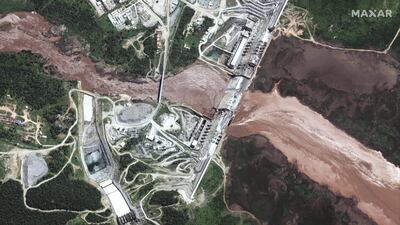
  • A satellite image of the Grand Ethiopian Renaissance Dam and reservoir behind it on June 26, 2020. Maxar Technologies via Reuters
    A satellite image of the Grand Ethiopian Renaissance Dam and reservoir behind it on June 26, 2020. Maxar Technologies via Reuters
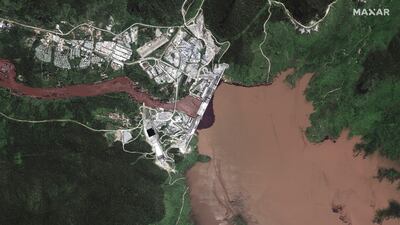
  • A satellite image of the Grand Ethiopian Renaissance Dam and reservoir behind it 16 days later on July 12, 2020. Maxar Technologies via Reuters
    A satellite image of the Grand Ethiopian Renaissance Dam and reservoir behind it 16 days later on July 12, 2020. Maxar Technologies via Reuters
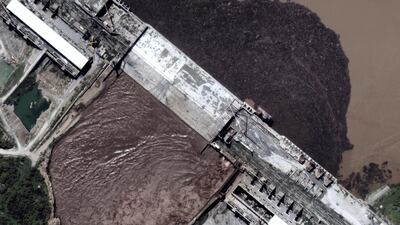
  • The Grand Ethiopian Renaissance Dam and the Blue Nile River in Ethiopia on July 12, 2020. Maxar Technologies via Reuters
    The Grand Ethiopian Renaissance Dam and the Blue Nile River in Ethiopia on July 12, 2020. Maxar Technologies via Reuters
  • An aerial view Grand Ethiopian Renaissance Dam on the Blue Nile River in Guba, northwest Ethiopia, on the 20th July. AFP
    An aerial view Grand Ethiopian Renaissance Dam on the Blue Nile River in Guba, northwest Ethiopia, on the 20th July. AFP
  • An aerial view Grand Ethiopian Renaissance Dam on the Blue Nile River in Guba, northwest Ethiopia, on the 20th July. AFP
    An aerial view Grand Ethiopian Renaissance Dam on the Blue Nile River in Guba, northwest Ethiopia, on the 20th July. AFP
  • An aerial view Grand Ethiopian Renaissance Dam on the Blue Nile River in Guba, northwest Ethiopia, on the 20th July. AFP
    An aerial view Grand Ethiopian Renaissance Dam on the Blue Nile River in Guba, northwest Ethiopia, on the 20th July. AFP

Sudan and Egypt have been trying to persuade Ethiopia to enter a legally binding deal on the operation of the dam as well as agree on mechanisms for resolving future disputes. Ethiopia favours recommendations, rather than a binding deal.

The latest round of negotiations on the dam collapsed this week when Sudan insisted that experts from the African Union be given a greater role in drafting an agreement.

Ethiopia and Egypt rejected the suggestion, insisting the three nations must maintain ownership of the negotiating process.

Ziina users can donate to relief efforts in Beirut

Ziina users will be able to use the app to help relief efforts in Beirut, which has been left reeling after an August blast caused an estimated $15 billion in damage and left thousands homeless. Ziina has partnered with the United Nations High Commissioner for Refugees to raise money for the Lebanese capital, co-founder Faisal Toukan says. “As of October 1, the UNHCR has the first certified badge on Ziina and is automatically part of user's top friends' list during this campaign. Users can now donate any amount to the Beirut relief with two clicks. The money raised will go towards rebuilding houses for the families that were impacted by the explosion.”

Key facilities
  • Olympic-size swimming pool with a split bulkhead for multi-use configurations, including water polo and 50m/25m training lanes
  • Premier League-standard football pitch
  • 400m Olympic running track
  • NBA-spec basketball court with auditorium
  • 600-seat auditorium
  • Spaces for historical and cultural exploration
  • An elevated football field that doubles as a helipad
  • Specialist robotics and science laboratories
  • AR and VR-enabled learning centres
  • Disruption Lab and Research Centre for developing entrepreneurial skills
In-demand jobs and monthly salaries
  • Technology expert in robotics and automation: Dh20,000 to Dh40,000 
  • Energy engineer: Dh25,000 to Dh30,000 
  • Production engineer: Dh30,000 to Dh40,000 
  • Data-driven supply chain management professional: Dh30,000 to Dh50,000 
  • HR leader: Dh40,000 to Dh60,000 
  • Engineering leader: Dh30,000 to Dh55,000 
  • Project manager: Dh55,000 to Dh65,000 
  • Senior reservoir engineer: Dh40,000 to Dh55,000 
  • Senior drilling engineer: Dh38,000 to Dh46,000 
  • Senior process engineer: Dh28,000 to Dh38,000 
  • Senior maintenance engineer: Dh22,000 to Dh34,000 
  • Field engineer: Dh6,500 to Dh7,500
  • Field supervisor: Dh9,000 to Dh12,000
  • Field operator: Dh5,000 to Dh7,000

In Full Flight: A Story of Africa and Atonement
John Heminway, Knopff

The Library: A Catalogue of Wonders
Stuart Kells, Counterpoint Press

What can victims do?

Always use only regulated platforms

Stop all transactions and communication on suspicion

Save all evidence (screenshots, chat logs, transaction IDs)

Report to local authorities

Warn others to prevent further harm

Courtesy: Crystal Intelligence

How to apply for a drone permit
  • Individuals must register on UAE Drone app or website using their UAE Pass
  • Add all their personal details, including name, nationality, passport number, Emiratis ID, email and phone number
  • Upload the training certificate from a centre accredited by the GCAA
  • Submit their request
What are the regulations?
  • Fly it within visual line of sight
  • Never over populated areas
  • Ensure maximum flying height of 400 feet (122 metres) above ground level is not crossed
  • Users must avoid flying over restricted areas listed on the UAE Drone app
  • Only fly the drone during the day, and never at night
  • Should have a live feed of the drone flight
  • Drones must weigh 5 kg or less
Dengue%20fever%20symptoms
%3Cul%3E%0A%3Cli%3EHigh%20fever%3C%2Fli%3E%0A%3Cli%3EIntense%20pain%20behind%20your%20eyes%3C%2Fli%3E%0A%3Cli%3ESevere%20headache%3C%2Fli%3E%0A%3Cli%3EMuscle%20and%20joint%20pains%3C%2Fli%3E%0A%3Cli%3ENausea%3C%2Fli%3E%0A%3Cli%3EVomiting%3C%2Fli%3E%0A%3Cli%3ESwollen%20glands%3C%2Fli%3E%0A%3Cli%3ERash%3C%2Fli%3E%0A%3C%2Ful%3E%0A%3Cp%3EIf%20symptoms%20occur%2C%20they%20usually%20last%20for%20two-seven%20days%3C%2Fp%3E%0A
Key findings of Jenkins report
  • Founder of the Muslim Brotherhood, Hassan al Banna, "accepted the political utility of violence"
  • Views of key Muslim Brotherhood ideologue, Sayyid Qutb, have “consistently been understood” as permitting “the use of extreme violence in the pursuit of the perfect Islamic society” and “never been institutionally disowned” by the movement.
  • Muslim Brotherhood at all levels has repeatedly defended Hamas attacks against Israel, including the use of suicide bombers and the killing of civilians.
  • Laying out the report in the House of Commons, David Cameron told MPs: "The main findings of the review support the conclusion that membership of, association with, or influence by the Muslim Brotherhood should be considered as a possible indicator of extremism."
Company%C2%A0profile
%3Cp%3E%3Cstrong%3ECompany%20name%3A%20%3C%2Fstrong%3Eamana%3Cbr%3E%3Cstrong%3EStarted%3A%20%3C%2Fstrong%3E2010%3Cbr%3E%3Cstrong%3EFounders%3A%3C%2Fstrong%3E%20Karim%20Farra%20and%20Ziad%20Aboujeb%3Cbr%3E%3Cstrong%3EBased%3A%20%3C%2Fstrong%3EUAE%3Cbr%3E%3Cstrong%3ERegulator%3A%20%3C%2Fstrong%3EDFSA%3Cbr%3E%3Cstrong%3ESector%3A%20%3C%2Fstrong%3EFinancial%20services%3Cbr%3E%3Cstrong%3ECurrent%20number%20of%20staff%3A%20%3C%2Fstrong%3E85%3Cbr%3E%3Cstrong%3EInvestment%20stage%3A%20%3C%2Fstrong%3ESelf-funded%3Cbr%3E%3C%2Fp%3E%0A

Mercer, the investment consulting arm of US services company Marsh & McLennan, expects its wealth division to at least double its assets under management (AUM) in the Middle East as wealth in the region continues to grow despite economic headwinds, a company official said.

Mercer Wealth, which globally has $160 billion in AUM, plans to boost its AUM in the region to $2-$3bn in the next 2-3 years from the present $1bn, said Yasir AbuShaban, a Dubai-based principal with Mercer Wealth.

Within the next two to three years, we are looking at reaching $2 to $3 billion as a conservative estimate and we do see an opportunity to do so,” said Mr AbuShaban.

Mercer does not directly make investments, but allocates clients’ money they have discretion to, to professional asset managers. They also provide advice to clients.

“We have buying power. We can negotiate on their (client’s) behalf with asset managers to provide them lower fees than they otherwise would have to get on their own,” he added.

Mercer Wealth’s clients include sovereign wealth funds, family offices, and insurance companies among others.

From its office in Dubai, Mercer also looks after Africa, India and Turkey, where they also see opportunity for growth.

Wealth creation in Middle East and Africa (MEA) grew 8.5 per cent to $8.1 trillion last year from $7.5tn in 2015, higher than last year’s global average of 6 per cent and the second-highest growth in a region after Asia-Pacific which grew 9.9 per cent, according to consultancy Boston Consulting Group (BCG). In the region, where wealth grew just 1.9 per cent in 2015 compared with 2014, a pickup in oil prices has helped in wealth generation.

BCG is forecasting MEA wealth will rise to $12tn by 2021, growing at an annual average of 8 per cent.

Drivers of wealth generation in the region will be split evenly between new wealth creation and growth of performance of existing assets, according to BCG.

Another general trend in the region is clients’ looking for a comprehensive approach to investing, according to Mr AbuShaban.

“Institutional investors or some of the families are seeing a slowdown in the available capital they have to invest and in that sense they are looking at optimizing the way they manage their portfolios and making sure they are not investing haphazardly and different parts of their investment are working together,” said Mr AbuShaban.

Some clients also have a higher appetite for risk, given the low interest-rate environment that does not provide enough yield for some institutional investors. These clients are keen to invest in illiquid assets, such as private equity and infrastructure.

“What we have seen is a desire for higher returns in what has been a low-return environment specifically in various fixed income or bonds,” he said.

“In this environment, we have seen a de facto increase in the risk that clients are taking in things like illiquid investments, private equity investments, infrastructure and private debt, those kind of investments were higher illiquidity results in incrementally higher returns.”

The Abu Dhabi Investment Authority, one of the largest sovereign wealth funds, said in its 2016 report that has gradually increased its exposure in direct private equity and private credit transactions, mainly in Asian markets and especially in China and India. The authority’s private equity department focused on structured equities owing to “their defensive characteristics.”

The specs
  • Engine: 3.9-litre twin-turbo V8
  • Power: 640hp
  • Torque: 760nm
  • On sale: 2026
  • Price: Not announced yet