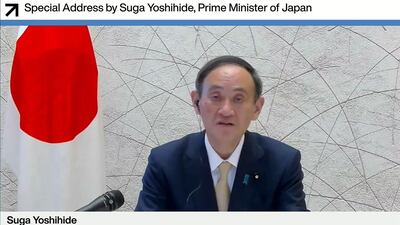
Japan's Prime Minister Yoshihide Suga, addressing an all-virtual World Economic Forum, which usually takes place in Davos, Switzerland. AFP

Prime Minister Yoshihide Suga outlines a green and digital future for Japan


Soraya Ebrahimi
  • English
  • Arabic

The Japanese Prime Minister hailed his country’s world-leading green drive to boost economy during his speech at the WEF Summit on Friday.

Yoshihide Suga began his address by explaining his country’s response to the coronavirus pandemic, as well as his plans for the environment, digitalisation, free trade and the Olympics.

The prime minister acknowledged that the coronavirus crisis was affecting the health and lives of Japanese people, as well as business and the economy.

He said: “I am resolved that I am going to find an answer to the difficult challenges and lead the world by growing the Japanese economy.”

Mr Suga vowed to do the “utmost for the closure of this pandemic. I'm determined to ride over this difficulty, no one's health is left behind.”

He said that with the season being winter, the number of new cases was still high in Japan.

“We want to get the infection (rate) and Covid-19 pandemic under control as quickly as possible to enable people to regain a safe lifestyle,” Mr Suga said.

He highlighted how Japan had bolstered vaccine supply for developing nations by pledging more than $130 million.

Mr Suga then outlined plans to build a new engine for the growth that would propel the Japanese and global economy – a green and digital country.

“My administration declared last year that we go carbon neutral by 2050,” Mr Suga said. He expects this green revolution to create jobs for 15 million people.

“We will be moving forward with decisive enhancements of renewable energy, such as hydrogen and ocean windfarm, and regarding electric vehicles we plan that by 2035 all new vehicle sales will be 100 per cent electric,” he said.

The prime minister explained his vision for digitalisation, saying the pandemic has presented severe challenges but that plans will now be accelerated.

He said a digital agency will be established as the command centre directly reporting to him and it will commence its activities in autumn, helping to create a technologically progressive Japan.

“We will work with all our efforts so that Japan is a nation of science and technology that can lead the world with our innovation, even in a post Covid-era,” Mr Suga said.

The prime minister emphasised his “unwavering commitment to free trade” and pledged that Japan will lead efforts towards expanding free and fair economic areas and strengthening rules for a multilateral free trading system.

Referring to the World Trade Organisation, Mr Suga said: “While we continue to proactively work on WTO reform, we will show our leadership in realising what we call free flow of data with trust through the e-commerce negotiation at WTO.”

Of his country's relations with the Indo-Pacific nations, he said: “Japan will collaborate with like-minded countries and strategically promote our efforts to make free and open Indo-Pacific concept a reality.”

The prime minister stressed the importance of multilateralism and said that Japan will “work together with the international community to live up to the challenge of global issues in order to realise a united world”.

Mr Suga also highlighted Japan’s role as host of the Olympic Games saying that he is resolved to deliver it in a safe and secure manner.

The prime minister said: “The future beyond is full of hope. The Olympic (Games) will offer hope and courage to the whole world as a testimony of mankind prevailing over Covid-19 – and as a symbol of the unity of the world.”

The Olympics were due to be staged in Japan in 2020 but were cancelled because of the coronavirus outbreak. The event is now scheduled to take place from July 23.


BRIEF SCORES

England 353 and 313-8 dec
(B Stokes 112, A Cook 88; M Morkel 3-70, K Rabada 3-85)  
(J Bairstow 63, T Westley 59, J Root 50; K Maharaj 3-50)
South Africa 175 and 252
(T Bavuma 52; T Roland-Jones 5-57, J Anderson 3-25)
(D Elgar 136; M Ali 4-45, T Roland-Jones 3-72)

Result: England won by 239 runs
England lead four-match series 2-1

UPI facts

More than 2.2 million Indian tourists arrived in UAE in 2023
More than 3.5 million Indians reside in UAE
Indian tourists can make purchases in UAE using rupee accounts in India through QR-code-based UPI real-time payment systems
Indian residents in UAE can use their non-resident NRO and NRE accounts held in Indian banks linked to a UAE mobile number for UPI transactions

THE SPECS

Engine: 1.5-litre, four-cylinder turbo

Transmission: seven-speed dual clutch automatic

Power: 169bhp

Torque: 250Nm

Price: Dh54,500

On sale: now

The specs

Engine: 3.8-litre, twin-turbo V8

Transmission: eight-speed automatic

Power: 582bhp

Torque: 730Nm

Price: Dh649,000

On sale: now  

The specs

Engine: 2.0-litre 4-cylinder turbo

Power: 258hp from 5,000-6,500rpm

Torque: 400Nm from 1,550-4,000rpm

Transmission: Eight-speed auto

Fuel consumption: 6.1L/100km

Price: from Dh362,500

On sale: now

Ten tax points to be aware of in 2026

1. Domestic VAT refund amendments: request your refund within five years

If a business does not apply for the refund on time, they lose their credit.

2. E-invoicing in the UAE

Businesses should continue preparing for the implementation of e-invoicing in the UAE, with 2026 a preparation and transition period ahead of phased mandatory adoption. 

3. More tax audits

Tax authorities are increasingly using data already available across multiple filings to identify audit risks. 

4. More beneficial VAT and excise tax penalty regime

Tax disputes are expected to become more frequent and more structured, with clearer administrative objection and appeal processes. The UAE has adopted a new penalty regime for VAT and excise disputes, which now mirrors the penalty regime for corporate tax.

5. Greater emphasis on statutory audit

There is a greater need for the accuracy of financial statements. The International Financial Reporting Standards standards need to be strictly adhered to and, as a result, the quality of the audits will need to increase.

6. Further transfer pricing enforcement

Transfer pricing enforcement, which refers to the practice of establishing prices for internal transactions between related entities, is expected to broaden in scope. The UAE will shortly open the possibility to negotiate advance pricing agreements, or essentially rulings for transfer pricing purposes. 

7. Limited time periods for audits

Recent amendments also introduce a default five-year limitation period for tax audits and assessments, subject to specific statutory exceptions. While the standard audit and assessment period is five years, this may be extended to up to 15 years in cases involving fraud or tax evasion. 

8. Pillar 2 implementation 

Many multinational groups will begin to feel the practical effect of the Domestic Minimum Top-Up Tax (DMTT), the UAE's implementation of the OECD’s global minimum tax under Pillar 2. While the rules apply for financial years starting on or after January 1, 2025, it is 2026 that marks the transition to an operational phase.

9. Reduced compliance obligations for imported goods and services

Businesses that apply the reverse-charge mechanism for VAT purposes in the UAE may benefit from reduced compliance obligations. 

10. Substance and CbC reporting focus

Tax authorities are expected to continue strengthening the enforcement of economic substance and Country-by-Country (CbC) reporting frameworks. In the UAE, these regimes are increasingly being used as risk-assessment tools, providing tax authorities with a comprehensive view of multinational groups’ global footprints and enabling them to assess whether profits are aligned with real economic activity. 

Contributed by Thomas Vanhee and Hend Rashwan, Aurifer