


Life in Lebanon may have ground to a halt because of the coronavirus, but one small factory in the south of the country is busier than ever.
“I’m really happy to be helping, because we must all cooperate to make this illness go away,” said Lama Ghazawi, 39, as she folded a pile of white hospital coveralls.
As Lebanese hospitals are hit by the global shortage of personal protection equipment (PPE), garment local factories have started shifting their production to overalls and masks for the country, which in normal times relies mostly on imports of such items.
The Mother’s Workshop led the change last month when it started making hundreds of coveralls a day, before diversifying into surgical masks more recently. The factory, run by a local NGO, helps widows and divorcees secure an income by training them in dressmaking. Some are then hired. Others work from home. Many are Syrian and Palestinian refugees.

When The National visited the factory in the city of Saida, sewing machines hummed as 20 women wearing masks, gloves and shoe covers worked on coveralls that would eventually be sent to hospitals, municipalities and delivery workers around the country.
“I preferred making clothes, but this is a humanitarian job and we have to do it,” said Safa Moussa, an employee.
Proceeds from selling the coveralls and masks will go to their training programmes, said Ghassan Hankir, public relations manager of the Islamic Welfare Association, which oversees the Mother’s Workshop.
Additionally, the NGO will double the factory employees’ pay – currently a little above minimum wage at $500 (Dh1,800) a month – and distribute food parcels and hygiene kits to locals who lost their job because of confinement measures announced on March 15. “This crisis is teaching us to be a productive society. Lebanon used to import everything before,” said Mr Hankir.
The shortage of medical supplies in Lebanon is compounded by a financial crisis that has hindered imports since last summer. The government paid only 40 per cent of its dues to Rafic Hariri University Hospital in Beirut, where most coronavirus cases are treated, for 2019, and made no payments for 2020, according to a recent Human Right Watch report. The government also owes private hospitals an estimated $1.3 billion in unpaid bills since 2011. Medical importers told HRW they do not have enough gloves, masks and gowns.
Although the number of Covid-19 deaths in Lebanon is still relatively low – six out of 368 confirmed cases – health officials fear they will increase rapidly, with a peak in early May.
In this context, hospitals are seriously considering locally made PPE. The Industry Ministry is encouraging local factories to diversify their products to respond to the coronavirus crisis. They do not need an extra licence but must be inspected to check that the products are sterilised, said the ministry’s director, Dany Gedeon. Indevco, a company that owns Sanita, one of the biggest tissue makers in the country, said it would start producing masks and ventilators within the next few weeks.
Talal Hijazi, general manager of the Lebanese Association of Industrialists, said dozens of other garment factories would also start making protective masks and gowns. Other businesses are following suit: a company specialised in prefabricated houses plans to produce isolation rooms for hospitals and public administrations.
However, hospitals have to be cautious. In the absence of national specifications for masks and coveralls, the infections control department of each hospital must test their resistance to penetration by blood and bodily fluids before use.
-
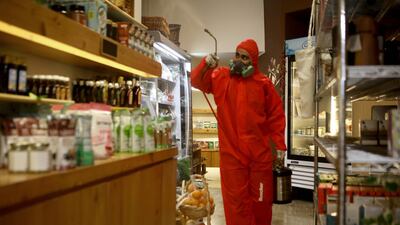
An employee of a public health company sprays disinfectant inside an organic grocery shop in the Lebanese capital Beirut. AFP -

A student attends an online class from home, following the outbreak of the coronavirus disease, in the holy city of Karbala, Iraq. Reuters -
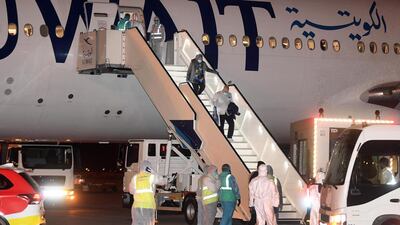
Kuwaitis returning from Frankfurt leave an aircraft that landed at the Kuwait International Airport. AFP -
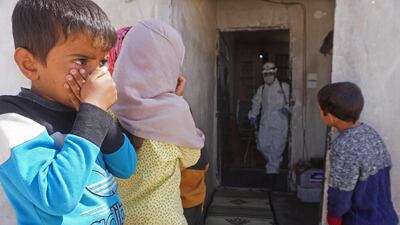
Children watch a member of the Syrian civil defence, known as the White Helmets, disinfecting a former school building currently inhabited by displaced families in the rebel-held town of Binnish in Syria's northwestern Idlib province. AFP -
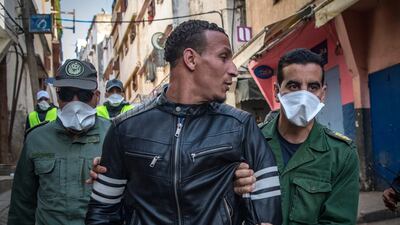
Moroccan authorities arrest a man who refused the confinement as security forces instruct people to return to and remain at home, in Rabat's district of Takadoum. AFP -
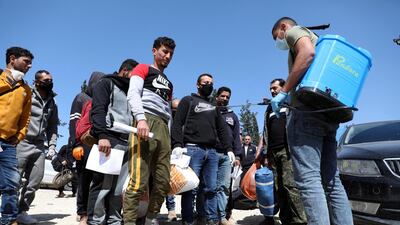
An employee of the Palestinian health ministry sprays disinfectant on workers crossing the checkpoint of Tarqumiya, near the West Bank town of Hebron. EPA -

A man walks past a closed cafe in La Marsa, outside Tunis. AP Photo


On the advice of a mechanical engineer, coveralls from the Mother’s Workshop are made of cotton dipped in a titanium solution. “Let me be clear: in Lebanon, there are no standards. Our research and our partners, especially this engineer and experiments that have been done in hospitals, lead us to use this material,” said Mr Hankir.
After testing, Saida’s Hamoud Hospital found that coveralls from the Mother’s Workshop lose their effectiveness after one to two washes and are thus not re-usable. “We’ll use them, but just once,” said Ahmad Zaatari, the hospital's chief medical officer.
Along with samples from other producers, the Mother Workshop’s coveralls will also be tested in the coming days at Rafic Hariri Hospital.
Rawad Chehayeb, materials management and medical logistics officer at the government hospital, said that its stocks of imported PPE are expected to run out within days. The cost of what is left in the market has exploded.
“Today, an FFP2 mask, which filters 94 per cent of air particles, costs 15,000 Lebanese pounds [Dh36]. Before the pandemic, they cost 1,500 pounds,” he said. There are rumours of coveralls being sold for up to US$150 (Dh550) apiece.
“In [times of] crisis, we will go for something like this,” he said, referring to the Mother’s Workshop coveralls, which cost 40,000 Lebanese pounds.
Mr Hankir said the price was only slightly more than the cost of production, because the titanium-layered material is expensive.
WHO safety recommendations for medical staff treating Covid-19 patients do not include coveralls, but hospitals are keen to buy them anyway. “We are preparing for the next step. You have to be ready ahead of time, you can’t wait for disaster,” said Dr Zaatari.
“We would not use coveralls for everyone, but maybe for healthcare workers in direct contact with infected patients. You want to protect them from being exposed to any kind of contact.”
Additionally, hospitals have their own regulations about when staff should wear coveralls – when taking samples from a patient, for example.
Before the coronavirus pandemic, Hamoud Hospital used disposable coveralls imported from China. They cost significantly less than locally produced coveralls, at $10 apiece, said Dr Zaatari. And washing and sanitising them will also represent an additional financial burden. “This is a cost that we have to bear in order to protect our healthcare during the crisis. We hope the government will financially assist private hospitals,” he said.
One institution that was quick to adopt the Mother’s Workshop coveralls was Saida’s municipality, which stocked up on 200 for its staff, said Marwan Al Masri, the head of the municipality’s health department.
Every day, workers wearing the factory’s blue coveralls and goggles spray a mixture of chlorine and Dettol on the city’s streets.
Not everybody agrees on how coveralls should be used. Salim Adib, a professor of epidemiology and public health at the American University of Beirut, argued that this represented an “unwise use of resources”.
“Masks and gloves are enough in hospitals. This is not Ebola,” Mr Adib said. “If the municipality has money to spend, it should help people stay at home by making sure they have bread.”
The Mother’s Workshop, which has not been inspected yet but sterilises its equipment, has improvised tough regulations. Wafa Wehbee, the factory’s energetic manager, makes sure that everyone in the building stays at least one metre apart and has organised shifts so that the 40 employees do not work in close proximity. Anyone with a temperature or a cough is sent home immediately.
“The danger is not a joke,” she said.

