


On the surface, US President Donald Trump's Middle East peace plan appeared to give the Palestinians everything they longed for: a sovereign, undivided Palestinian state with a capital in occupied East Jerusalem.
It has offered them anything but that.
When asked what was wrong with the plan, one Palestinian official replied: “Everything”.
Sifting through the 180-page document on which leaders in Ramallah were not consulted, it is obvious to the Palestinians that the proposal, three years in the making, seeks to entrench the status quo.
It allows for the aspirations of Israel’s hard-right government to formalise annexation that ends Palestinian dreams of statehood.
The Palestinians seek occupied East Jerusalem in its entirety as the capital of any future state.
The proposed Palestinian capital would be created across several under-serviced and impoverished occupied East Jerusalem towns outside of Israel’s security barrier, giving the city inside the wall to Israel.
A key right-wing Israeli desire is for Jews to be able to pray at Al Aqsa Mosque compound in Jerusalem’s Old City.
The document proposes that “people of every faith should be permitted to pray” at the site.
But it has been a flashpoint of violence and arguably the most sensitive issue for Palestinians for decades, one that sparked the Second Intifada in 2000 when Ariel Sharon visited the site under the protection of hundreds of security officers.
The document says the status quo would initially continue uninterrupted, but US ambassador and settlement donor David Friedman has signalled a desire for that to change, something that could renew conflict in the region.
The planned Palestinian state looks like a series of land pockets that would somehow be connected by an “innovative network of roads, bridges and tunnels".
That would require an immense effort so that Israeli settlers could keep the land they have already taken from the Palestinians. The plan permits the annexation of the settlements.
It also proposes the land transfer of 10 majority Arab communities in northern Israel’s "Triangle" area, something residents have decried as a new “nakba,” or catastrophe, referring to the creation of Israel in 1948.
This unilateral move, one long touted by far-right former defence minister Avigdor Lieberman, is unwanted by those who live in these areas, and again would probably prove to be unworkable.
The Palestinian state’s borders would be under the control of Israel. The document explicitly states that Israel will keep “overriding security responsibility for the state of Palestine”.
They will not be allowed to build their own port, but rather use those in Haifa and Ashdod under Israeli control.
Instead of giving the Palestinians their own port, it envisages an artificial island port off of Gaza that would be subject to Israeli checks, and says the Palestinians, subject to Jordanian consent, could use the port of Aqaba.
It appears that Jordan was not consulted about that clause.
The plan also includes a tunnel between the occupied West Bank and Gaza that would be overseen by the Israelis, not the Palestinians.
Israel will maintain control over the “airspace west of the Jordan River”. It would even maintain the right to engage in “incursions” into the state of Palestine at its discretion.
Palestine’s security agreements would be dictated by Israel, which would decide with whom the state could and could not strike an accord.
A particular sticking point is the right of return. It remains unclear how many of those exiled by the creation of Israel and their descendants, both unwanted by the Israeli government, would be able to return to modern-day Israel.
The document says any solution to that must be negotiated and settled outside Israel.
But it remains a key Palestinian demand, and refugees would not be allowed to be absorbed into a Palestinian state at a rate that increases “security risks” to Israel.
Again, almost every Palestinian policy and move will be dictated by the Israelis.
This is not a negotiated state for the Palestinians, rather the final terms of a “state-minus” that Israel’s right wing has long advocated, one that would risk amplifying the calls of apartheid from Palestinians, the international community and activists.
-

US President Donald Trump shakes hands with Benjamin Netanyahu, Israel's prime minister during a news conference in the East Room of the White House. Bloomberg -

Ivanka Trump, senior adviser to President Trump, and Jared Kushner, senior White House advisor, smile during a news conference in the East Room of the White House in Washington. Bloomberg -

US President Donald Trump and Israeli Prime Minister Benjamin Netanyahu take part in an announcement of Trump's Middle East peace plan in the East Room of the White House in Washington. AFP -
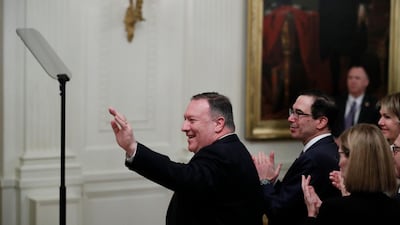
Secretary of State Mike Pompeo, joined by Treasury Secretary Steven Mnuchin, waves as he is acknowledged during an event with President Donald Trump and Israeli Prime Minister Benjamin Netanyahu in the East Room of the White House in Washington. AP Photo -
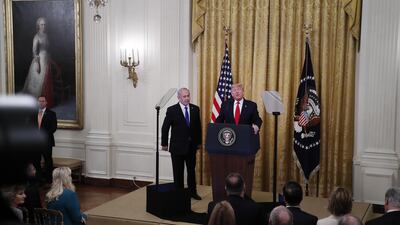
US President Donald Trump speaks as Benjamin Netanyahu, Israel's prime minister, listens during a news conference in the East Room of the White House. Bloomberg -
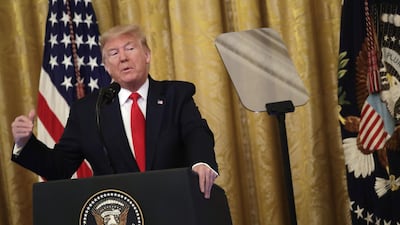
US President Donald Trump speaks during a news conference in the East Room of the White House in Washington. Bloomberg -
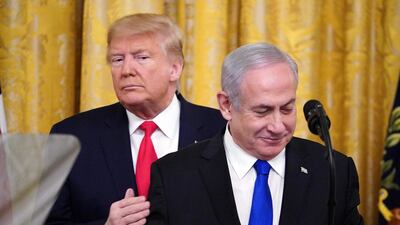
US President Donald Trump and Israeli Prime Minister Benjamin Netanyahu take part in an announcement of Trump's Middle East peace plan in the East Room of the White House in Washington. AFP -
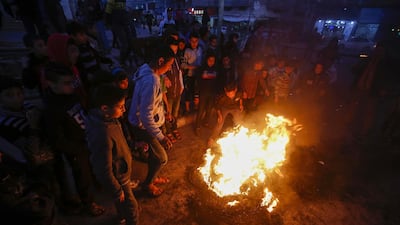
Palestinian demonstrators chant slogans as they stand by flaming tyres during a protest against US President Donald Trump's expected peace plan proposal in Rafah in the southern Gaza Strip. AFP


Palestinian commentators have called the plan a document of surrender, one that their leaders could never accept.
They say it would leave Israel in control of all Palestinian affairs, as opposed to the “dignity” that Mr Trump’s son-in-law and adviser Jared Kushner said the plan would give them.
So they have nothing to lose in rejecting what essentially hands Israeli Prime Minister Benjamin Netanyahu everything he ever wanted: the end of the rival claim to territory between the Jordan River and the Mediterranean Sea, and a boost for his re-election campaign amid corruption charges.
If one is to understand the instant Palestinian rejection of the plan, it is worth recalling the words of Mahmoud Darwish.
“The Palestinians are the only nation in the world that feels with certainty that today is better than what the days ahead will hold," the late Palestinian national poet once said.
"Tomorrow always heralds a worse situation.”

