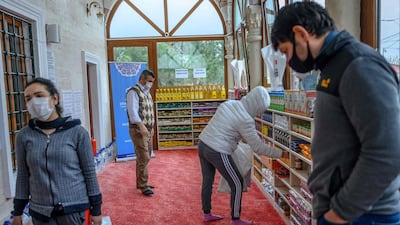
People take their need on April 21, 2020, in the Sariyer district of Istanbul, at the entrance of the Dedeman mosque where the racks reserved for shoes of the Muslim faithful is instead loaded with food. AFP
People take their need on April 21, 2020, in the Sariyer district of Istanbul, at the entrance of the Dedeman mosque where the racks reserved for shoes of the Muslim faithful is instead loaded with fo

Turkish mosque turned into temporary 'supermarket'


  • English
  • Arabic

At the entrance of an Istanbul mosque, the racks usually reserved for the shoes of the faithful are loaded with pasta packages, oil bottles, biscuits - like a supermarket.

But they aren't for sale. Instead they are destined for the needy, hard hit by the coronavirus pandemic.

The sign on the mosque's window asks anyone who can to leave something, and says those in need can take something.

Abdulsamet Cakir, 33, imam of the Dedeman mosque in the Sariyer district, came up with this idea of reaching out to the poor via the place of worship after Turkey suspended mass prayers in mosques until the risk of outbreak passes.

Turkey's official death toll from the virus now stands at 2,259 after 119 more deaths were reported on Tuesday, and major cities including Istanbul will be under lockdown for four days from Thursday.

"After the suspension of mass prayers, I had an idea to revive our mosque by bringing together well-off people with the people in need," Mr Cakir said inside the mosque, where bags of food and cleaning products were piled up on the floor.

The young imam, who takes the products from the floor and places them on the shelves at the entrance, said he was inspired by a donation culture in the Ottoman period called "charity stone" - a small pillar stone erected at certain locations of the city to connect rich people with the poor.

In this Ottoman system aimed at giving charity in a dignified manner without offending the needy, people with means would leave whatever amount they wanted in a cavity on the top of the charity stone.

Those who were in need would then take the amount they needed and leave the rest for others.

"After the coronavirus pandemic, we have thought about what we can do to help our brothers in need," said Cakir, who would already help the poor in his neighbourhood before the outbreak.

"With the inspiration from our ancestors' 'charity stone' culture, we decided to fill the racks in our mosque with the help from our brothers with means," he added.

Cakir hangs a list on the wall of the mosque where citizens who need help write their names and telephone numbers.

The imam later sends the list to local authorities who check whether the names are really in need and his team then sends a message that they can visit the mosque and receive whatever they need: eight items at maximum.

"I am really in dire need. My husband doesn't work. I used to clean houses but since the virus, they no longer call," Guleser Ocak, 50, told AFP.

"I wrote my name on the list before. I received a message today to pick up aid," she said. "We are in a tough situation."

The mosque has been providing services for two weeks and reaches out to 120 people in need per day. And the list includes over 900 people.

A maximum of two people wearing masks and gloves enter the mosque and take what they need, while others wait outside, standing a few paces from each other.

"We spread the services through the day. We call 15 people for each half an hour, so that we respect social distancing and do not cause big queues," the imam said.

"We are doing our best to help our sisters and brothers in the best possible way without offending them," he added.

The mosque does not accept cash donations and instead receives aid packages.

"Producers also donate. A miller brings in flour, a baker brings in bread, a water distributor brings in water," Cakir said.

The mosque's shelves are full of products sent from all over Turkey and even abroad.

"Everyone does whatever they can to help people in need. For example, a brother who lives in France did online shopping and directed the aid to our mosque," he said.

"What the mosque is doing is really, really good for us. Ramadan is coming," said Duygu Kesimoglu, 29, referring to the Muslim fasting month beginning this week.

"I am unfortunately jobless, they don't employ us because of the coronavirus. No job, no money. This help is very, very good," she said.


Ten tax points to be aware of in 2026

1. Domestic VAT refund amendments: request your refund within five years

If a business does not apply for the refund on time, they lose their credit.

2. E-invoicing in the UAE

Businesses should continue preparing for the implementation of e-invoicing in the UAE, with 2026 a preparation and transition period ahead of phased mandatory adoption. 

3. More tax audits

Tax authorities are increasingly using data already available across multiple filings to identify audit risks. 

4. More beneficial VAT and excise tax penalty regime

Tax disputes are expected to become more frequent and more structured, with clearer administrative objection and appeal processes. The UAE has adopted a new penalty regime for VAT and excise disputes, which now mirrors the penalty regime for corporate tax.

5. Greater emphasis on statutory audit

There is a greater need for the accuracy of financial statements. The International Financial Reporting Standards standards need to be strictly adhered to and, as a result, the quality of the audits will need to increase.

6. Further transfer pricing enforcement

Transfer pricing enforcement, which refers to the practice of establishing prices for internal transactions between related entities, is expected to broaden in scope. The UAE will shortly open the possibility to negotiate advance pricing agreements, or essentially rulings for transfer pricing purposes. 

7. Limited time periods for audits

Recent amendments also introduce a default five-year limitation period for tax audits and assessments, subject to specific statutory exceptions. While the standard audit and assessment period is five years, this may be extended to up to 15 years in cases involving fraud or tax evasion. 

8. Pillar 2 implementation 

Many multinational groups will begin to feel the practical effect of the Domestic Minimum Top-Up Tax (DMTT), the UAE's implementation of the OECD’s global minimum tax under Pillar 2. While the rules apply for financial years starting on or after January 1, 2025, it is 2026 that marks the transition to an operational phase.

9. Reduced compliance obligations for imported goods and services

Businesses that apply the reverse-charge mechanism for VAT purposes in the UAE may benefit from reduced compliance obligations. 

10. Substance and CbC reporting focus

Tax authorities are expected to continue strengthening the enforcement of economic substance and Country-by-Country (CbC) reporting frameworks. In the UAE, these regimes are increasingly being used as risk-assessment tools, providing tax authorities with a comprehensive view of multinational groups’ global footprints and enabling them to assess whether profits are aligned with real economic activity. 

Contributed by Thomas Vanhee and Hend Rashwan, Aurifer

MATCH INFO

Uefa Champions League semi-final, first leg
Bayern Munich v Real Madrid

When: April 25, 10.45pm kick-off (UAE)
Where: Allianz Arena, Munich
Live: BeIN Sports HD
Second leg: May 1, Santiago Bernabeu, Madrid

The Perfect Couple

Starring: Nicole Kidman, Liev Schreiber, Jack Reynor

Creator: Jenna Lamia

Rating: 3/5

Jetour T1 specs

Engine: 2-litre turbocharged

Power: 254hp

Torque: 390Nm

Price: From Dh126,000

Available: Now

The five pillars of Islam

1. Fasting

2. Prayer

3. Hajj

4. Shahada

5. Zakat 

COMPANY PROFILE
Name: HyperSpace
 
Started: 2020
 
Founders: Alexander Heller, Rama Allen and Desi Gonzalez
 
Based: Dubai, UAE
 
Sector: Entertainment 
 
Number of staff: 210 
 
Investment raised: $75 million from investors including Galaxy Interactive, Riyadh Season, Sega Ventures and Apis Venture Partners
Who's who in Yemen conflict

Houthis: Iran-backed rebels who occupy Sanaa and run unrecognised government

Yemeni government: Exiled government in Aden led by eight-member Presidential Leadership Council

Southern Transitional Council: Faction in Yemeni government that seeks autonomy for the south

Habrish 'rebels': Tribal-backed forces feuding with STC over control of oil in government territory

ARGYLLE
%3Cp%3EDirector%3A%20Matthew%20Vaughn%3C%2Fp%3E%0A%3Cp%3EStarring%3A%20Bryce%20Dallas%20Howard%2C%20Sam%20Rockwell%2C%20John%20Cena%3C%2Fp%3E%0A%3Cp%3ERating%3A%203%2F5%3C%2Fp%3E%0A
The years Ramadan fell in May

1987

1954

1921

1888

Try out the test yourself

Q1 Suppose you had $100 in a savings account and the interest rate was 2 per cent per year. After five years, how much do you think you would have in the account if you left the money to grow?
a) More than $102
b) Exactly $102
c) Less than $102
d) Do not know
e) Refuse to answer

Q2 Imagine that the interest rate on your savings account was 1 per cent per year and inflation was 2 per cent per year. After one year, how much would you be able to buy with the money in this account?
a) More than today
b) Exactly the same as today
c) Less than today
d) Do not know
e) Refuse to answer

Q4 Do you think that the following statement is true or false? “Buying a single company stock usually provides a safer return than a stock mutual fund.”
a) True
b) False
d) Do not know
e) Refuse to answer

The “Big Three” financial literacy questions were created by Professors Annamaria Lusardi of the George Washington School of Business and Olivia Mitchell, of the Wharton School of the University of Pennsylvania. 

Answers: Q1 More than $102 (compound interest). Q2 Less than today (inflation). Q3 False (diversification).

Company%C2%A0profile
%3Cp%3E%3Cstrong%3ECompany%20name%3A%20%3C%2Fstrong%3Eamana%3Cbr%3E%3Cstrong%3EStarted%3A%20%3C%2Fstrong%3E2010%3Cbr%3E%3Cstrong%3EFounders%3A%3C%2Fstrong%3E%20Karim%20Farra%20and%20Ziad%20Aboujeb%3Cbr%3E%3Cstrong%3EBased%3A%20%3C%2Fstrong%3EUAE%3Cbr%3E%3Cstrong%3ERegulator%3A%20%3C%2Fstrong%3EDFSA%3Cbr%3E%3Cstrong%3ESector%3A%20%3C%2Fstrong%3EFinancial%20services%3Cbr%3E%3Cstrong%3ECurrent%20number%20of%20staff%3A%20%3C%2Fstrong%3E85%3Cbr%3E%3Cstrong%3EInvestment%20stage%3A%20%3C%2Fstrong%3ESelf-funded%3Cbr%3E%3C%2Fp%3E%0A
AI traffic lights to ease congestion at seven points to Sheikh Zayed bin Sultan Street

The seven points are:

Shakhbout bin Sultan Street

Dhafeer Street

Hadbat Al Ghubainah Street (outbound)

Salama bint Butti Street

Al Dhafra Street

Rabdan Street

Umm Yifina Street exit (inbound)

While you're here
Rebel%20Moon%20-%20Part%20One%3A%20A%20Child%20of%20Fire
%3Cp%3E%3Cstrong%3EDirector%3A%20%3C%2Fstrong%3EZack%20Snyder%3Cbr%3E%3Cstrong%3EStars%3A%20%3C%2Fstrong%3ESofia%20Boutella%2C%20Djimon%20Hounsou%2C%20Ed%20Skrein%2C%20Michiel%20Huisman%2C%20Charlie%20Hunnam%3Cbr%3E%3Cstrong%3ERating%3A%20%3C%2Fstrong%3E2%2F5%3C%2Fp%3E%0A