


In full protective gear, two doctors climb the stairs four at a time. Their first task of the day: to test a woman who has had contact with a coronavirus patient in Istanbul.
Flustered by the appearance of men in white bodysuits on her landing, the resident in the populous Fatih district answers their questions before she is tested.
She will get her results the next day.
In Turkey, nearly 6,000 teams of "tracers" – all health professionals – track potential Covid-19 cases 24 hours a day by identifying and following up with people who have had contact with patients.
By helping find new cases who are then quickly isolated and treated, the Turkish government says tracing has helped to contain the outbreak and limit the number of deaths.
-
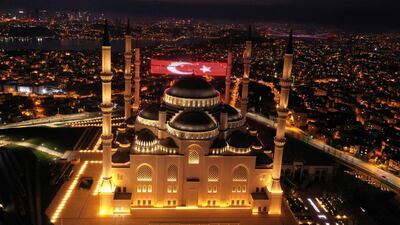
Mahya depicts Turkey's national flag which is installed between the minarets of Camlica mosque, as the outbreak of COVID-19 continues in Istanbul, April 28, 2020. Reuters -
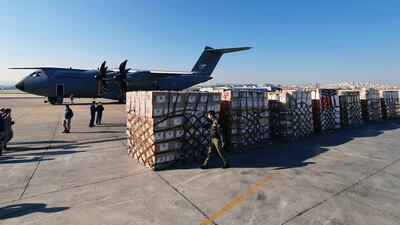
Turkish soldiers load medical protection equipment into a Turkish military cargo plane to be donated to the United States at the Etimesgut airport in Ankara, Turkey, April 28, 2020. EPA -

A flight crew member stands in front of a donation of medical supplies from Turkey on April 28, 2020, at Andrews Air Force Base, Maryland. The donation to help fight the new coronavirus in the United States included surgical masks, sanitisers and protective suits. AP Photo -
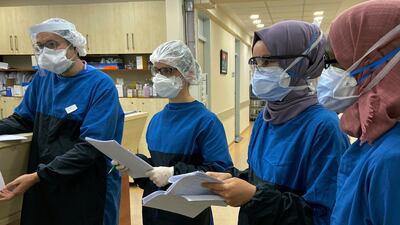
Medical personnel participate in a briefing at Istanbul University Cerrahpasa - Cerrahpasa Medical Faculty Hospital's ward dedicated to patients with coronavirus (COVID-19) in Istanbul, Tuesday, April 28, 2020. Turkey has seen a decline this week in the number of daily deaths and rates of infection since it started to grapple with the novel coronavirus pandemic last month. The government has refrained from imposing a total lockdown, fearing its negative impact on the already fragile economy. (AP Photo/Mehmet Guzel) -
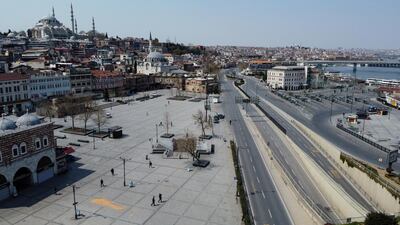
An aerial view of Eminonu district during a two-day curfew imposed to prevent the spread of the coronavirus in Istanbul, Turkey, on April 11, 2020. Reuters -
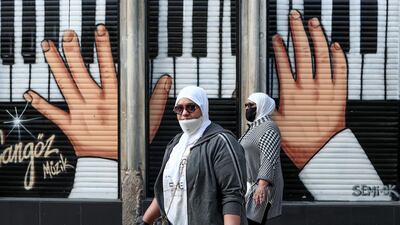
epa08392157 Women walk with face masks in Istanbul, Turkey, 29 April 2020. Turkish President Recep Tayip Erdogan announced that there will be another curfew in 31 big cities, including Istanbul (the country's most populous urban agglomeration), between 01-03 May due to the ongoing pandemic of the COVID-19 disease caused by the SARS-CoV-2 coronavirus. The government has also decreed the cancellation of public events and has temporarily shut down schools and suspended sporting events amid the pandemic. EPA/SEDAT SUNA -
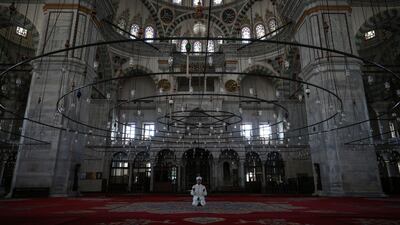
Esat Sahin, Imam of the iconic Fatih Mosque, holds a prayer held without public due to the coronavirus restrictions in Istanbul, April 24, 2020, during the first day of the holy fasting month of Ramadan. (AP Photo/Emrah Gurel) -
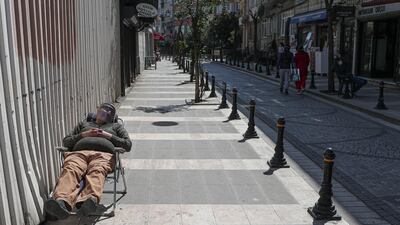
epa08392155 A man sleeps with face protective equipment on street in Istanbul, Turkey, 29 April 2020. Turkish President Recep Tayip Erdogan announced that there will be another curfew in 31 big cities, including Istanbul (the country's most populous urban agglomeration), between 01-03 May due to the ongoing pandemic of the COVID-19 disease caused by the SARS-CoV-2 coronavirus. The government has also decreed the cancellation of public events and has temporarily shut down schools and suspended sporting events amid the pandemic. EPA/SEDAT SUNA -
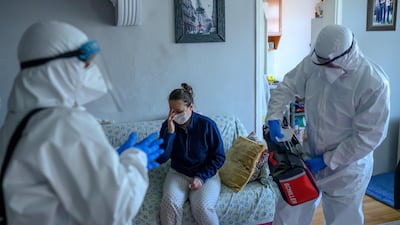
TOPSHOT - Health workers help a woman who tested positive for the novel coronavirus COVID-19, at Bagcilar in Istanbul, on April 28, 2019, in Istanbul. / AFP / Bulent Kilic -
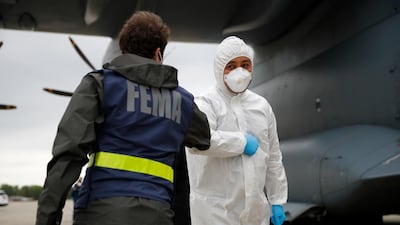
A Turkish military flight crew member, right, bumps elbows with a FEMA worker as crews unload a donation of medical supplies from Turkey, Tuesday, April 28, 2020, at Andrews Air Force Base, Md. The donation to help fight the new coronavirus in the United States included surgical masks, sanitizers and protective suits. (AP Photo/Patrick Semansky) -
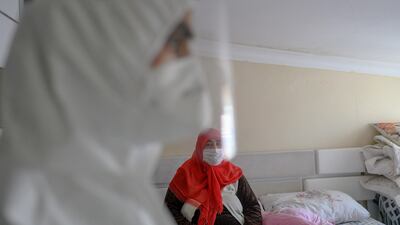
Health workers help a woman who tested positive for the novel coronavirus COVID-19, at Bagcilar in Istanbul, on April 28, 2019, in Istanbul. / AFP / Bulent Kilic -
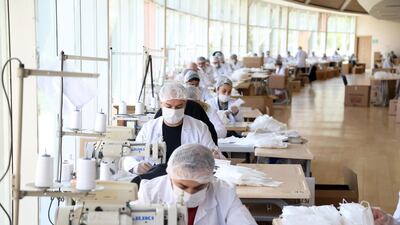
TOPSHOT - Employees of Ankara Metropolitan Municipality youth center sews face masks, in Ankara, Turkey, on April 28, 2020, amid the spread of the novel COVID-19 coronavirus. / AFP / Adem ALTAN -

Employees of Ankara Metropolitan Municipality youth center sews face masks, in Ankara, Turkey, on April 28, 2020, amid the spread of the novel COVID-19 coronavirus. / AFP / Adem ALTAN -
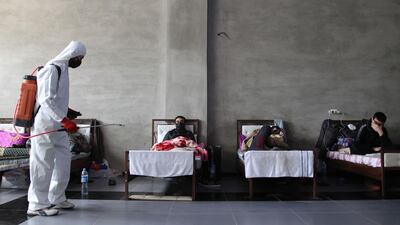
TOPSHOT - A man sanitises the room as Syrians who returned from Turkey rest at a quarantine facility in the countryside of the town of Jisr al-Shughur, west of the mostly rebel-held Syrian province of Idlib, on April 27, 2020 during the coronavirus COVID-19 pandemic. / AFP / Abdulaziz KETAZ -
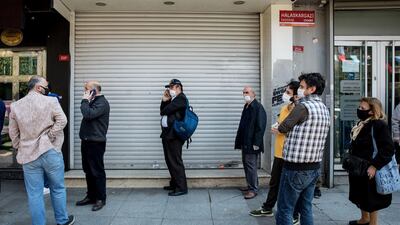
Customers wearing protective face masks maintain social distancing while queuing before the opening of a bank branch in Istanbul, Turkey, on Monday, April 27, 2020. Coming off a brief recession just over a year ago, the urgency is mounting for Turkey to loosen the screws on the economy as its currency and reserves come under pressure more than a month after it introduced social-distancing measures. Photographer: Kerem Uzel/Bloomberg -
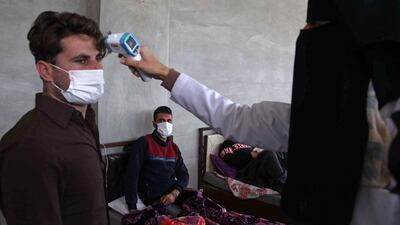
A health worker measures the temperature of a man at a quarantine facility for Syrians who returned from Turkey in the countryside of the town of Jisr al-Shughur, west of the mostly rebel-held Syrian province of Idlib, on April 27, 2020 amid the coronavirus COVID-19 pandemic. / AFP / Abdulaziz KETAZ -
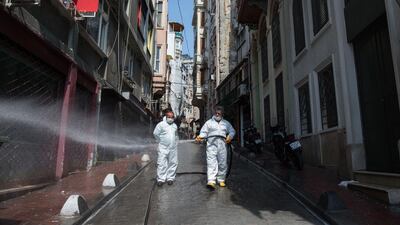
Istanbul Metropolitan Municipality workers spray a street with disinfectant to prevent the spread of coronavirus in Istanbul, Turkey, on Monday, April 27, 2020. Coming off a brief recession just over a year ago, the urgency is mounting for Turkey to loosen the screws on the economy as its currency and reserves come under pressure more than a month after it introduced social-distancing measures. Photographer: Kerem Uzel/Bloomberg -
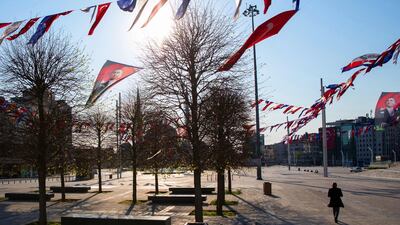
A lone pedestrian walks across an empty Taksim square during curfew in Istanbul, Turkey, on Sunday, April 26, 2020. Coming off a brief recession just over a year ago, the urgency is mounting for Turkey to loosen the screws on the economy as its currency and reserves come under pressure more than a month after it introduced social-distancing measures. Photographer: Kerem Uzel/Bloomberg


Even if some observers have questioned the reliability of official figures, Turkey's death toll relative to countries of a similar size like Germany is low given the number of infections. There were 3,739 fatalities recorded and more than 137,000 cases, according to data released over the weekend.
Health Minister Fahrettin Koca said on Monday that he believed tracing was "at the heart of [Turkey's] success" in the fight against the disease.
Each tracing process identifies an average of 4.5 people who have been in contact with a patient, according to Mr Koca.
More than 460,000 people had been contacted by tracers in Turkey, he said on April 29.
To find potential cases, the doctors do "real detective work", said Melek Nur Aslan, director of the public health agency in Fatih district.
When a Covid-19 patient is identified, "We try to retrace their journey in the last 48 hours before the appearance of the first symptoms until the moment when they are tested positive" for the virus, she said.
For this, the doctors go to the patients' bedside or home with a list of questions: where did they go? Who did they speak to? Were they wearing a mask?
They then compile a list of potentially infected people whom they ask to self-isolate for 14 days.
If the person has symptoms or develops them during their confinement, they are tested.
This is exactly what happened in Fatih, where the doctors have just intervened: the woman they visited complained of fatigue and migraines.
Once the doctors leave the building, they remove their protective equipment and throw it into a large rubbish bag.
One of them carries a box containing the sample that will be sent to the laboratory during the day.
If the test is positive, the woman "will appear as a confirmed case in our file, which will lead to a new tracing process", said one of the tracers, Mustafa Sever, a GP.
The tracers' role will also be crucial to avoid a second wave of contagion as Turkey prepares to loosen restrictive measures, including reopening shopping centres and hairdressers from Monday.
Unlike in some other countries where tracing has led to debates over confidentiality and how the data is used, Turkey began this route to tackling the pandemic from the start.
Mr Aslan said only the health workers in charge of tracking potential coronavirus cases have access to the data collected.
Tracing is not new in Turkey – Mr Sever said he had carried out similar "investigations" during measles epidemics in Istanbul.
The tracers also rely on family doctors who regularly call their patients to enquire about their health and ensure they are respecting lockdown measures.
In Istanbul alone, 1,200 teams of two to four tracers constantly track potential cases, Mr Aslan said.
In addition to their tracing efforts, they also provide advice on how to avoid infecting others and reassure people they visit.
"When we go to people's homes, they see that someone is taking care of them, that they are not neglected," said Mr Sever.
"If they are worried, we speak a little with them to reassure them."

