Bahrain, Saudi Arabia, Israel, Turkey, Lebanon and elsewhere in the Middle East have all started outlining when, how and at what cost corona vaccines will become available, as several pharmaceutical companies and research centres announce breakthroughs in their vaccine trials.
Governments are moving to authorise and launch the drugs and nations around the world are already buying doses that could become available by the end of the year.
For developing countries that lack the resources to buy large quantities of vaccine, the World Health Organisation has created the Covax scheme in partnership with the Gavi Vaccine Alliance and the Coalition for Epidemic Preparedness Innovations (Cepi).
It plans to ensure participating nations are supplied with enough vaccine doses to immunise 20 per cent of their populations.
As of early December, Covax has the world’s largest and most diverse Covid-19 vaccine portfolio, including nine candidate vaccines, with a further nine under evaluation and conversations under way with other major producers.
The WHO called on G20 nations to help fill a $4.5 billion funding gap to be able to distribute the vaccines globally.
What are the main Covid-19 vaccines?
Four main initiatives have so far emerged from hundreds of attempts to produce vaccines. These are Pfizer/BioNTech; Moderna; Oxford/AstraZeneca; Sputnik V.
Sinopharm, a vaccine developed by a Chinese company, has been approved for emergency use in several countries, and has been given the green light for wider use in the UAE, where Phase 3 trials took place.
The recently opened logistics centre known as the Hope Consortium, which includes the UAE Department of Health, Etihad Cargo and the Abu Dhabi Ports Company, will be able to store and distribute billions of Covid-19 vaccines to the world.
Here is a look at what each nation in the Middle East has so far said about the vaccine roll-out:
When will people in Algeria get a Covid-19 vaccine?
Algiers said it had received a first shipment of the Russian Sputnik V vaccine on January 30.
Health Minister Abderrahmane Benbouzid said the country was working to acquire sufficient vaccine doses to immunise all of Algeria's 44 million people.
Algeria has signed a contract with Russia to supply it with the Sputnik V vaccine, the RDIF sovereign wealth fund said December 31, but did not provide any details on the number of doses agreed upon.
Algeria has said it plans to begin its vaccination campaign in January.
President Abdelmadjid Tebboune tweeted on December 20 that he had ordered the prime minister to immediately chair a meeting of the overseeing the virus response.
Algeria joined the Covax scheme and Health Minister Abd Al Rahman bin Bouzid said earlier that the government would "acquire the vaccine which provides sure guarantees, therefore there is a need to avoid any haste or random decisions".
The government is yet to detail the rollout plan or timetable.
When will people in Bahrain get a Covid-19 vaccine?
King Hamad Al Khalifa has ordered that vaccinations be provided to the public for free, according to the Bahrain News Agency.
Bahrain's National Health Regulatory Authority approved the registration of the Sinopharm vaccine on December 13. It has been given to frontline workers on a voluntary basis since November.
Bahrain said it granted emergency-use authorisation for the Pfizer-BioNTech vaccine on December 4, becoming the second country after Britain to approve it.
In August, the kingdom placed an order for more than 1 million doses of both vaccines as well as the Oxford/AstraZeneca vaccine.
Bahrain participated in the Sinopharm Phase 3 clinical trials, administered voluntarily to health workers.
The government is yet to detail the rollout plan or timetable.
-
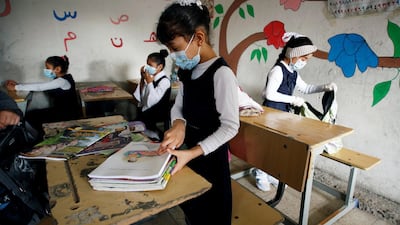
Pupils arrange their books following the reopening of their school, in Baghdad, Iraq. Reuters -
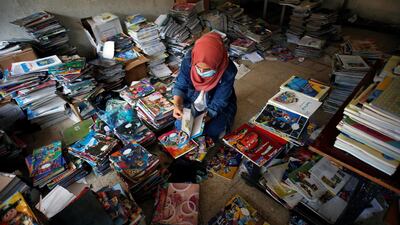
An Iraqi teacher sorts the school books until they are handed over to pupils after schools reopen in Baghdad, Iraq. Reuters -
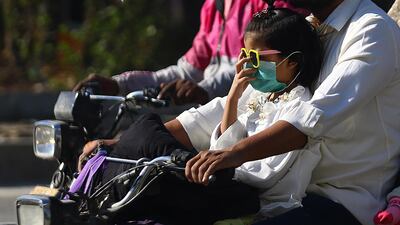
People wear face masks on a road during a 'smart lockdown' in Karachi, Pakistan. EPA -
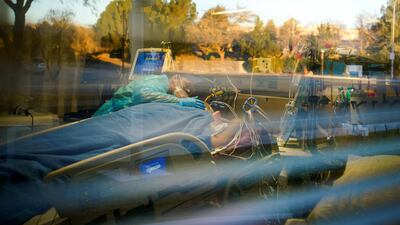
Nurse Carolina Garcia takes care of her father, Jose Garcia, who is intubated and sedated at Memorial Medical Centre in Las Cruces, New Mexico, US. Reuters -
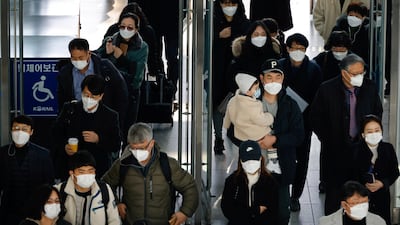
People walk at a railway station in Seoul, South Korea. Reuters -

Relatives of a man who died of coronavirus related complications wait to cremate his body at Vadaj Cemetery in Ahmedabad, India. AP Photo -
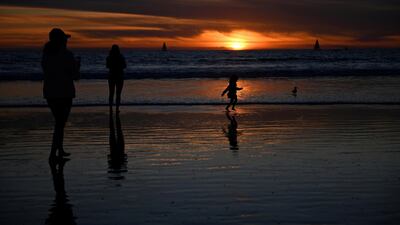
People visit the beach a day before renewed restrictions due to a surge of Covid-19 cases in Los Angeles, California, US. Reuters -
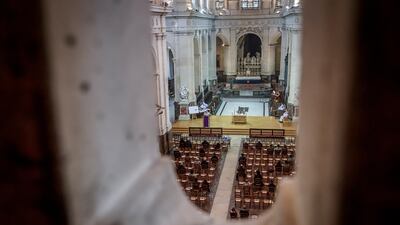
Faithful attend the mass at St Roch Church in Paris, France. Churches have reopened in France with a maximum capacity of 30 people after being closed since October 30, 2020, due to the second wave of the Covid-19 pandemic. EPA -

A woman takes a photo with a smartphone of a Christmas tree in front of the Brandenburg Gate in Berlin, Germany. Christmas markets have been cancelled in Berlin this year. EPA -
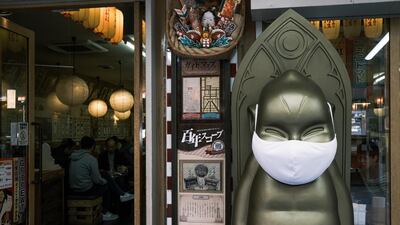
A statue in front of a restaurant wears a protective mask in the Shinsekai shopping district of Osaka, Japan. Bloomberg -

The traditional Christmas tree of the Galeries Lafayette department store stands under its great dome in Paris. French stores can reopen starting November 28 after several weeks of lockdown. EPA -
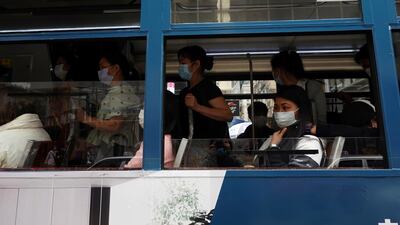
Passengers ride on a tram in Hong Kong. Reuters -

Barbara Roque holds a sign during a Voice for Choice - Open Our Schools rally in Horsham, Pennsylvania. AP -
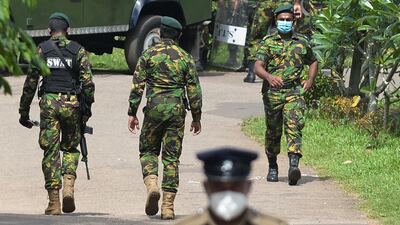
Special Task Force personnel deploy at Mahara prison on the outskirts of Colombo a day after a prison riot over the surge of coronavirus infections. AFP -
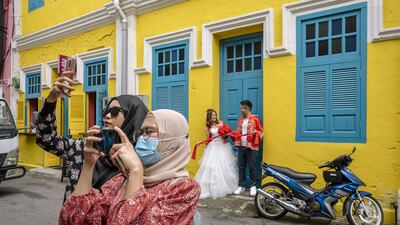
Visitors pose for photographs at a street in Kuala Lumpur, Malaysia. Bloomberg


When will people in Egypt get a Covid-19 vaccine?
Egypt will begin administering coronavirus vaccinations on January 24, beginning with medical staff, President Abdel-Fattah Al-Sisi said.
Egypt has received 100,000 doses of the Sinopharm vaccine on December 10, but has not begun vaccinations yet, according to the health ministry. The finance ministry said another 20 million doses had been ordered, without giving further information.
Egypt will also get 40 million vials via the GAVI vaccine alliance, enough for 20 million people or 20 per cent of the 100 million population, its health minister said last week.
Russia agreed to supply 25 million doses of its Sputnik V vaccine to Egypt in the near future.
Egypt has reserved enough of the Pfizer/BioNTech vaccine to inoculate 20 per cent of its 100 million population, Health Minister Hala Zayed said in late November.
Another 30 per cent will be covered by a potential vaccine being produced by the Oxford/AstraZeneca team, Ms Zayed said.
The government is yet to detail the roll-out plan or timetable.
When will people in Iran get a Covid-19 vaccine?
Iranian Foreign Minister Mohammad Javad Zarif said on January 26 that Tehran had approved the Russian Sputnik V coronavirus vaccine for domestic use.
"The Sputnik V vaccine was yesterday also registered and approved by our health authorities," Mr Zarif said at a meeting with his Russian counterpart, Sergei Lavrov, in Moscow on Tuesday.
Iran will begin Covid-19 vaccinations in the coming weeks, Iranian President Hassan Rouhani said on January 24.
He said foreign vaccines were "a necessity until local vaccines are available", without giving details about what vaccines would be used.
Vaccinations involving three domestic vaccines – Barekat, Pasteur and Razi, some of which were developed with foreign collaboration – could begin in the spring or the summer, he added.
Iran began its first human trial of locally made virus vaccine on December 29, state TV reported.
Dozens of people were due to receive the domestically developed shot even as details about its production remained slim.
The vaccine is produced by Shifa Pharmed, part of a state-owned pharmaceutical conglomerate known as Barekat. It is the first in the country to reach human trials.
Health Minister Saeed Namaki was quoted as saying Tehran had pre-ordered about 16.8 million doses via the World Health Organisation's vaccine project Covax.
The government is yet to detail the roll-out plan or a timetable.
When will people in Iraq get a Covid-19 vaccine?
Iraq's cabinet said on December 22 that the finance ministry had set aside $3 million as an advance payment to Pfizer-BioNTech and had secured the remaining $12 million for the full delivery.
Iraq's health authorities signed an initial agreement to reserve 1.5 million doses of the Pfizer-BioNTech vaccine on December 21.
Each person will require two doses so the order will cover just 750,000 of Iraq's 40 million people, with troops and the elderly prioritised for vaccinations.
Health Ministry spokesman, Saif Al Badr, said the initial order could be increased later.
The vaccines will arrive early next year, he said.
President Barham Saleh affrimed that Iraq aims to provide the jab for free to its citizens.
Iraq joined the Covax scheme to secure enough doses for 20 per cent of its population of about 38 million people.
Mr Badr said the country had set aside money for the vaccines and prepared all logistical requirements.
Iraq has committed $170 million to be among the first countries to receive the vaccine, according to the WHO.
"Whenever there is a successful, effective and approved vaccine, we will import and use," he said. Iraq is following up with all scientific research by different countries, but all deals will be through Gavi, the WHO's partner in the Covax scheme.
Western officials in Iraq told AFP Washington was putting pressure on Baghdad to choose Pfizer-BioNTech over other options.
The government is yet to detail the roll-out plan or a timetable.
-
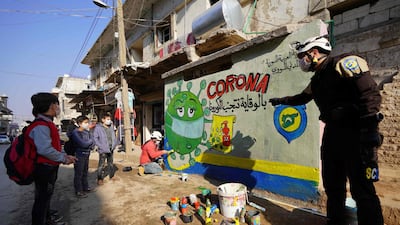
A member of the Syrian Civil Defence group known as the White Helmets instructs school children about the coronavirus during an awareness campaign organised in the town of Binnish in Syria's northwestern Idlib province. AFP -
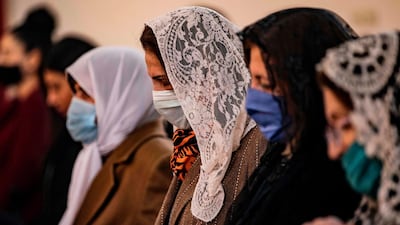
Worshippers pray during Sunday mass while wearing protective masks amid the COVID-19 pandemic at the Syriac Orthodox Church of Virgin Mary in the Kurdish-majority city of Qamishli in Syria's northeastern Hasakeh province, following the end of a lockdown. AFP -
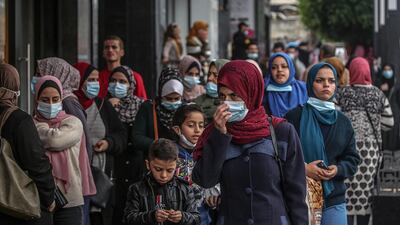
Palestinians wearing protective face masks walk in the market amid the ongoing coronavirus COVID-19 pandemic in Gaza City. The Ministry of Interior in Gaza City announced new measures as the number of new infections with the coronavirus increases, which are the closure of schools, universities, mosques, and government ministries until further notice, and work from six in the morning until six in the evening only, and a comprehensive closure on Friday and Saturday of every week. EPA -
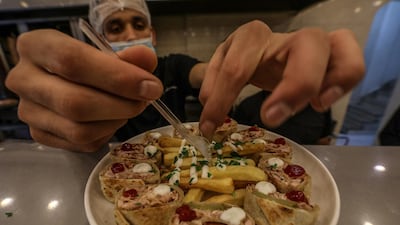
A Palestinian cook, wearing a protective face mask, works at a resturant amid the ongoing coronavirus COVID-19 pandemic in Gaza City. The Ministry of Interior in Gaza City announced new measures in light of the increasing number of new infections with the Coronavirus, which are the closure of schools, universities, mosques and government ministries until further notice, as well as work from six in the morning until six in the evening only, and on Friday and Saturday of every week, a comprehensive closure. EPA -

Palestinians wearing protective face masks walk in the market amid the ongoing coronavirus COVID-19 pandemic in Gaza City. The Ministry of Interior in Gaza City announced new measures in light of the increasing number of new infections with the Coronavirus, which are the closure of schools, universities, mosques and government ministries until further notice, as well as work from six in the morning until six in the evening only, and on Friday and Saturday of every week, a comprehensive closure. EPA -
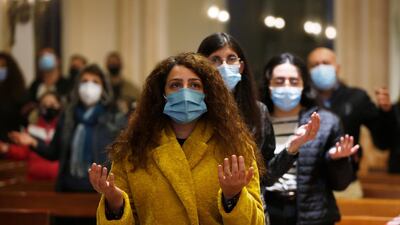
Faithfuls wearing protective masks and maintaining social distance attend a mass before turning on the lights on the Christmas tree, at Church of the Sacred Heart, amid fears over rising numbers of coronavirus disease cases in downtown Amman, Jordan. Reuters -
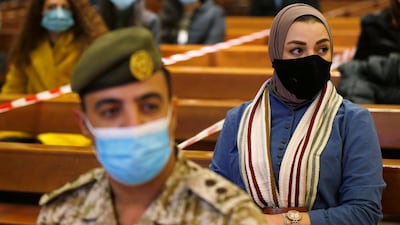
A Jordanian muslim woman and a soldier wearing protective masks and maintaining social distance attend a mass before the Christmas tree lighting ceremony, at Church of the Sacred Heart, amid fears over rising numbers of coronavirus disease cases in downtown Amman, Jordan. Reuters -
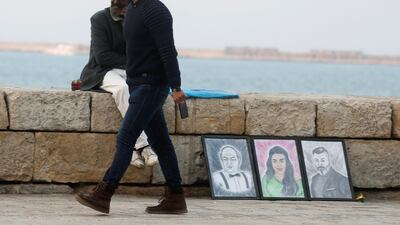
A man walks in front of a street painting vendor amid the coronavirus disease pandemic in the Mediterranean city of Alexandria, north of Cairo, Egypt. Reuters -
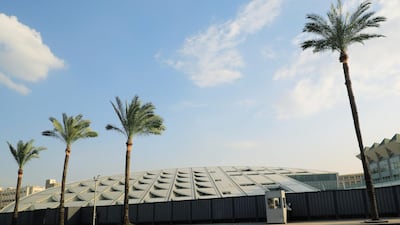
A general view of Bibliotheca Alexandrina library and cultural center amid the coronavirus disease pandemic in Alexandria, Egypt, north of Cairo, Egypt. Reuters -
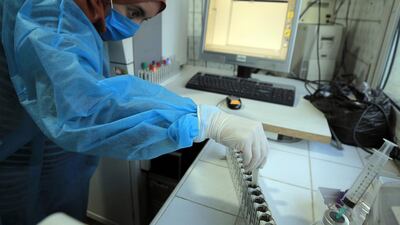
A nurse works on COVID-19 tests in a private laboratory of Algiers. Algeria received rapid antigen testing kits, adding plans to widen access to the tests across the country by March 2021, and increase the number of private laboratories approved to run PCR tests. AP -

A nurse administers a PCR COVID-19 test on a man in a private laboratory of Algiers. Algeria received rapid antigen testing kits, adding plans to widen access to the tests across the country by March 2021, and increase the number of private laboratories approved to run PCR tests. AP -
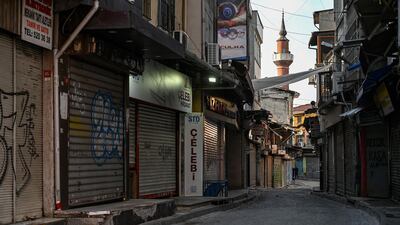
A deserted street with shops closed can be seen near Eminonu square in Istanbul during a week-end curfew aimed at curbing the spread of the Covid-19 pandemic caused by the novel coronavirus. Under the new restrictions beginning from December 1, a curfew will be imposed on weekdays from 9:00 pm. to 5:00 am. Over the weekend the lockdown will last from 9:00 pm Friday until 5:00 am on Monday. AFP -
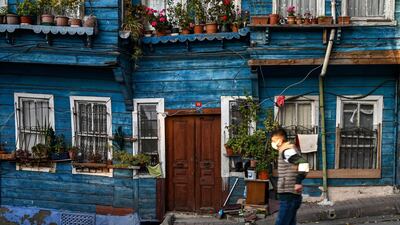
A man walks in a deserted street near Suleymaniye mosque in Istanbul during a week-end curfew aimed at curbing the spread of the Covid-19 pandemic caused by the novel coronavirus. Under the new restrictions beginning from December 1, a curfew will be imposed on weekdays from 9:00 pm. to 5:00 am. Over the weekend the lockdown will last from 9:00 pm Friday until 5:00 am on Monday. AFP


When will people in Israel get a Covid-19 vaccine?
Israel's coronavirus vaccination campaign, the world's fastest per capita, have started administering the second dose of the Pfizer-BioNTech vaccine on January 11 to Israelis over the age of 60, medical personnel and people with health problems. Israelis have been receiving the first injection of the Pfizer-BioNTech vaccine since December 19.
The Health Ministry said it had administered 19.5 doses for every 100 people of the total population, including more than 72 per cent of those aged over 60.
Israel received its first batch of 8 million doses ordered from Pfizer's on December 9 and plans to start administering the vaccinations ahead of the scheduled date of December 27, in line with capacity of the health system, Prime Minister Benjamin Netanyahu said.
Health Minister Yuli Edelstein said that it may be possible to begin vaccinating medical staff starting from December 21.
Prime Minister Benjamin Netanyahu was one of the first people in Israel to get the Pfizer-BioNTech vaccine, as the country began its rollout on December 19.
Israel has ordered 16 million doses of the vaccine, from Pfizer as well as US biotech firm Moderna.
The two-dose inoculation would cover 4 million of the country's 8 million population. "The goal is for the vaccine supply to start in January and increase in the months thereafter," Prime Minister Benjamin Netanyahu said. Israel submitted its interest in the Covax scheme in August.
The government is yet to detail the roll-out plan or a detailed timetable.
When will people in Jordan get a Covid-19 vaccine?
Inoculations in Jordan started on January 13 using the Pfizer-BioNTech vaccine and China’s Sinopharm.
The Jordanian government announced on January 10, that it will buy an unspecified amount of the Chinese vaccine Sinopharm through an Emirati company, weeks after government assertions that it had bought one million doses of the American Pfizer-BioNTech vaccine.
No specific amount of the Sinopharm vaccine purchased by Jordan was announced.
Jordan began inoculating its citizens against coronavirus on December 13, with the aim of vaccinating one-fifth of the country’s ten million people.
They are being administered to people who had registered on a government internet portal to take it and received SMS messages to come.
About 300,000 Jordanians have registered online to take the vaccine.
Heath officials urged people to register to take the vaccine, saying those the government had acquired are safe.
In September, then Health Minister Dr Saad Jaber said that “Jordan will be joining the Covax facility to give our citizens the best chance at having access to safe vaccines".
There is, as yet, no detailed roll-out plan.
When will people in Kuwait get a Covid-19 vaccine?
Kuwait Ministry of Health has authorised the emergency use of Pfizer/BioNTech's Covid-19 vaccine, launching a website for people to sign up to be inoculated, a ministry official announced on December 13.
The Health Ministry ordered about 1 million doses of the Pfizer/BioNTech vaccine in November, with the first batch of 150,000 doses reserved for healthcare workers, the elderly and those with chronic health conditions.
Kuwait submitted its interest in the Covax scheme as well.
The government is yet to detail a timetable.
When will people in Lebanon get a Covid-19 vaccine?
Over one million people in Lebanon are expected to receive the Pfizer-BioNTech vaccine over the next few months, said Abdul Rahman Bizri, head of the technical expert group in charge of the country's Covid-19 vaccination campaign.
The government has ordered 2.1 million doses of the vaccine which will arrive in batches over the first months of 2021, with a first batch of about 60,000 doses expected in early February. Two doses are needed for each person.
At a later, still undetermined stage in 2021, the government will allow the private sector to offer vaccines those willing to pay for it, under the supervision of Mr Bizri’s committee.
The committee is also considering ordering the Oxford-AstraZeneca and the China-developed vaccines Sinovac and Sinopharm.
Lebanon has also joined Covax, where the agreement stipulates the delivery of 2.2 million vaccines to Lebanon, according to Dr Mahmoud Zalzali, advisor to the health minister.
The ministry said it would later secure "additional vaccines" to cover another 20 per cent of the population as part of an agreement with Covax, without specifying which brand.
Health Minister Hamad Hasan said in November that a committee was established to oversee the importing and handling of the vaccine because the Pfizer drug will require refrigeration at low temperatures.
He said the government was also in talks with Moderna “especially that its founders are of Lebanese origin."
When roll-out happens, vaccination will be free for residents of all nationalities, with priority given to healthcare workers, the elderly with chronic conditions and essential workers such as employees at electricity maintenance networks, bakeries and supermarkets.
-

Police issue fines to civilians violating health safety measures on the waterfront in Beirut as Lebanon imposes three-week lockdown amid a record post-holiday surge of new coronavirus cases that has overwhelmed the national health sector. AP Photo -

A Lebanese policeman in Antelias books a driver for violating the coronavirus lockdown. AFP -
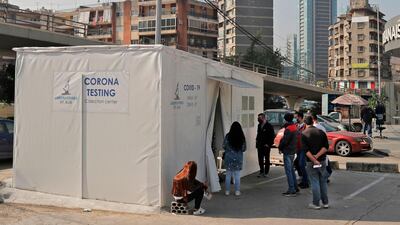
People line up to get tested for the coronavirus during a lockdown imposed by the authorities in a bid to slow the spread of the disease, in the town of Antelias, east of the Lebanese capital Beirut. AFP -
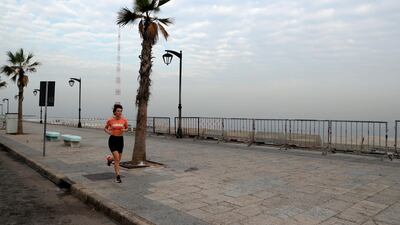
A woman runs on the empty waterfront promenade in Beirut amid a nationwide lockdown in Lebanon. AP Photo -
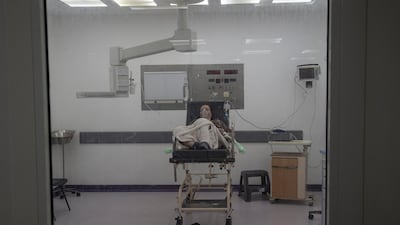
A patient in the Covid-19 intensive care unit at Rafic Hariri University Hospital in Beirut, Lebanon. EPA -
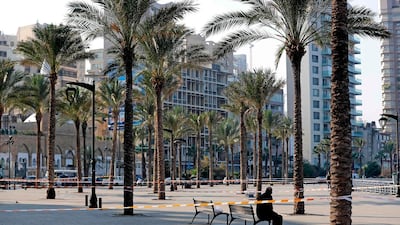
The usually crowded seaside promenade in Beirut is deserted, during a lockdown imposed by Lebanese authorities to slow the spread of the coronavirus. AFP -
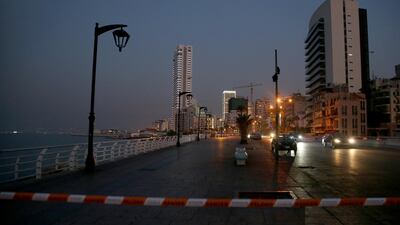
A warning tape seals off the seaside promenade in Beirut, Lebanon. EPA -
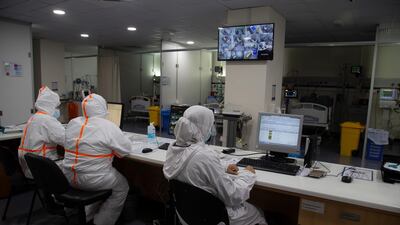
Healthcare staff and nurses monitor Covid-19 patients in intensive care at Rafic Hariri University Hospital in Beirut, Lebanon. EPA -
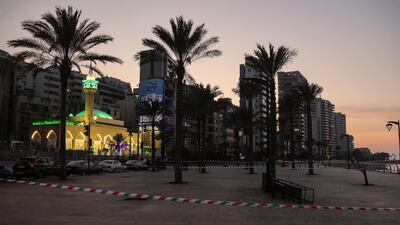
Beirut's seaside promenade is deserted during the first day of Lebanon latests coronavirus lockdown. EPA -
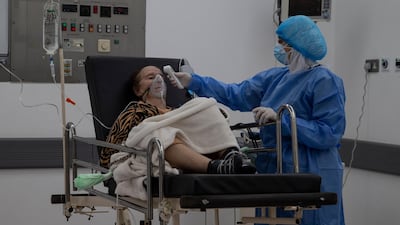
A nurse treats a Covid-19 patient in the intensive care unit at Rafic Hariri University Hospital in Beirut, Lebanon. EPA -

A Covid-19 patient in the intensive care unit at Rafic Hariri University Hospital in Beirut, Lebanon. EPA -

A nurse treats a patient in the Covid-19 intensive care unit at Rafic Hariri University Hospital in Beirut, Lebanon. EPA


When will people in Libya get a Covid-19 vaccine?
Libya has bought 2.7 million doses of the British-Swedish AstraZeneca vaccine for about $10 million, Badreddine al-Najjar, head of the country's national disease control centre, told AFP. It is hoped supplies will begin arriving in March.
The Government of National Accord also signed up to Covax to secure 2 million doses.
Neither government has yet detailed the roll-out plan or a timetable.
When will people in Morocco get a Covid-19 vaccine?
Morocco's health ministry has started distributing COVID-19 vaccines across the country on January 26, and appointments have been made for health workers and citizens are registering online to receive the vaccine in 3,000 locations, said Ben Azouz Mohammed, head of the ministry's vaccination programme.
Morocco received 2 million doses of AstraZeneca’s Covid-19 vaccine on January 22.
The shipment arrived on a Royal Air Maroc flight from India, which began exporting the vaccine developed in conjunction with Oxford University, to mid- and lower-income countries.
Morocco’s free vaccination campaign will start end of January, targeting health workers first, followed by public authorities, teachers and the elderly, in areas with higher infections, the health ministry said in a statement.
About 3,000 vaccine locations have been prepared as well as mobile units to deliver doses in hard-to-reach areas.
The capital city of Rabat has also placed orders for 66 million doses, where 25 million doses will be supplied by AstraZeneca - for which it has deals with both Serum Institute of India (SII) and Russia’s R-Pharm – and the remainder with China’s Sinopharm.
Morocco expects to receive its first vaccine batch from China’s Sinopharm on January 27.
The Moroccan authorities have already received the approval to start producing the Chinese vaccine domestically.
Morocco joined the Covax scheme as a lower-middle-income nation.
Dr Tayeb Hamdi, head of the National Syndicate of General Medicine in the private sector in Morocco, said the country "has an agreement with the [British] company AstraZeneca to obtain millions of doses of its vaccine when it is ready", and that there are negotiations with Pfizer/BioNTech and Johnson & Johnson so that several vaccines will arrive in Morocco.
On December 8, King Mohammed VI instructed the government to make the vaccine free of charge, the royal palace said.
The government is yet to detail the roll-out plan or a timetable.
When will people in Oman get a Covid-19 vaccine?
Oxford-AstraZeneca vaccines manufactured under licence by the Serum Institute of India (SII) arrived in Oman on January 30, ready for the next phase of the sultanate's vaccination campaign.
Oman started coronavirus vaccinations on December 27, two days ahead of plans to resume all flights and open borders that temporarily closed amid concerns over a new strain of the disease.
Oman directly contracted Pfizer and booked 370,000 vaccine doses, 20,000 of which will be delivered on December 23. The remainder will arrive at the beginning of next year. Each person will need two doses of the vaccine, according to Health Minister
A health ministry official said the first shipment would arrive on December 23, with the initial phase of inoculations to cover 20 per cent of the population.
Dr Al Saeedi said that the sultanate is negotiating with AstraZeneca, and has reserved 850,000 doses of their vaccine.
When will people in Palestine get a Covid-19 vaccine?
Israel agreed to transfer 5,000 doses of the coronavirus vaccine to immunise front-line Palestinian medical workers, Israeli Defence Minister Benny Gantz’s office said on Sunday.
Mr Gantz’s office said the transfer was approved. It had no further details on when that would happen.
There was no comment from Palestinian officials.
Four million doses of the Sputnik V vaccinwere expected to arrive in Palestine by the end of 2021 and the beginning of this year, said Osama Najjar, an official with the Palestinian Ministry of Health, told Voice of Palestine radio.
Minister of Health Mai Alkaila confirmed that the vaccine should arrive in Palestine by early next year and said that Palestine is in touch with Russia, Moderna and AstraZeneca companies regarding the purchase of the vaccine.
The Palestinian government said on November 30 that it plans to get about 2 million vaccines from the WHO.
Palestine is among the 92 countries to receive funding for the procurement of Covid-19 vaccines through the Covax scheme. The funding will cover up to 20 per cent of the population, while the government will finance enough for 50 per cent of the people of the West Bank and Gaza Strip, Ms Allkaila said.
The government is yet to detail the roll-out plan or a timetable.
-
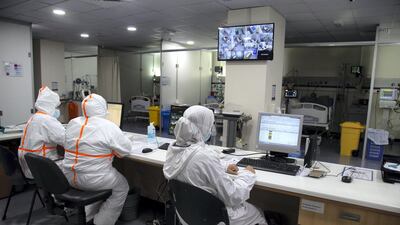
Healthcare staff and nurses watch over Covid-19 patients in the Covid-19 intensive care unit at Rafic Hariri University Hospital in Beirut. Lebanon started a 25-day long nationwide lockdown to battle a surge in coronavirus infections during the holiday season that has challenged the country's already battered health care sector. EPA -

A mother walks with her son down an alleyway deserted of tourists in Chefchaouen, northern Morocco. The picturesque town, its facades painted in distinctive hues of blue, shut its small population off from the world, and kept the virus out for months. Now, as the country cautiously reopens and tries to resuscitate its struggling economy, Chefchaouen stands subdued, deserted by the tourists that have long been its lifeblood. AP Photo -
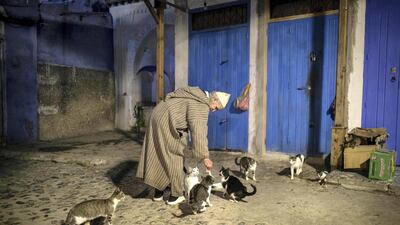
A shop owners feeds street cats, a hallmark of the town, in an alleyway deserted of tourists in Chefchaouen, northern Morocco. AP Photo -
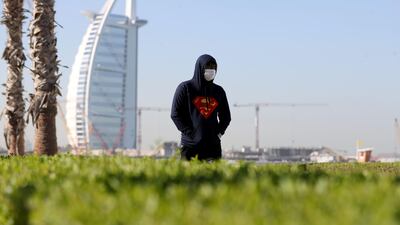
A man walks along the beach wearing a mask and a hoodie on as the colder weather sets in, Dubai. Chris Whiteoak / The National -
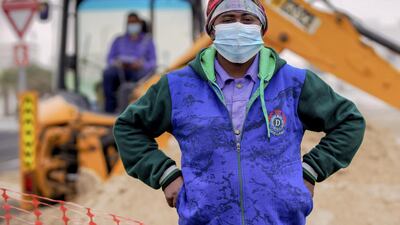
Road workers wearing masks on a chilly and hazy morning at Khalifa City. Victor Besa/The National -
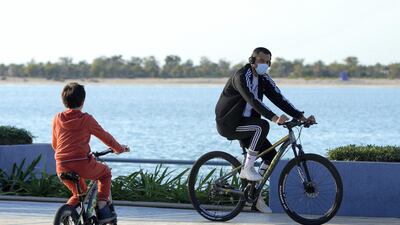
Abu Dhabi residents wearing warm clothing to protect themselves from the chilly weather and masks from coroanvirus. Victor Besa/The National -

People wearing face masks sit aboard a train, at the main train station, in Cairo, Egypt. The Egyptian government imposed a fine of 50 EGP (2.60 euro) from 03 January, to any individual not wearing a face mask when entering or working in markets, businesses, government installations, private establishments and banks, and also while riding in public or private mass transportation. This move is to help stop the spread of the coronavirus during the second wave of the pandemic. EPA -
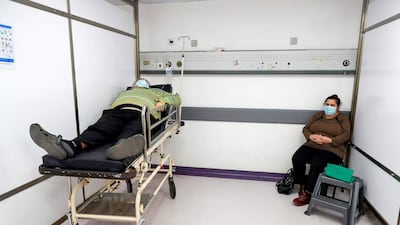
A man waits for treatment in the intensive care unit of the Rafic Hariri University Hospital in the Lebanese capital Beirut. With 192,000 reported cases and almost 1,500 deaths, Lebanon is not among the world's worst hit countries, but its infrastructure is crumbling and a small surge in infections is enough to take its health sector to breaking point. AFP -

Worker fills oxygen cylinders in a Gulf Gases factory in Cairo, Egypt. Egypt's health ministry affirmed the availability of oxygen in sufficient quantities at all hospitals receiving coronavirus patients nationwide, after reports claimed six patients with Covid19 died allegedly due to the lack of oxygen in two public hospitals in Sharqiya and Gharbiya governorates. EPA -
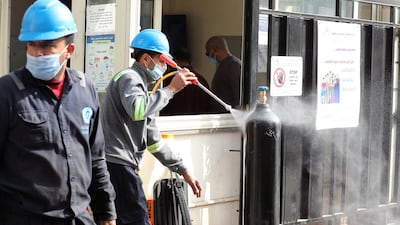
A worker sprays disinfectants on oxygen cylinders at a Gulf Gases factory in Cairo, Egypt. Egypt's health ministry affirmed the availability of oxygen in sufficient quantities at all hospitals receiving coronavirus patients nationwide, after reports claimed six patients with Covid19 died allegedly due to the lack of oxygen in two public hospitals in Sharqiya and Gharbiya governorates. EPA -
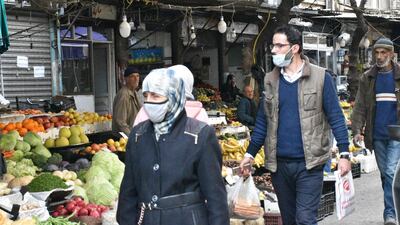
Syrians wearing masks as precautionary measures against the Coronavirus, buy their daily basic food items and other necessities in one of the streets of Damascus, Syria. EPA -
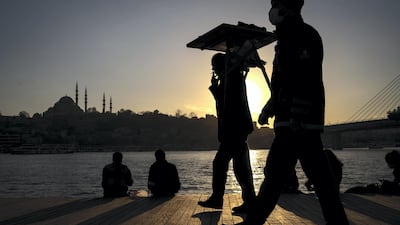
A street vendor selling simit pastries near Golden Horn with Suleymaniye Mosque in the background on sunny day in Istanbul, Turkey. EPA -
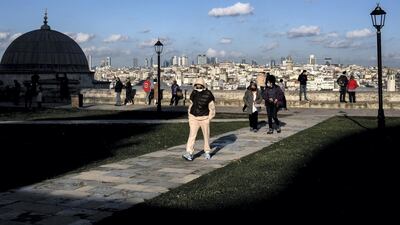
People wearing face masks at the garden of Suleymaniye Mosque on sunny day in Istanbul, Turkey. EPA -
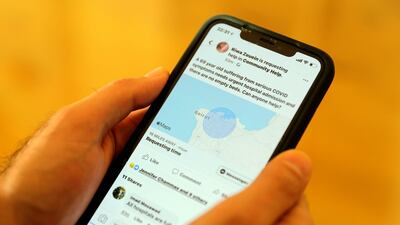
A man checks a community help page in order to locate an empty hospital bed for a COVID-19 patient in the Lebanese capital Beirut. With 192,000 reported cases and almost 1,500 deaths, Lebanon is not among the world's worst hit countries, but its infrastructure is crumbling and a small surge in infections is enough to take its health sector to breaking point. AFP -
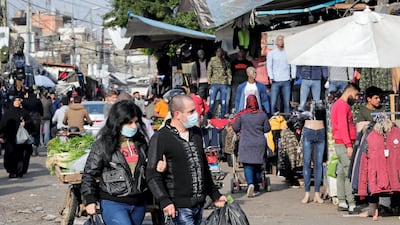
Lebanese, some wearing protective masks due to the COVID-19 pandemic, shop at a market in the Sabra neighbourhood of Beirut. The Lebanese government announced tightened restrictions through January in a bid to contain a spike in novel coronavirus infections threatening to overwhelm its health infrastructure. The authorities had eased measures in December but scenes of revellers thronging bars and clubs during the holiday season had left little doubt that fresh restrictions were on the way. AFP


When will people in Qatar get a Covid-19 vaccine?
Qatar received its first novel coronavirus vaccines on December 21, hours after regulators approved the Pfizer-BioNTech vaccine for use. Qatar announced it will inoculate all residents free of charge.
A shipment of 14 boxes of the vaccine landed at Doha's Hamad International Airport, without any indication of how many doses were in the boxes.
Last month, Qatar said it signed a deal with drug producer Moderna to buy its coronavirus vaccine as soon as it is approved.
Qatar has submitted its interest in joining the Covax scheme.
The government is yet to detail the rollout plan or a timetable.
When will people in Saudi Arabia get a Covid-19 vaccine?
The Serum Institute of India (SII) annoucned on January 26 that will supply Saudi Arabia with 3 million AstraZeneca COVID-19 vaccine doses priced at $5.25 each, in about a week on behalf of the British drugmaker.
Saudi Arabia's health ministry approved the AstraZeneca and Moderna vaccines on January 20 to speed up Covid-19 inoculations in the country.
The Pfizer-BioNTech vaccine is already being used in the kingdom.
The Health Ministry said it hoped to have enough vaccines to cover 70 per cent of the country's population by the end of 2021.
Registration to get the vaccine has already started through the Tawakulna application, for vulnerable groups identified by the ministry of health, said managing director of the Saudi Vaccine Company, Dr Mazen Hassanein.
Vaccination stations have been set up throughout the kingdom, and 50,000 people registered to receive the vaccine in the 24 hours after the minister urged Saudis and residents to sign up for it using Tawakulna.
Saudi Arabia has signed agreements with several countries to procure early supplies of vaccines that have reached the final stages of clinical trials and it expressed interest in the Covax scheme.
The Saudi Pharmaceutical Industries and Medical Supplies Corporation, SPIMACO Pharmaceutical, announced in November that it had signed a non-binding agreement with the German company CureVac to provide its vaccine for Saudi Arabia.
The kingdom has spent more than $200 million on drug development and procuring the vaccine.
Dr Abdullah Asiri, the assistant undersecretary at the Health Ministry, said in late November that a comprehensive timetable and roll-out plan would be announced "in weeks".
While it will be free for all citizens and residents of Saudi Arabia, those under 16 will not be vaccinated unless further studies show it is effective.
When will people in Sudan get a Covid-19 vaccine?
Sudanese Prime Minister Abdullah Hamdok said during a press conference in Khartoum on December 14, that Sudan has received 8.4 million doses of the vaccine, which will be allocated to "the sectors most vulnerable to the disease, especially the medical sector."
"We are seeking to obtain units to vaccinate all Sudanese," he added.
Distribution is expected to begin in the first quarter of 2021.
Mr Hamdok did not specify which vaccine was acquired, nor the method by which the acquisition of these vaccines was carried out.
The WHO says that Sudan is in line for assistance under the Covax scheme as a lower-middle-income country.
The government is yet to detail the roll-out plan or a timetable.
When will people in Syria get a Covid-19 vaccine?
Russia will give Syria both of its vaccines (Sputnik V and EpiVacCorona), the chairman of the State Duma’s committee on international affairs, Leonid Slutsky, said at a meeting with an official delegation of Syrian medics during their visit to Russia in October.
"There are no vaccines determined yet," the WHO regional office in Syria said. But the WHO, together with Unicef and Gavi were supporting Syria to acquire "vaccines to cover at least three per cent of the population to start with and aiming for 20 per cent in 2021."
The government is yet to detail the roll-out plan or a timetable.
When will people in Tunisia get a Covid-19 vaccine?
Tunisia signed up to the Covax scheme as a lower-middle-income nation and applied for the procurement of 5 million doses of the vaccine, Health Minister Faouzi Mehdi said in early December.
Hechmi Louzir, director of the Pasteur Institute of Tunis, said the Health Ministry has contracted to buy vaccines from Pfizer, scheduled to arrive in April or May 2021.
One million people will be vaccinated in the first stage, Mr Louzir said.
There are no other details regarding the roll out and timetable.
When will people in Turkey get a Covid-19 vaccine?
Turkey received another 6.5 million doses of the Sinovac Biotech coronavirus vaccine on January 25, CNN Turk reported, allowing its nationwide rollout to continue.
An initial consignment of 3 million doses previously arrived early on December 30 and it has so far vaccinated 1.245 million people, mostly health workers and elderly people.
Health Minister Fahrettin Koca stated that the vaccines will be delivered in batches between December and February.
State broadcaster TRT Haber said the latest shipment, part of a second consignment which will total 10 million doses, arrived at Istanbul Airport early in the morning on a Turkish Airlines flight from Beijing.
Russian sovereign wealth fund RDIF announced on January 23 that it had signed an agreement with Turkey on production of its Sputnik V vaccine, adding that it had begun transferring the production technology to Turkey.
Turkey is also in talks to increase the amount of coronavirus vaccines from Pfizer and BioNTech, from the initial 1 million doses, Sozcu newspaper quoted Mr Koca as saying.
When will people in the UAE get a Covid-19 vaccine?
Dubai rolled out the Pfizer-BioNTech vaccine across the emirate on December 23, giving priority to those age 60 and over, people with chronic diseases, disabled members of the public and frontline workers and those operating in key sectors.
The UAE officially registered the Sinopharm vaccine on December 9, saying it was 86 per cent effective, according to analysis of third-phase trials.
The Health Ministry "has announced the official registration" of the vaccine, state news agency WAM said, without elaborating.
The rollout of the Sinopharm vaccine has begun, with the health ministry saying there were "no serious safety concerns".
The vaccine was approved for emergency use for healthcare workers in September.
The UAE has participated in the Phase 3 clinical trial for the Sinopharm vaccine since July and set up by a partnership between Sinopharm's China National Biotec Group and Abu Dhabi-based artificial intelligence and cloud computing company Group 42.
Two vaccines have undergone third-phase trials in the UAE, the Sinopharm project and Russia's Sputnik V.
Authorities recently announced that those who have been vaccinated against Covid-19 will no longer be required to quarantine for 14 days on return to Abu Dhabi from abroad.
When will people in Yemen get a Covid-19 vaccine?
According to the WHO, the Gavi board agreed in July to support several low-income countries including Yemen.
The government is yet to detail the roll-out plan or a timetable and there are worries that the ongoing war could slow a vaccination drive.

