
Tests show the Oxford-AstraZeneca vaccine is be up to 70 per cent effective in fighting coronavirus infection.
In a surprise twist, the much-vaunted vaccine was up to 90 per cent effective when administered at a half dose and then at a full dose.
Here’s a look at the key questions behind how the Oxford vaccine works:
How does it trigger an immune response?
The vaccine uses a weakened version of a virus to prepare the body for an attack.
In this case, scientists used a virus that causes a common cold in chimpanzees but is harmless to humans.
The genetic instructions for the “spike protein” of coronavirus – which it needs to invade cells – are transferred to the vaccine.
It triggers an immune response, effectively training the body to recognise coronavirus and destroy it.
Having been through a practice run, the body is ready to fight the real thing.
Does it work differently to Pfizer and Moderna’s vaccines?
Yes. The Oxford vaccine uses conventional technology, while Pfizer and Moderna’s vaccine is a new approach.
Pfizer and Moderna are messenger RNA vaccines.
RNA vaccines use only the virus’s genetic code, while the Oxford vaccine uses a weakened version of the virus.
Pfizer and Moderna’s vaccines, which each have 95 per cent efficacy, tell the body to create antigens to fight infected cells.
No actual virus is needed to create RNA vaccines.
How is it administered and why does the dose matter?
Curiously, the Oxford vaccine was less effective when given as two full doses.
In clinical trials, the vaccine was 90 per cent effective when administered as one half dose followed by a full dose a month later.
The result was 62 per cent when given as two full doses over the same time period.
Together, the results calculate to an average efficacy of 70 per cent.
Prof Andrew Pollard, head of the Oxford Vaccine Group, said on Monday more data was needed to explain why there was a difference.
“We think by giving a smaller first dose we’re priming the immune system differently, we’re setting it up to respond better," he said.
“But we don’t know whether it is in the quality or the quantity of the immune response.”
Prof Sarah Gilbert, who worked on the vaccine, theorised that the smaller dosage better mimicked how coronavirus infects the body.
“It could be that it is a better way of kicking the immune system into a reaction,” she said.
When will it be rolled out?
AstraZeneca said it hopes to have four million doses of the vaccine manufactured by the end of the year.
It is hoped that number will rise sharply to 40 million by the end of March.
At times of peak distribution, 200 million doses will be manufactured each month.
Pam Cheng, AstraZeneca's vice president of operations, said the company was planning for half-dose and full-dose scenarios.
“There are not many implications for distribution (under both scenarios),” she said.
Are Pfizer and Moderna’s vaccines better than Oxford’s?
Scientists are cautioning against judging one vaccine as better than another.
Prof Pollard said comparisons were difficult because the data behind Pfizer and Moderna’s vaccines had not yet been released.
“Press releases don’t give all the information,” he said. The Oxford data is expected to be released in coming days.
While the Oxford vaccine may have a lower efficacy, it is cheaper and can be distributed easily.
The Pfizer shot needs to be kept at minus 75°C while Oxford’s can be stored at refrigerator temperature.
Is it safe?
No one who was on the Oxford trial needed to be admitted to hospital for coronavirus, scientists said.
The team reported that minor side effects included tiredness, headaches and fever.
The safety data has been submitted to regulators on a “rolling basis” and the team believes they can apply for emergency approval shortly.
Can this vaccine help the elderly?
The University of Oxford said its vaccine could induce a strong immune response in all age groups.
The immune responses among younger and older adults were similar, it said.
-

A pedestrian wearing a face mask walks past Cstreet art, advising to "Stay Alert" and "Save Lives" in central London. AFP -
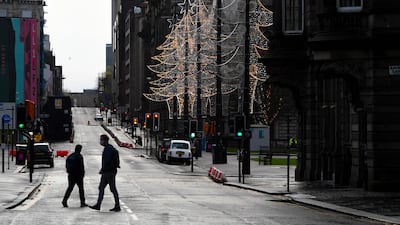
Pedestrians cross a near-deserted George Street in central Glasgow. AFP -
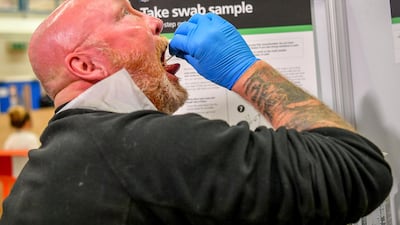
A testing staff member completes a lateral flow test swab, mandatory before opening to the public, at Rhydycar leisure centre in Merthyr Tydfil, Wales. AP Photo -
Pensioners walk through woodland during lockdown in London. Reuters -
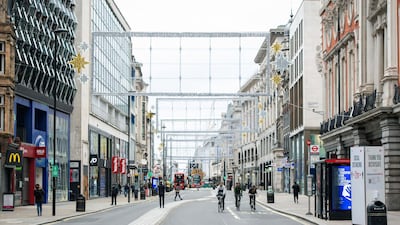
Cyclists ride along a quiet Oxford Street in London. AP Photo -
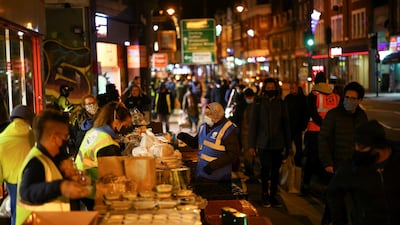
Volunteers working for the Tooting Community Kitchen prepare food to be donated to those in need in London. Reuters -
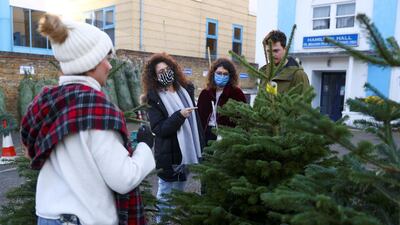
People shop for Christmas trees in the Balham area of London. Reuters -

Pedestrians wearing a protective face covering walk past a Christmas tree in Covent Garden in central London. AFP -
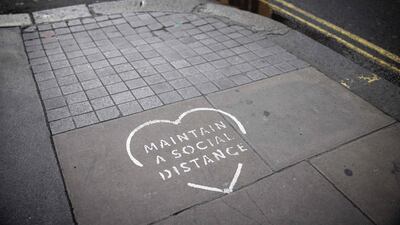
A sign on a pavement advises pedestrians to "Maintain Social Distancing" in central London. AFP -
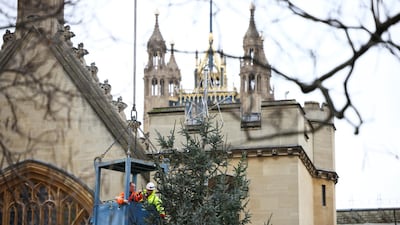
Workers hang lights on to a Christmas tree within the grounds of The Houses of Parliament in London. Reuters



