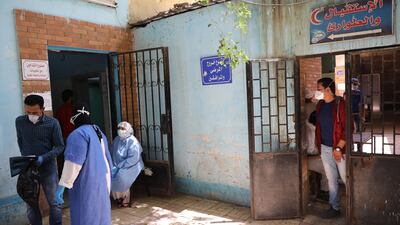
A man walks in front of a pharmacy amid the coronavirus pandemic in Alexandria, Egypt on December 6, 2020. Reuters

Coronavirus surge in Egypt sees daily cases double in a month


Hamza Hendawi
  • English
  • Arabic

The number of Covid-19 cases reported in Egypt has surged from a daily average of less than 200 to well over 400 since the start of the month, giving credence to forecasts of a “second wave”.

These are relatively small numbers in a country of 100 million people, but Health Ministry figures are taken as a reliable indicator of the rate of infections, rather than the number of cases.

This is attributed in part to limited testing by the state’s health services and the large number of patients who contract a mild form of Covid-19 and recover without reporting to hospitals.

While Covid-19 cases and related deaths are fewer in the wave, the publicity surrounding the relatively high number of Egyptian celebrities who contracted the disease is drawing added attention.

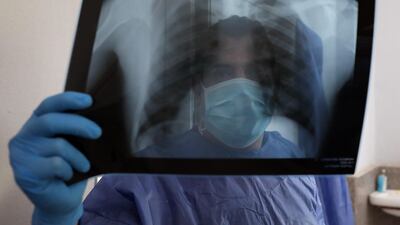
  • Medical personnel checks an X-ray at the Imbaba Fevers Hospital in Cairo. EPA
    Medical personnel checks an X-ray at the Imbaba Fevers Hospital in Cairo. EPA
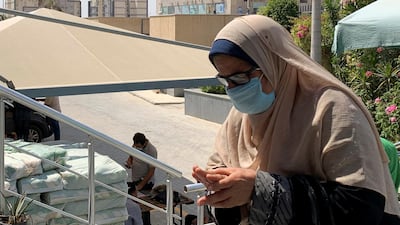
  • A woman wears a protective face mask, amid concerns over the coronavirus disease in Cairo, Egypt. Reuters
    A woman wears a protective face mask, amid concerns over the coronavirus disease in Cairo, Egypt. Reuters
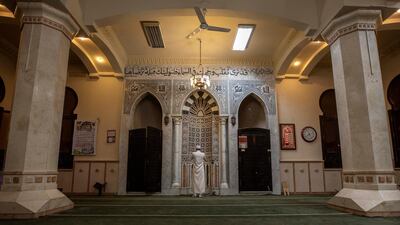
  • An Imam makes the Adaan call to prayer inside an empty mosque after the government banned all religious activities due to the coronavirus outbreak in Cairo. AP
    An Imam makes the Adaan call to prayer inside an empty mosque after the government banned all religious activities due to the coronavirus outbreak in Cairo. AP
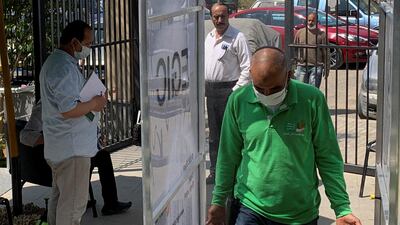
  • A man wears a protective face mask while walking through a sanitizing gate in Cairo. Reuters
    A man wears a protective face mask while walking through a sanitizing gate in Cairo. Reuters
  • People at the Imbaba Fevers Hospital in Cairo, Egypt. EPA
    People at the Imbaba Fevers Hospital in Cairo, Egypt. EPA
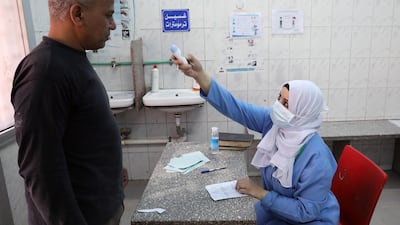
  • Medical personnel check the body temperature of a man at the Imbaba Fevers Hospital in Cairo. EPA
    Medical personnel check the body temperature of a man at the Imbaba Fevers Hospital in Cairo. EPA
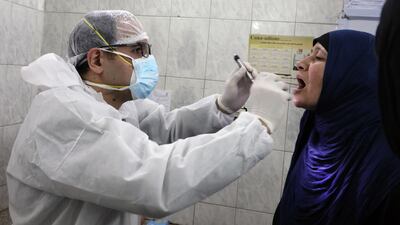
  • A doctor checks a patient at the Imbaba Fevers Hospital in Cairo. EPA
    A doctor checks a patient at the Imbaba Fevers Hospital in Cairo. EPA
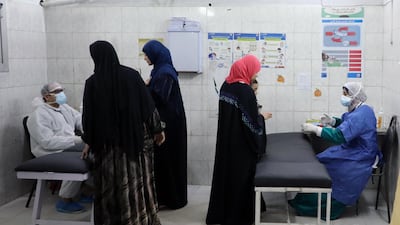
  • Medical personnel with patients at the Imbaba Fevers Hospital in Cairo. EPA
    Medical personnel with patients at the Imbaba Fevers Hospital in Cairo. EPA
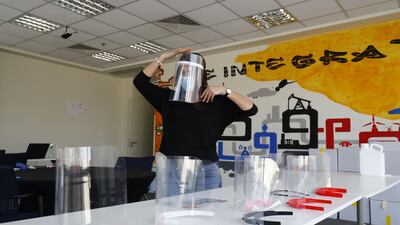
  • Aya Dessouky, public relations specialist at the Giza Systems Education Foundation, packs a newly-fabricated protective face shield before sending it for use by medical professionals treating Covid-19 coronavirus patients. AFP
    Aya Dessouky, public relations specialist at the Giza Systems Education Foundation, packs a newly-fabricated protective face shield before sending it for use by medical professionals treating Covid-19 coronavirus patients. AFP
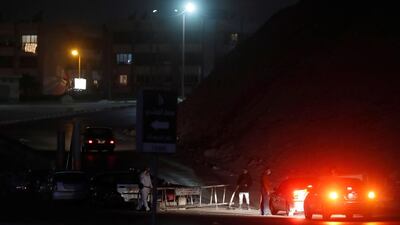
  • A police checkpoint at the area of the Cairo suburb of Maadi during a night-time curfew to contain the spread of the coronavirus. Reuters
    A police checkpoint at the area of the Cairo suburb of Maadi during a night-time curfew to contain the spread of the coronavirus. Reuters
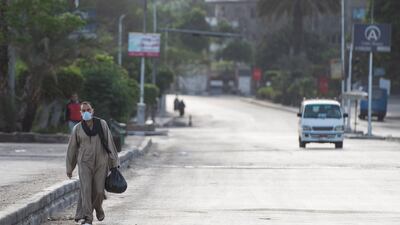
  • A man wearing a protective face mask walks in street in Cairo. EPA
    A man wearing a protective face mask walks in street in Cairo. EPA
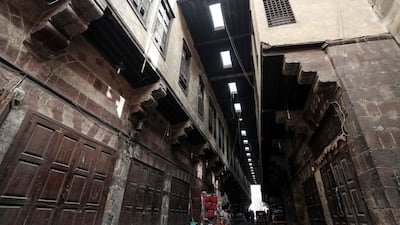
  • Closed shops along Khayamiya Street in the old city of the Egyptian capital Cairo, almost empty due to the Covid-19 coronavirus pandemic. AFP
    Closed shops along Khayamiya Street in the old city of the Egyptian capital Cairo, almost empty due to the Covid-19 coronavirus pandemic. AFP
  • A member of the medical staff at the infectious diseases unit of the Imbaba hospital in Cairo. AFP
    A member of the medical staff at the infectious diseases unit of the Imbaba hospital in Cairo. AFP
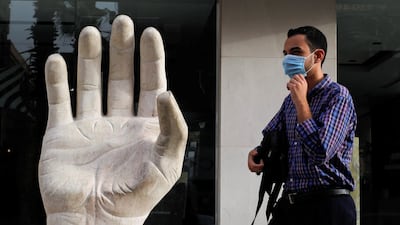
  • A man wearing a protective face mask walks near a granite symbol hand of peace, amid concerns over the coronavirus disease. Reuters
    A man wearing a protective face mask walks near a granite symbol hand of peace, amid concerns over the coronavirus disease. Reuters
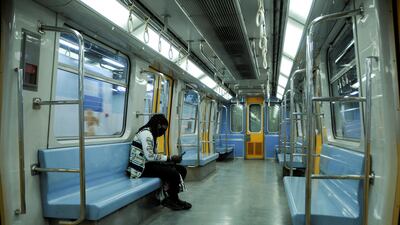
  • A woman wearing a protective face mask sits inside an empty metro train, as she travels on a line Shubra Al Khaimah to Tahrir Square. Reuters
    A woman wearing a protective face mask sits inside an empty metro train, as she travels on a line Shubra Al Khaimah to Tahrir Square. Reuters
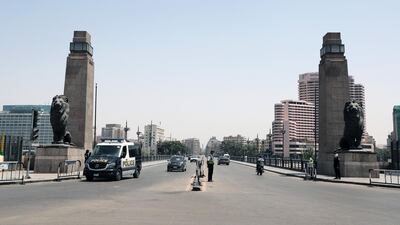
  • Egyptian policemen patrol the Qasr Nile bridge to ensure people abiding by restrictions during the national holiday of Sham El-Nessim. EPA
    Egyptian policemen patrol the Qasr Nile bridge to ensure people abiding by restrictions during the national holiday of Sham El-Nessim. EPA
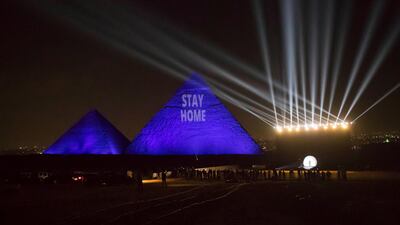
  • The Great pyramids lighten-up with blue light and reading with a laser projection the message "Stay Home" on the Giza plateau outside the Egyptian capital of Cairo. AFP
    The Great pyramids lighten-up with blue light and reading with a laser projection the message "Stay Home" on the Giza plateau outside the Egyptian capital of Cairo. AFP
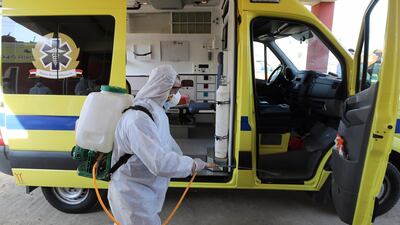
  • A medical worker disinfects an ambulance which transported a possible patient with coronavirus Covid-19 at fever hospital in Embaba district. EPA
    A medical worker disinfects an ambulance which transported a possible patient with coronavirus Covid-19 at fever hospital in Embaba district. EPA

The most prominent of those celebrities was Liverpool and Egypt star striker Mohamed Salah, who is believed to have been infected at his brother’s wedding in Cairo last month.

Images online showed Salah not wearing a mask or wearing it negligently.

He missed two international fixtures with the Pharaohs and a Premier League match before he tested negative and resumed playing for Liverpool.

About half a dozen movie stars caught the disease at a popular film festival held at an upscale Red Sea resort in late October.

Organisers countered criticism by insisting that preventive measures such as face masks and social distancing were strictly enforced.

But images online showed crowded auditoriums and after parties, where few guests observed precautions.

Another film festival opened on Thursday in Cairo, with most celebrities walking the red carpet without masks and images from parties again showing film stars mingling freely without masks or social distancing.

A total of 118,014 people have fallen victim to the coronavirus since February when the pandemic first arrived in Egypt, the Health Ministry said, while the death toll has reached 6,750.

Officials have said the number could be much higher, perhaps 10 times the reported amount.

June had the highest number of cases and deaths, with the daily number hitting as many as 1,700 and about 100 respectively, the ministry said.

The government has repeatedly warned that, until a vaccine is available, Egyptians must take precautions against the spread of the coronavirus.

Authorities said they intend to reinforce the 4,000-pound fine on anyone using public transport or going to government offices without wearing a mask.

They said failure to observe preventive measures would allow the disease to spread as it did elsewhere in the world with disastrous consequences, and an unwanted repeat of the March-July lockdown that hurt the economy.


The specs: 2019 Mini Cooper

Price, base: Dh141,740 (three-door) / Dh165,900 (five-door)
Engine: 1.5-litre four-cylinder (Cooper) / 2.0-litre four-cylinder (Cooper S)
Power: 136hp @ 4,500rpm (Cooper) / 192hp @ 5,000rpm (Cooper S)
Torque: 220Nm @ 1,480rpm (Cooper) / 280Nm @ 1,350rpm (Cooper S)
Transmission: Seven-speed automatic
Fuel consumption, combined: 4.8L to 5.4L / 100km

Mercer, the investment consulting arm of US services company Marsh & McLennan, expects its wealth division to at least double its assets under management (AUM) in the Middle East as wealth in the region continues to grow despite economic headwinds, a company official said.

Mercer Wealth, which globally has $160 billion in AUM, plans to boost its AUM in the region to $2-$3bn in the next 2-3 years from the present $1bn, said Yasir AbuShaban, a Dubai-based principal with Mercer Wealth.

Within the next two to three years, we are looking at reaching $2 to $3 billion as a conservative estimate and we do see an opportunity to do so,” said Mr AbuShaban.

Mercer does not directly make investments, but allocates clients’ money they have discretion to, to professional asset managers. They also provide advice to clients.

“We have buying power. We can negotiate on their (client’s) behalf with asset managers to provide them lower fees than they otherwise would have to get on their own,” he added.

Mercer Wealth’s clients include sovereign wealth funds, family offices, and insurance companies among others.

From its office in Dubai, Mercer also looks after Africa, India and Turkey, where they also see opportunity for growth.

Wealth creation in Middle East and Africa (MEA) grew 8.5 per cent to $8.1 trillion last year from $7.5tn in 2015, higher than last year’s global average of 6 per cent and the second-highest growth in a region after Asia-Pacific which grew 9.9 per cent, according to consultancy Boston Consulting Group (BCG). In the region, where wealth grew just 1.9 per cent in 2015 compared with 2014, a pickup in oil prices has helped in wealth generation.

BCG is forecasting MEA wealth will rise to $12tn by 2021, growing at an annual average of 8 per cent.

Drivers of wealth generation in the region will be split evenly between new wealth creation and growth of performance of existing assets, according to BCG.

Another general trend in the region is clients’ looking for a comprehensive approach to investing, according to Mr AbuShaban.

“Institutional investors or some of the families are seeing a slowdown in the available capital they have to invest and in that sense they are looking at optimizing the way they manage their portfolios and making sure they are not investing haphazardly and different parts of their investment are working together,” said Mr AbuShaban.

Some clients also have a higher appetite for risk, given the low interest-rate environment that does not provide enough yield for some institutional investors. These clients are keen to invest in illiquid assets, such as private equity and infrastructure.

“What we have seen is a desire for higher returns in what has been a low-return environment specifically in various fixed income or bonds,” he said.

“In this environment, we have seen a de facto increase in the risk that clients are taking in things like illiquid investments, private equity investments, infrastructure and private debt, those kind of investments were higher illiquidity results in incrementally higher returns.”

The Abu Dhabi Investment Authority, one of the largest sovereign wealth funds, said in its 2016 report that has gradually increased its exposure in direct private equity and private credit transactions, mainly in Asian markets and especially in China and India. The authority’s private equity department focused on structured equities owing to “their defensive characteristics.”

COMPANY%20PROFILE
%3Cp%3E%3Cstrong%3ECompany%20name%3A%20%3C%2Fstrong%3ESupy%0D%3Cbr%3E%3Cstrong%3EStarted%3A%20%3C%2Fstrong%3E2021%0D%3Cbr%3E%3Cstrong%3EFounders%3A%20%3C%2Fstrong%3EDani%20El-Zein%2C%20Yazeed%20bin%20Busayyis%2C%20Ibrahim%20Bou%20Ncoula%0D%3Cbr%3E%3Cstrong%3EBased%3A%20%3C%2Fstrong%3EDubai%0D%3Cbr%3E%3Cstrong%3EIndustry%3A%20%3C%2Fstrong%3EFood%20and%20beverage%2C%20tech%2C%20hospitality%20software%2C%20Saas%0D%3Cbr%3E%3Cstrong%3EFunding%20size%3A%20%3C%2Fstrong%3EBootstrapped%20for%20six%20months%3B%20pre-seed%20round%20of%20%241.5%20million%3B%20seed%20round%20of%20%248%20million%0D%3Cbr%3E%3Cstrong%3EInvestors%3A%20%3C%2Fstrong%3EBeco%20Capital%2C%20Cotu%20Ventures%2C%20Valia%20Ventures%20and%20Global%20Ventures%3C%2Fp%3E%0A
The burning issue

The internal combustion engine is facing a watershed moment – major manufacturer Volvo is to stop producing petroleum-powered vehicles by 2021 and countries in Europe, including the UK, have vowed to ban their sale before 2040. The National takes a look at the story of one of the most successful technologies of the last 100 years and how it has impacted life in the UAE. 

Read part four: an affection for classic cars lives on

Read part three: the age of the electric vehicle begins

Read part two: how climate change drove the race for an alternative 

German intelligence warnings
  • 2002: "Hezbollah supporters feared becoming a target of security services because of the effects of [9/11] ... discussions on Hezbollah policy moved from mosques into smaller circles in private homes." Supporters in Germany: 800
  • 2013: "Financial and logistical support from Germany for Hezbollah in Lebanon supports the armed struggle against Israel ... Hezbollah supporters in Germany hold back from actions that would gain publicity." Supporters in Germany: 950
  • 2023: "It must be reckoned with that Hezbollah will continue to plan terrorist actions outside the Middle East against Israel or Israeli interests." Supporters in Germany: 1,250 

Source: Federal Office for the Protection of the Constitution