

The headlines were dramatic: "Hundreds reported to have died in Iraqi explosion," in the New York Times while the Associated Press leader proclaimed disaster at a "missile plant".
Unnamed western diplomats claimed that a secretive Iraqi military base, later known as Al Qa Qaa Special Weapons Facility, had been destroyed in a mysterious accident.
There were rumours of 700 dead, and the blast being heard in Baghdad, 40 kilometres away. If confirmed, the disaster would be one of the worst accidental explosions in history, worse even than the tragedy in Beirut last month that left at least 190 people dead.
As news of the explosion spread, 31-year-old Iranian-British freelance journalist Farzad Bazoft rushed to the site. But despite having gained the trust of authorities due to his anti-Ayatollah views, he was turned away at the scene, along with a news crew from ITN.

Undeterred, he returned disguised as a doctor and with the help of a British nurse, Daphne Parish, took 32 photographs of the ruined site.
"Farzad was very keen to get to the explosion site. On the day, the car and driver that Farzad was promised failed to turn up. All the other journalists got there and some were detained, briefly, for climbing the fence," Ms Parish told The National.
Read More
Lebanese brave perilous sea crossing to escape country in crisis
Iraq-Iran war: a legacy of carnage that shaped the Middle East for 40 years
Invasion of Kuwait 30 years on: Iraq still reeling from disaster of Saddam’s misstep
Mr Bazoft’s intrepid reporting would cost him his life. His probing of Iraqi officials in the weeks after the incident raised suspicions and he was arrested before boarding a flight to London in September, according to reports.
Tortured in Abu Ghraib prison, he later made a staged televised “confession” to being a spy and was executed on March 15, 1990, hanged reportedly on the orders of former Iraqi dictator Saddam Hussein.
An international outcry and pleas from the British government (then allied to Saddam) failed to save him. Ms Parish, who was arrested alongside him, was released after a six-month ordeal but an Iraqi suspected of processing Mr Bazoft’s film spent 14 years in jail and had his finger amputated.
Years passed, and the explosion drifted from historical memory. A former CIA officer who could not be quoted, but worked in Iraq at the time, has only a vague recollection of the incident.
Rumours of WMD
Before UN and International Atomic Energy Agency weapons inspectors arrived in the 1990s, Al Qa Qaa facility was shrouded in mystery.
The IAEA had visited numerous times after the Gulf War, which ended in 1991, uncovering attempts to design “explosive lenses,” which use an implosive force to detonate nuclear warheads. This discovery was a critical moment in the 12-year hunt for weapons of mass destruction in Iraq.
-
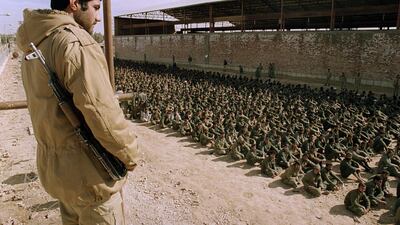
An Iranian soldier guards Iraqi prisoners of war in Ahvaz, Iran, on January 22, 1987. AFP -
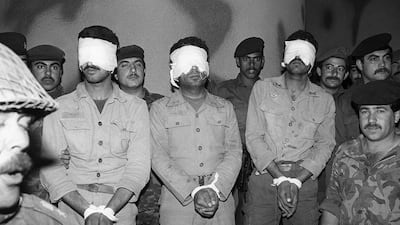
Iranian prisoners of war north of Basra on March 18, 1985, after a foiled offensive by Iranian troops. AFP -
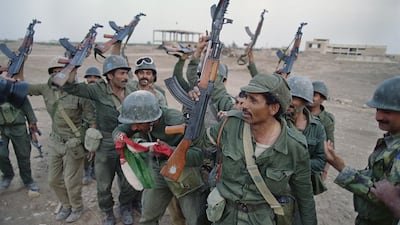
Iraqi soldiers celebrate their victory over Iran in the strategic Al Faw peninsula of south Iraq on April 20, 1988. AFP -
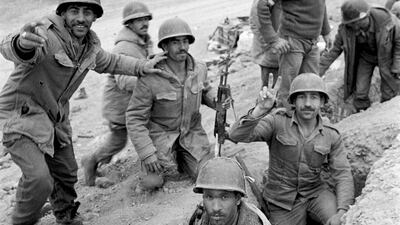
An Iraqi soldier flashes a victory sign near Al Howeizah swamps, north of Basra city, on March 18, 1985. AFP -
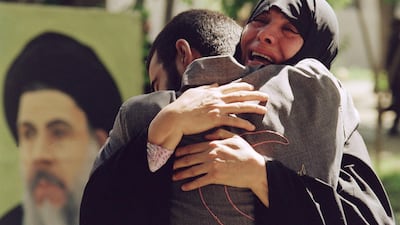
An Iranian mother hugs her son in Tehran following his release from an Iraqi prison, on August 1, 1989. AFP -
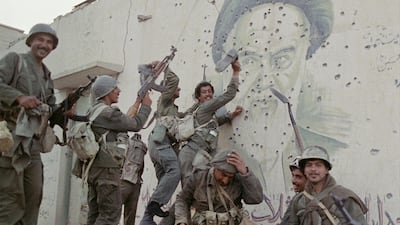
Iraqi soldiers pose in front of a mural of Ayatollah Ruhollah Khomeini in the strategic Al Faw peninsula of southern Iraq on April 20, 1988. AFP -
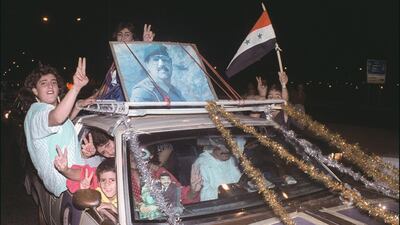
Iraqis in Baghdad celebrate the ceasefire between Iraq and Iran on August 20, 1988. AFP -

Iraqi soldiers wave near a tank after the destruction of Iranian positions in the Al Faw peninsula in southern Iraq, April 20, 1988. AFP -
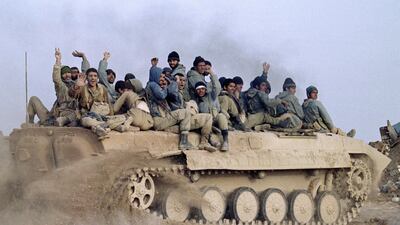
Iranian revolutionary guards celebrate their victory over Iraqi troops in Iraq's Bovarian Island, near Basra, on January 23, 1987. AFP -
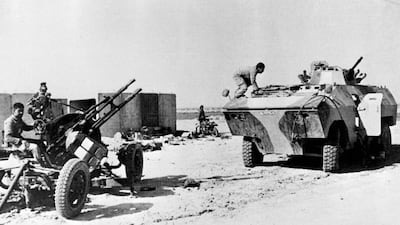
Iranian anti-aircraft artillery and captured Iraqi hardware in the Iraqi Al Faw peninsula, on February 17, 1986, AFP. -
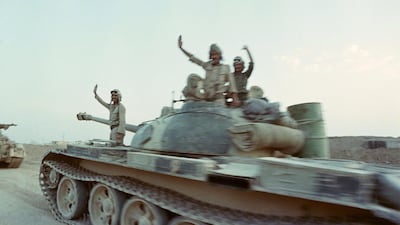
Iraqi soldiers as they regained the Al Faw peninsula of south Iraq on April 20, 1988. Al Faw was scene of some of the bloodiest fighting in the Iran-Iraq war. AFP -
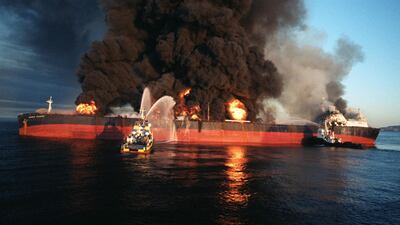
Firefighting vessels on the Singapore-flagged tanker Norman Atlantic after an Iranian attack near the Strait of Hormuz on December 6, 1987. AFP -
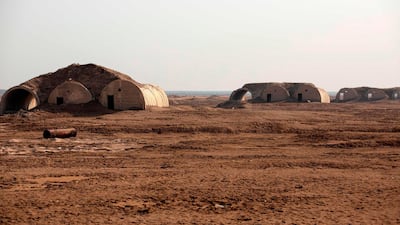
Former Iranian military bunkers in the southern Iraqi region of Al Faw on September 17, 2020. AFP -
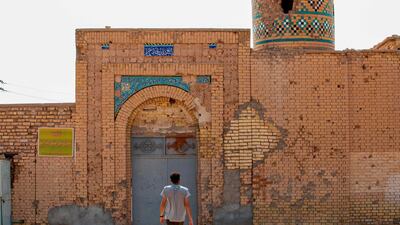
A destroyed mosque in Iraq's southern Al Faw peninsula on September 17, 2020. AFP -
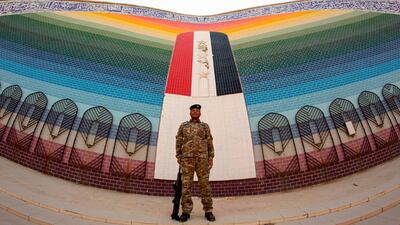
An Iraqi soldier at Al Rahman mosque, built in 1989, on the southern region of Al Faw on September 17, 2020. AFP -
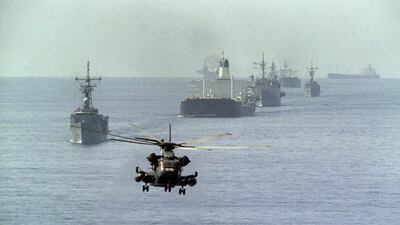
A US Navy minesweeping helicopter leads the way for a US reflagged Kuwaiti tanker convoy, on October 22, 1987, in the Arabian Gulf. AFP -

Firefighting vessels extinguish flames on the Singapore-flagged Norman Atlantic after it was attacked by an Iranian warship in Omani territorial waters, on December 6, 1987. AFP


After the overthrow of Saddam in the 2003 US-led invasion, the site was never far from controversy. Comprising miles of bunkers and ruined buildings, it was a place of foreboding. According to Craig Whiteside, a former US army officer tasked with overseeing the clear up of the site, many Iraqis would simply not visit, despite being desperate for work in the war-ravaged economy.
“With Al Qa Qaa it was a deep fear of the place. I think the Iraqis were afraid to uncover something there that was very bad and they weren’t sure what it was, but could probably guess. They flat-out refused, and I tested them by offering some money to do a decent clean-up. They were quite dismissive.”
A family tragedy
For Sabah Abdulamir Al Sultani, August 19, 1989, should have been a happy day. The 22-year-old construction worker had just completed vocational training and had been married just over a month. He was visiting his family in Hillah, a small town not far from Al Qa Qaa, before departing for the afternoon shift at the factory.
A long, grinding war with Iran from 1980 to 1988, which had claimed up to a million lives, was coming to a close and Mr Ameedee’s niece Safa had just been born. Life should have been looking up.
“My mother said Sabah was making jokes and happy to see me as I was born that year. She said Sabah was quite cheerful before leaving for work,” recalls Safa, who now lives in Germany.
Mr Ameedee said farewell to his family and departed for Al Qa Qaa. It was the last they would see of him.
'Like a nuclear bomb'
Classed as a secondary high explosive, TNT can sometimes burn fiercely when exposed to heat, rather than explode, because it needs a detonator to set off.
So, when a barrel full of TNT caught fire in a warehouse in Al Qa Qaa, many of the thousands of workers on site stopped work to gaze at the gathering smoke.
According to witness Kamil Al Turfi, who worked as an engineer at the site, the barrel was burning like a fuse, "from the upper hole". Mr Al Turfi described how a fire truck had managed to reach the scene and was dousing the flames, but the fire kept burning he told The National.
-

Picture taken on August 14, 1990 at Ruwaished showing Arab refugees from different countries waiting for the permission to return to their homelands at the Iraq-Jordan border checkpoint as thousands of foreigners flee the war in Iraq and Kuwait. AFP -
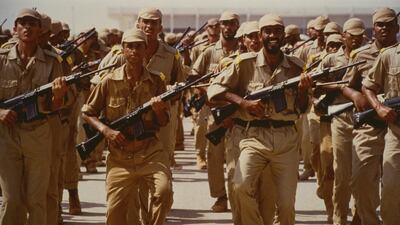
August 1990: A training camp for new recruits in the United Arab Emirates, following the country's appeal for servicemen on the 11th August 1990, during the Gulf Crisis. Getty -
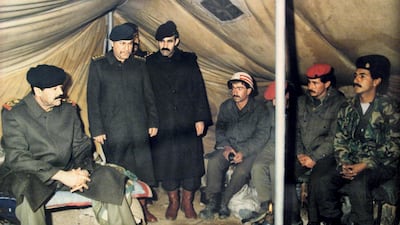
A reproduction of a picture displayed at the Nasr or Victory Museum in Baghdad shows Iraqi President Saddam Hussein (L) visiting Iraqi troops at a military camp in occupied territory in Kuwait after the August 2, 1990 invasion of the Gulf emirate. Getty -

The Emir of Kuwait Jaber Al Sabah (R) walks with Egyptian President Hosni Mubarak 9 August 1990 upon his arrival for the emergency Arab Summit to discuss Iraq's invasion of Kuwait and the worsening situation. AFP -
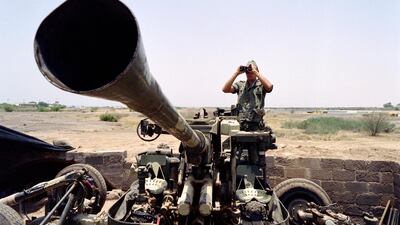
A French soldier looks through binoculars as he mans an anti-craft gun near Djibouti airport, on August 20, 1990, as French army was deployed in the Persian Gulf since Iraq's invasion of Kuwait on August 02, 1990, leading to a conflict between Iraq and Kuwait and an international military intervention. AFP -
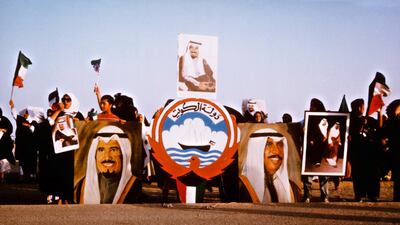
A demonstration in Kuwait, following the country's invasion by Iraq at the start of the Gulf War, 4th-6th August 1990. In the centre is the Emblem of Kuwait, adopted in 1962. Getty -
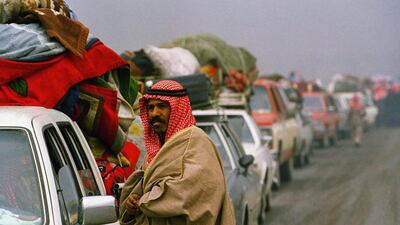
A Kuwaiti refugee stands beside his car outside Kuwait City after Iraq invaded 30 years ago. Scott Applewhite / AP


He later realised that the warehouse where his colleagues had gathered “was not designated for storing explosive materials, they were usually in special stores far from the factories and shielded by mounds of compacted earth”.
Moments later, a second barrel ignited and the fire spread rapidly. Within seconds, “a bright ignition, like the sun” lit up the warehouse, almost burning onlookers with the searing heat from the flames.
Mr Al Turfi screamed for his workmates to run. Placing his hands over his head and neck, he sprinted towards a large workshop with 40cm-thick reinforced walls.
That’s when a second, much larger blast occurred, according to an onlooker, “like a nuclear bomb”.
Mr Al Turfi was left dazed by the shockwave, and scrambled through rubble and clouds of dust, losing his shoes in the process. Thousands had been injured, and were now staggering, deafened and concussed with torn and bloodied clothing.
He spent the day evacuating the wounded to overwhelmed local hospitals, with little regard for his injuries. He remembers slipping in a hospital corridor and looking down to see his socks slick with blood from his injured colleagues.
When he finally had time to check himself for injuries, he noticed the clothing on his back had been ripped by the shockwave, but he was otherwise unscathed.
Other workers recall similar horrors. Hamid Al Ameri was changing out of his work clothes when the first explosion caused part of his office to collapse, trapping some of his co-workers. As Mr Ameri tried to free his mortally wounded friend Ali, the second explosion rammed the building’s doors into the ground, making them almost impossible to open - a phenomenon which can happen during earthquakes.
There was a desperate struggle to escape, with some people unable to see due to head injuries, their vision obscured by blood.
Eventually, Mr Al Ameri and surviving colleagues escaped through a “storm” of burning debris and barrels of burning TNT that were flying through the air.
When the dust settled, all that remained of the warehouse was a 600-metre-wide crater.
Lingering sadness
Sabah Ameedee was leaving work that afternoon with a friend when he heard the explosion. Running back to check what was happening, he was likely killed in the second blast. His loss devastated the family.
“Afterwards my aunt, his mother wore black for 27 years. She was so sad about him and at that time it was not normal to lose members of family, unlike how things became later.”
Al Qa Qaa explosion is remembered by few now. At least 30 people died, although there was some disagreement on the final toll among survivors. Asked about this discrepancy, Mr Al Turfi explained the climate of fear under Saddam’s regime, where “employees were afraid of talking because they knew it’s a sensitive security matter”.
This climate of secrecy fuelled fears in Washington and London that the kind of work carried out at Al Qa Qaa would lead to more experiments with “explosive lenses” and other weapons of mass destruction research. The West was slowly waking up to the callousness and military ambition of a dictator they had helped arm.
Perhaps for this reason, Mr Bazoft took soil samples when he entered the site, likely suspecting a WMD accident.
His former colleague at The Observer, Ian Mather, remembers a young man who "attached himself like a limpet" to the paper, desperate to make it as a young reporter.
“My wife, Margaret, used to say: ‘That young man will end up in serious trouble".
The epitaph on Mr Bazoft’s gravestone in Highgate, north London, conveys his determination to expose the story, even after death:
“I hope the world will decide after I have gone what kind of person I have really been. It’s a shame to die without the world having heard the whole truth.”
Thirty-one years later, the victims of Al Qa Qaa are finally telling their story.

