


Adel Al Jubeir, the Saudi Minister of State for Foreign Affairs, said on Tuesday that the kingdom believed Iran was responsible for the September 14 attacks on two Aramco oil centres.
But Mr Al Jubeir, speaking at the Council on Foreign Relations in New York, stopped short of revealing the place from which the attacks were launched.
“We are certain it came from the north,” he said.
Mr Al Jubeir said the exact launch location would be disclosed after the UN-led investigation into the attacks.
He said all options for response were on the table but repeated that Saudi Arabia wanted to avoid war at all costs.
“We want to make sure we know exactly what happened and then look at all our options, including military,” Mr Al Jubeir said.
He praised Aramco, the state-owned company that is looking to announce an initial public offering, for its swift recovery after the attack, calling it "nothing short of spectacular.”
“They put out the fires in six hours, closed the gap and by the end of this month they will be back to full operation," Mr Al Jubeir said.
"I can't imagine any other company can do that. This should increase investor confidence."
He said Riyadh was consulting with the US and Europe after the attacks.
"The Trump administration was clear that this is an act of war," Mr Al Jubeir said.
France, Germany and Britain also held Iran responsible, after their leaders met on Monday evening.
Mr Al Jubeir said the kingdom agreed with the US on changes it wants to the nuclear deal from which Mr Trump withdrew in 2018.
“The deal with Iran needs to be amended," he said. "Iran's ballistic missile programme is not acceptable, terrorism is a problem. Our objective is no nukes, no missiles and no terrorism from Iran.
“We want an Iran that acts like a nation state. Since the revolution we saw death and destruction from Iran.”
Mr Al Jubeir told of a “consistent record of evil that has to stop. We want an Iran that's a good neighbour".
On Yemen, where Saudi has led an Arab Coalition against rebels since 2015, he said Riyadh “supported every political agreement for settlement while the Houthis reneged on their commitments".
He hoped that the rebels would return to the table and said the objective was “a unified Yemen with no Iranian influence".
-
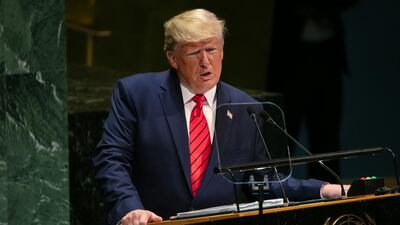
US President Donald Trump speaks during the UN General Assembly meeting in New York, U.S., on Tuesday, Sept. 24, 2019. Bloomberg -
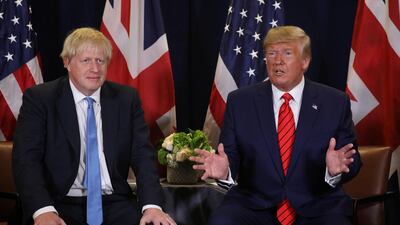
US President Donald Trump speaks during a bilateral meeting with British Prime Minister Boris Johnson on the sidelines of the annual United Nations General Assembly in New York, September 24, 2019. Reuters -
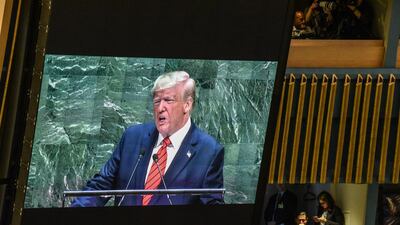
US President Donald Trump is shown on a monitor during his speech at the United Nations General Assembly on September 24, 2019 in New York. AFP -
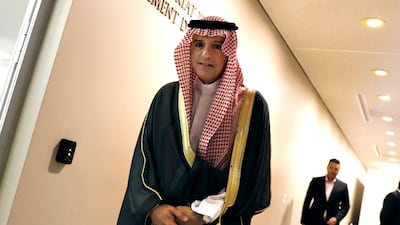
Adel al-Jubeir, Saudi Minister of State for Foreign Affairs walks through the hallway during the general debate of the 74th session of the General Assembly of the United Nations at United Nations Headquarters in New York, New York, USA. The annual meeting of world leaders at the United Nations runs until 30 September 2019. EPA -
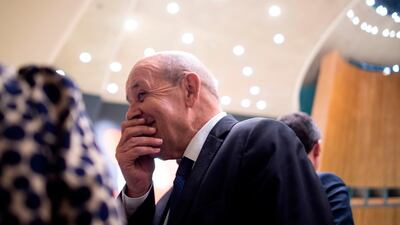
French Foreign Minister Jean-Yves Le Drian speaks with his delegation during the United Nations General Assembly at the United Nations Headquarters in New York City. AFP -
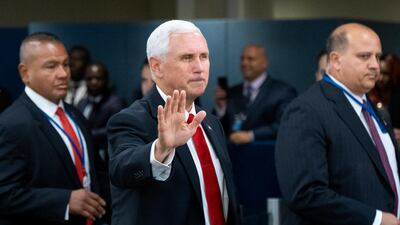
US Vice-President Mike Pence arrives for the 74th session of the United Nations General Assembly. AP Photo -
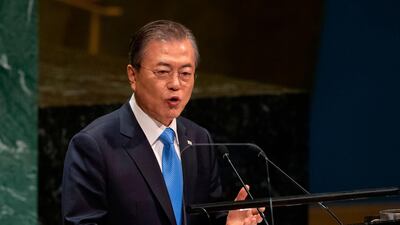
Moon Jae-in, President of South Korea speaks during the United Nations General Assembly at the United Nations Headquarters in New York City. AFP -

King Abdullah II bin Al Hussein of Jordan speaks at the United Nations (U.N.) General Assembly in New York City. World leaders are gathered for the 74th session of the UN amid a warning by Secretary-General Antonio Guterres in his address yesterday of the looming risk of a world splitting between the two largest economies - the U.S. and China. Getty Images -
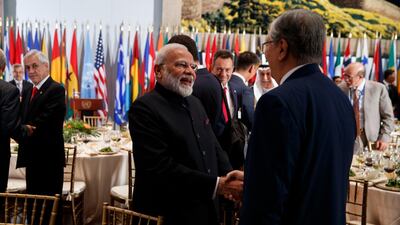
Indian Prime Minister Narendra Modi arrives for a luncheon hosted by United Nations Secretary General Antonio Guterres at the United Nations General Assembly in New York. AP Photo -
French President Emmanuel Macron addresses the 74th session of the United Nations General Assembly at U.N. headquarters in New York City, New York, U.S. Reuters -
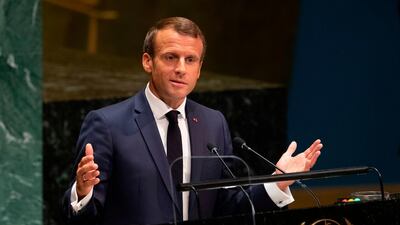
French President Emmanuel Macron speaks during the United Nations General Assembly at the United Nations Headquarters in New York City. AFP -
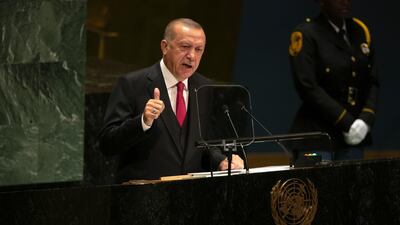
Recep Tayyip Erdogan, Turkey's president, speaks during the UN General Assembly meeting in New York, U.S. Erdogan used his speech to reinforce his image as a champion of the underdog -- and particularly of Muslims he says are being oppressed. Bloomberg -
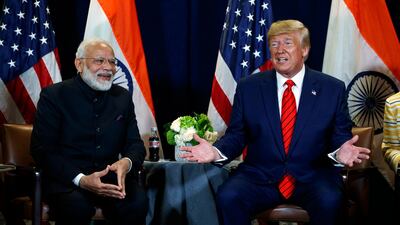
President Donald Trump meets with Indian Prime Minister Narendra Modi at the United Nations General Assembly in New York. AP Photo -
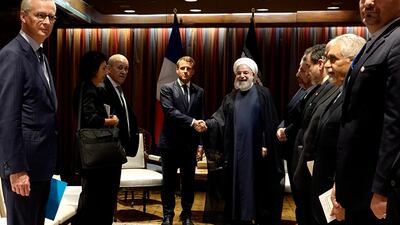
President Hassan Rouhani, right, shakes hands with French President Emmanuel Macron during their meeting on the sidelines of the United Nations General Assembly. AP -
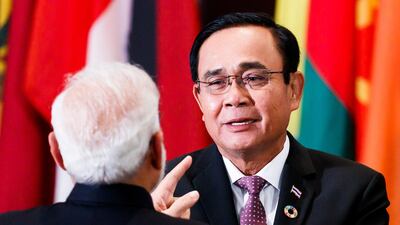
Thailand's Prime Minister Prayut Chan-o-cha talks with India's Prime Minister Narendra Modi at the start of an annual luncheon for heads of state on the sidelines the general debate of the 74th session of the General Assembly of the United Nations. EPA -

President Hassan Rouhani, right, meets Germany's Chancellor Angela Merkel, left, on the sideline of the United Nations General Assembly at the United Nations Headquarters. AP -
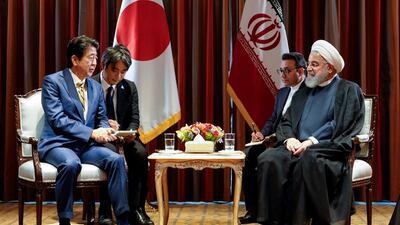
President Hassan Rouhani, right, meets Japanese Prime Minister Shinzo Abe, left, on the sideline of the United Nations General Assembly at the United Nations. AP -
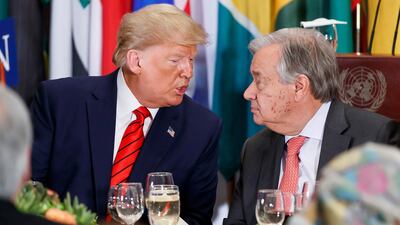
US President Donald Trump and United Nations Secretary-General Antonio Guterres talk at the start of an annual luncheon for heads of state on the sidelines the general debate of the 74th session of the General Assembly of the United Nations. EPA


Stability in Yemen and preventing a takeover by Iran was in Saudi and US interests, Mr Al Jubeir said.
He defended the decision two years ago by Saudi, the UAE, Bahrain and Egypt to break ties with Qatar.
“Qatar continues to fund extremists,” Mr Al Jubeir said. “Allowing clerics to go on television and spread hate is not acceptable.
"Providing hundreds of millions to Hashed Al Shaabi [in Iraq] or Hezbollah to get your hostages is not acceptable. Otherwise it's a wonderful country.”
US Secretary of State Mike Pompeo hosted the foreign ministers of the GCC and Jordan on Tuesday in New York to discuss the Middle East Strategic Alliance, known informally as the Arab Nato.
Mr Trump was expected to appear at the meeting.
The Trump administration has been seeking to build a joint Arab force to counter Iran and improve Middle East defence co-operation, something that successive US governments have tried since 1953 and failed to achieve.
Egypt withdrew its membership in April. A diplomatic source told The National that major differences about the concept of Mesa remain and that the participants clashed at their last low-level meeting in Washington.
US Assistant Secretary for Near East affairs, David Schenker, said on Tuesday that the Iraqi Foreign Minister was also expected to attend the meeting.

