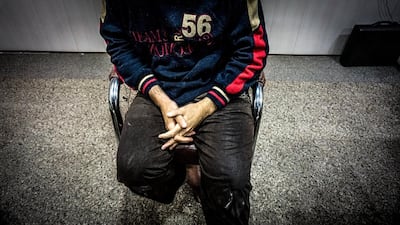
Israel has acknowledged the existence of an Arab Israeli ISIS fighter who has languished in solitary confinement at a northern Iraqi prison without trial for more than two years, according to a letter obtained by The National. It says he would be allowed to return home if he can reach Israel's borders from Iraq, despite a lack of formal ties between the two countries.
When US forces captured Mohammed Khalid in a December 2017 raid in eastern Syria following four years spent fighting for ISIS across the group's self-proclaimed state, Israel kept the case of the Palestinian from Israel's Arab-majority Northern Triangle area, and his whereabouts, in the dark.
But after The National interviewed him at an Iraqi Kurdish counter-terrorism facility and tracked down his family in northern Israel, the Israeli government finally acknowledged his existence in the state's first comments on his case, one fraught with legal implications and that counter-terror experts said was the first they had witnessed of a state refusing to even recognise a foreign fighter as its own – let alone allow his repatriation.
All evidence pointed to Israeli knowledge about his case despite its denials. Before Khalid’s capture, the family say they were questioned about him on numerous occasions at Israel’s Ben Gurion Airport. Since then, their repeated attempts to obtain information about him from the Israeli government since October 2018 have been ignored. Khalid himself said Israeli security agents approached him at least twice before he fled to Syria.
After he was captured, the 29-year-old from the northern Israeli town of Umm Al Fahm was transferred between American forces, the Jordanians, the Iraqis in Baghdad and the Kurds in Sulaymaniyah, according to Iraqi officials, who say Israel rejected his return when Jordan offered him back.
In the October interview, he admitted that he fought for the terror group, denied committing crimes on the battlefield and defended rape, slavery and the murder of journalists. He is an unashamed militant who is unwanted by his country and viewed as a traitor, and whom the Israeli government has repeatedly denied knowledge of until now.
In the letter dated February 18, 2020, titled 'Entry to Israel', and sent to the Khalid family lawyer by the Israeli Ministry of Justice in English, Hebrew and Arabic, government lawyer Omri Ben-Zvi told the family attorney, Hussein Abu Hussein: "I would like to inform you that according to relevant government officials, the State does not prohibit the entry of Mr Mahameed to the territory of Israel."
The government referred to Khalid, whose full name is Mohammed Khalid Mohammed, as Muhammad Muhameed.
Mr Ben-Zvi did not respond to a request for comment on which government officials approved of Khalid’s return, nor the discrepancy in the Israeli government’s policy. At least two Arab ISIS fighters, unlike Khalid, have had their Israeli citizenships revoked since ISIS rose to global attention in 2014, according to Israeli officials.
An Israeli Justice Department spokesperson said policy regarding admission into Israel is directed solely by the Minister of Interior, who “consults with the relevant security authorities fighting abroad for terrorist organisations”.
Both an Israeli interior ministry official and spokesperson for the Shin Bet, Israel’s domestic spy agency, declined to comment.
After Israel's admission, there is now a growing effort to bring the hardened fighter back to Israel, where his family want him to face justice and serve any prison sentence meted out. Mr Hussein told The National that he had connected the family with the Red Cross in Jerusalem "in order to make the needed efforts to find their son, enquire about the conditions of his detention and bring him back".
The Red Cross refused to comment, saying that the agency “works directly with families in need of tracing their loved ones and treats cases with strict confidentiality.” But Khalid’s sister, Tala, said there “aren’t any updates” on his case. A family lawyer in Mr Hussein’s office said: “The family is frustrated and is afraid that the maximum they will get is a telephone call with their son”.

The family had sporadic contact with Khalid after he fled northern Israel for the southern Turkish city of Adana in August 2013, where he was smuggled into Syria to fight with rebels, before defecting and joining the ranks of ISIS. He cut off contact with the family in late 2016, and they thought he was dead, until The National revealed his location. His family now want him to face his punishment at home, instead of a far away land with no judicial oversight.
"Even if it's 10, 15 years here in prison, it would be better. At least we [would] know where he is," Mousa, Khalid's father, told The National in November.
Even though Israel said it is willing to receive Khalid, its lack of formal diplomatic relations with Iraq means his repatriation, and any subsequent trial, remains unlikely, but acknowledging his existence paves the way for an eventual return.
An Iraqi Kurdish intelligence official said Khalid is still in detention in Sulaymaniyah as his situation “remains the same as before”: that of a “prisoner of war” caught fighting coalition forces. The Kurdish counter-terrorism forces with whom he is detained are part of the semi-autonomous Kurdistan Region of Iraq. As non-state actors, they have no obligations under international law, nor the formal ability to conduct a proper trial by international standards.

A number of Iraqi Kurdish officials have long held clandestine relations with the Israelis, who have worked to boost Kurdish independence ambitions in return for help with Iraqi recognition of Israel.
While officials and politicians in Baghdad have been consistently opposed to the normalisation of ties with Israel, many Kurdish officials privately express hope for a future deal that brings Israeli money and tech to their semi-autonomous region of Iraq.
Yet, on the matter of Khalid’s incarceration, they say there has been no agreement with his home country.
“There’s no deal of any sort. There is no communication between Iraq and Israel,” the Kurdish intelligence official said. “We’re not holding him on their behalf.”
“How can they take him back? Israel and Iraq have no relations whatsoever.”
An alternative to repatriation to Israel is a trial under Iraqi law. Such trials have been criticised by rights groups for severe due process violations, as well as the prospect of torture faced by suspects.
The United Nations, which first commented on his case in October, is clear that he should be returned to Israel for trial because of his prolonged incarceration in solitary confinement, which scientific research shows can have a degenerative impact on prisoners, leading to incidents of self-harm, and in the worst cases, death by suicide.
"If there is evidence of Mr Mahameed being ill-treated, and extensive solitary confinement could constitute ill-treatment, then the Kurdish authorities are violating their obligations under the law of war, and Israel, knowing of his conditions of detention, should, in my opinion, seek his removal," Agnes Callamard, the UN special rapporteur on extrajudicial killings, told The National.
“The nature of the crime committed by Mr Muhameed does not strip him of (all) his rights as an Israel citizen and certainly not the rights related to his life and dignity,” she said. “From this standpoint, Israel is under an obligation to ensure he is not the subject of torture or ill-treatment, and it ought to take all measures to prevent his life from being arbitrarily taken.”
But the global body’s repeated call for justice to be administered to Khalid, according to international human rights law, continues to remain a low priority for those involved in his case.
“[At the] end of the day…[there is] not a lot of interest in anyone to release an ISIS fighter who doesn’t even deny he was a terrorist,” the Kurdish intelligence official said.
“Will they charge him if they take him back?” he asked. “If they can’t charge him, then do they really want to let a terrorist back into their country?”

