Roland Marchal, the French researcher freed last month after more than nine months imprisoned in Iran, detailed on Monday the conditions of his confinement, with only the occasional book, odd visit or exchanges with other inmates to keep him sane.
In his first public statements since returning to France as part of a prisoner exchange, Mr Marchal said the isolation was worse than the interrogations.
"I was not physically tortured, but I suffered greatly from my confinement, and above all, my isolation," he said in a written message transmitted by his support group of friends and colleagues.
"Much more than the interrogations, it is confinement – very different to the type imposed on us because of the coronavirus – which proved very painful," he said.
-
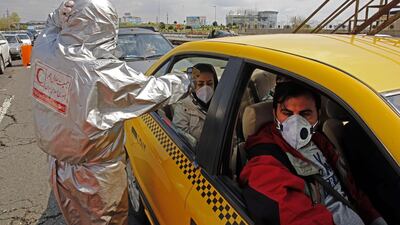
Members of Iranian Red Crescent test people with possible coronavirus Covid-19 symptoms, as police blocked Tehran to Alborz highway to check every car following ordered by the Iranian government, outside Tehran. AFP -
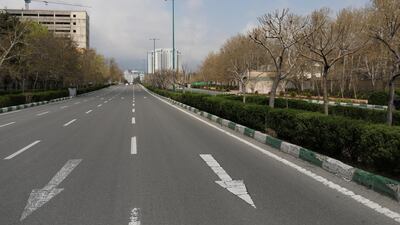
General view of a deserted street, during the intercity ban, amid fear of coronavirus disease (COVID-19), in Tehran, Iran. REUTERS -
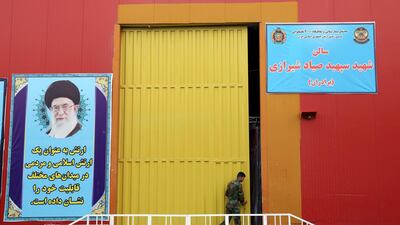
A member of the Iranian Army works at a temporary hospital in Tehran, Iran. AP Photo -
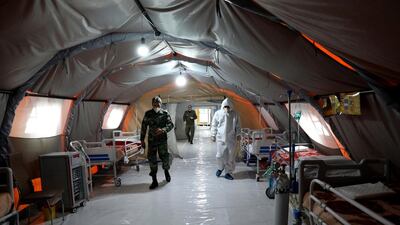
Iranian army soldiers work in a temporary 2,000-bed hospital for COVID-19 coronavirus patients set up by the army at the international exhibition center in northern Tehran, Iran. AP Photo -
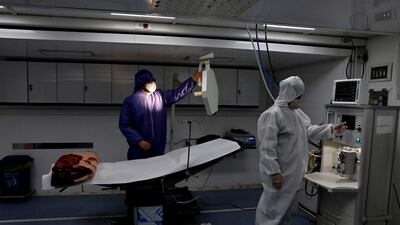
People in protective clothing work in a temporary 2,000-bed hospital for COVID-19 coronavirus patients set up by the Iranian army at the international exhibition center in northern Tehran, Iran. AP Photo -
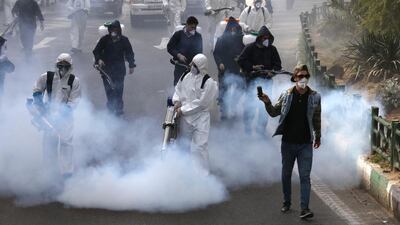
Firefighters disinfect a square against the new coronavirus as a man takes film, in western Tehran, Iran. AP Photo -
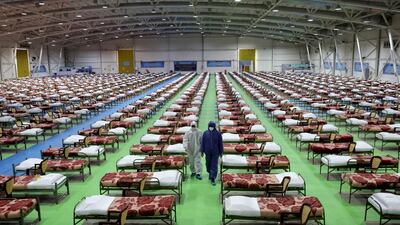
People in protective clothing walk past rows of beds at a temporary 2,000-bed hospital for COVID-19 coronavirus patients set up by the Iranian army at the international exhibition center in northern Tehran, Iran. AP Photo -
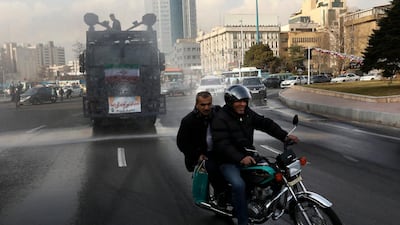
A police vehicle disinfects streets against the coronavirus, in Tehran, Iran. AP Photo -
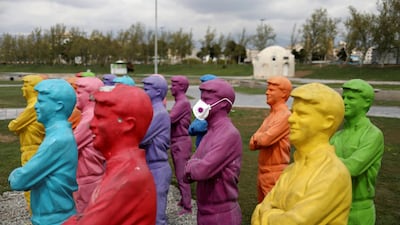
A statue wearing a protective face mask is pictured, amid fear of coronavirus disease (COVID-19), in Azadi square, in Tehran, Iran. REUTERS -
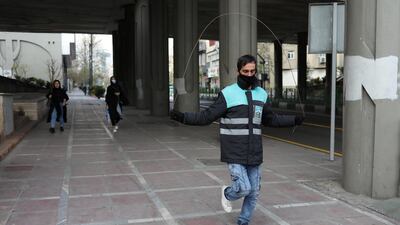
A man wearing a protective face mask and gloves, amid fear of coronavirus disease (COVID-19), jumps rope at Valiasr street in Tehran, Iran. REUTERS -
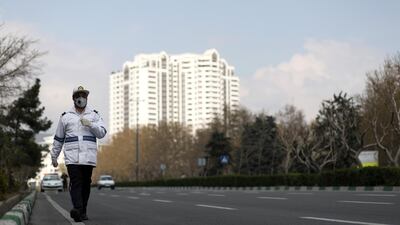
A traffic police officer wears a protective face mask and gloves, amid fear of coronavirus disease (COVID-19), as he walks in Tehran, Iran. REUTERS -
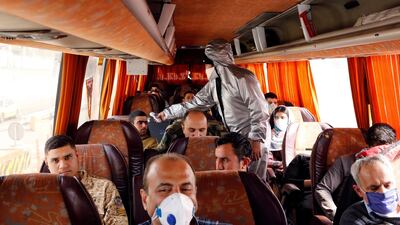
A member of Iranian red crescents test passengers of a bus for possible coronavirus Covid-19 symptoms, as police blocked Tehran to Alborz highway to check every car following ordered by Iranian government, outside of Tehran. EPA -
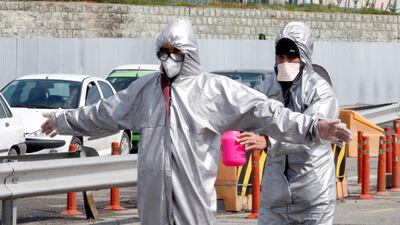
Members of Iranian Red Crescent get themselves disinfected after testing people for possible coronavirus Covid-19 symptoms, outside of Tehran. EPA
"Only the books... to which I had partial access, and friendships struck with a few inmates allowed me to hold on in a universe where each day resembles the previous and the next," Mr Marchal said.
Imprisoned in Iran since June last year, Mr Marchal was freed on March 20 after France released an Iranian, Jalal Rohollahnejad, who was facing extradition to the United States on accusations he tried to smuggle materials into Iran in violation of US sanctions.
Mr Marchal and his partner, fellow researcher Fariba Adelkhah, were detained on accusations of plotting against national security. The pair, who work at the Centre for International Studies at the prestigious Sciences Po university in Paris, have denied the charges.
Ms Adelkhah remains in jail. She has both French and Iranian citizenship, but Tehran does not recognise dual nationality.
Mr Marchal said he had been able to see Ms Adelkhah "only three times" during his imprisonment, each time for a few minutes and "under strict surveillance of interrogators".
He became aware only afterwards that she went on a hunger strike that lasted 49 days to protest against Iran's detention of researchers. Ms Adelkhah stopped her protest in February at the urging of her support committee after her health deteriorated sharply.
Mr Marchal thanked everyone who contributed to his liberation, and who are "continuing to mobilise for Fariba's" freedom.
Iran, the Middle Eastern country most affected by the coronavirus pandemic, has reported more than 60,500 infections, a figure that some foreign experts suspect is an underestimate.
The country's prison inmates have been hit particularly hard.

OPINIONS ON PALESTINE & ISRAEL
COMPANY%20PROFILE
What can victims do?
Always use only regulated platforms
Stop all transactions and communication on suspicion
Save all evidence (screenshots, chat logs, transaction IDs)
Report to local authorities
Warn others to prevent further harm
Courtesy: Crystal Intelligence
Avatar: Fire and Ash
Director: James Cameron
Starring: Sam Worthington, Sigourney Weaver, Zoe Saldana
Rating: 4.5/5
SPECS
Key findings of Jenkins report
- Founder of the Muslim Brotherhood, Hassan al Banna, "accepted the political utility of violence"
- Views of key Muslim Brotherhood ideologue, Sayyid Qutb, have “consistently been understood” as permitting “the use of extreme violence in the pursuit of the perfect Islamic society” and “never been institutionally disowned” by the movement.
- Muslim Brotherhood at all levels has repeatedly defended Hamas attacks against Israel, including the use of suicide bombers and the killing of civilians.
- Laying out the report in the House of Commons, David Cameron told MPs: "The main findings of the review support the conclusion that membership of, association with, or influence by the Muslim Brotherhood should be considered as a possible indicator of extremism."
WWE Super ShowDown results
Seth Rollins beat Baron Corbin to retain his WWE Universal title
Finn Balor defeated Andrade to stay WWE Intercontinental Championship
Shane McMahon defeated Roman Reigns
Lars Sullivan won by disqualification against Lucha House Party
Randy Orton beats Triple H
Braun Strowman beats Bobby Lashley
Kofi Kingston wins against Dolph Zigggler to retain the WWE World Heavyweight Championship
Mansoor Al Shehail won the 50-man Battle Royal
The Undertaker beat Goldberg
Who has been sanctioned?
Daniella Weiss and Nachala
Described as 'the grandmother of the settler movement', she has encouraged the expansion of settlements for decades. The 79 year old leads radical settler movement Nachala, whose aim is for Israel to annex Gaza and the occupied West Bank, where it helps settlers built outposts.
Harel Libi & Libi Construction and Infrastructure
Libi has been involved in threatening and perpetuating acts of aggression and violence against Palestinians. His firm has provided logistical and financial support for the establishment of illegal outposts.
Zohar Sabah
Runs a settler outpost named Zohar’s Farm and has previously faced charges of violence against Palestinians. He was indicted by Israel’s State Attorney’s Office in September for allegedly participating in a violent attack against Palestinians and activists in the West Bank village of Muarrajat.
Coco’s Farm and Neria’s Farm
These are illegal outposts in the West Bank, which are at the vanguard of the settler movement. According to the UK, they are associated with people who have been involved in enabling, inciting, promoting or providing support for activities that amount to “serious abuse”.
While you're here
Sholto Byrnes: A mainstreaming of racist ideas in Europe
Rashmee Roshan Lall: White males can be terrorists too
HA Hellyer: With dialogue, Islamophobia can be beaten
RESULTS
Light Flyweight (48kg): Alua Balkibekova (KAZ) beat Gulasal Sultonalieva (UZB) by points 4-1.
Flyweight (51kg): Nazym Kyzaibay (KAZ) beat Mary Kom (IND) 3-2.
Bantamweight (54kg): Dina Zholaman (KAZ) beat Sitora Shogdarova (UZB) 3-2.
Featherweight (57kg): Sitora Turdibekova (UZB) beat Vladislava Kukhta (KAZ) 5-0.
Lightweight (60kg): Rimma Volossenko (KAZ) beat Huswatun Hasanah (INA) KO round-1.
Light Welterweight (64kg): Milana Safronova (KAZ) beat Lalbuatsaihi (IND) 3-2.
Welterweight (69kg): Valentina Khalzova (KAZ) beat Navbakhor Khamidova (UZB) 5-0
Middleweight (75kg): Pooja Rani (IND) beat Mavluda Movlonova (UZB) 5-0.
Light Heavyweight (81kg): Farida Sholtay (KAZ) beat Ruzmetova Sokhiba (UZB) 5-0.
Heavyweight (81 kg): Lazzat Kungeibayeva (KAZ) beat Anupama (IND) 3-2.
Bridgerton%20season%20three%20-%20part%20one
Mercer, the investment consulting arm of US services company Marsh & McLennan, expects its wealth division to at least double its assets under management (AUM) in the Middle East as wealth in the region continues to grow despite economic headwinds, a company official said.
Mercer Wealth, which globally has $160 billion in AUM, plans to boost its AUM in the region to $2-$3bn in the next 2-3 years from the present $1bn, said Yasir AbuShaban, a Dubai-based principal with Mercer Wealth.
“Within the next two to three years, we are looking at reaching $2 to $3 billion as a conservative estimate and we do see an opportunity to do so,” said Mr AbuShaban.
Mercer does not directly make investments, but allocates clients’ money they have discretion to, to professional asset managers. They also provide advice to clients.
“We have buying power. We can negotiate on their (client’s) behalf with asset managers to provide them lower fees than they otherwise would have to get on their own,” he added.
Mercer Wealth’s clients include sovereign wealth funds, family offices, and insurance companies among others.
From its office in Dubai, Mercer also looks after Africa, India and Turkey, where they also see opportunity for growth.
Wealth creation in Middle East and Africa (MEA) grew 8.5 per cent to $8.1 trillion last year from $7.5tn in 2015, higher than last year’s global average of 6 per cent and the second-highest growth in a region after Asia-Pacific which grew 9.9 per cent, according to consultancy Boston Consulting Group (BCG). In the region, where wealth grew just 1.9 per cent in 2015 compared with 2014, a pickup in oil prices has helped in wealth generation.
BCG is forecasting MEA wealth will rise to $12tn by 2021, growing at an annual average of 8 per cent.
Drivers of wealth generation in the region will be split evenly between new wealth creation and growth of performance of existing assets, according to BCG.
Another general trend in the region is clients’ looking for a comprehensive approach to investing, according to Mr AbuShaban.
“Institutional investors or some of the families are seeing a slowdown in the available capital they have to invest and in that sense they are looking at optimizing the way they manage their portfolios and making sure they are not investing haphazardly and different parts of their investment are working together,” said Mr AbuShaban.
Some clients also have a higher appetite for risk, given the low interest-rate environment that does not provide enough yield for some institutional investors. These clients are keen to invest in illiquid assets, such as private equity and infrastructure.
“What we have seen is a desire for higher returns in what has been a low-return environment specifically in various fixed income or bonds,” he said.
“In this environment, we have seen a de facto increase in the risk that clients are taking in things like illiquid investments, private equity investments, infrastructure and private debt, those kind of investments were higher illiquidity results in incrementally higher returns.”
The Abu Dhabi Investment Authority, one of the largest sovereign wealth funds, said in its 2016 report that has gradually increased its exposure in direct private equity and private credit transactions, mainly in Asian markets and especially in China and India. The authority’s private equity department focused on structured equities owing to “their defensive characteristics.”
Who's who in Yemen conflict
Houthis: Iran-backed rebels who occupy Sanaa and run unrecognised government
Yemeni government: Exiled government in Aden led by eight-member Presidential Leadership Council
Southern Transitional Council: Faction in Yemeni government that seeks autonomy for the south
Habrish 'rebels': Tribal-backed forces feuding with STC over control of oil in government territory
• Remittance charges will be tackled by blockchain
• UAE's monumental and risky Mars Mission to inspire future generations, says minister
• Could the UAE drive India's economy?
• News has a bright future and the UAE is at the heart of it
• Architecture is over - here's cybertecture
• The National announces Future of News journalism competition
• Round up: Experts share their visions of the world to come
PROFILE OF SWVL
Started: April 2017
Founders: Mostafa Kandil, Ahmed Sabbah and Mahmoud Nouh
Based: Cairo, Egypt
Sector: transport
Size: 450 employees
Investment: approximately $80 million
Investors include: Dubai’s Beco Capital, US’s Endeavor Catalyst, China’s MSA, Egypt’s Sawari Ventures, Sweden’s Vostok New Ventures, Property Finder CEO Michael Lahyani
Afghanistan squad
Gulbadin Naib (captain), Mohammad Shahzad (wicketkeeper), Noor Ali Zadran, Hazratullah Zazai, Rahmat Shah, Asghar Afghan, Hashmatullah Shahidi, Najibullah Zadran, Samiullah Shinwari, Mohammad Nabi, Rashid Khan, Dawlat Zadran, Aftab Alam, Hamid Hassan, Mujeeb Ur Rahman.
While you're here
Paris%20Agreement
Our family matters legal consultant
Name: Hassan Mohsen Elhais
Position: legal consultant with Al Rowaad Advocates and Legal Consultants.
TECH%20SPECS%3A%20APPLE%20WATCH%20SERIES%208
How to wear a kandura
Dos
- Wear the right fabric for the right season and occasion
- Always ask for the dress code if you don’t know
- Wear a white kandura, white ghutra / shemagh (headwear) and black shoes for work
- Wear 100 per cent cotton under the kandura as most fabrics are polyester
Don’ts
- Wear hamdania for work, always wear a ghutra and agal
- Buy a kandura only based on how it feels; ask questions about the fabric and understand what you are buying


