


The Iraqi government has cut internet services indefinitely across Baghdad and southern provinces to quell anti-government protests that have swept across the country.
Last month at the start of the Baghdad protests, the Federal Ministry of Communications blocked internet across the country except in the Kurdistan region, hobbling activists' attempts to organise protests.
Earlier on Monday, at least four protesters and one member of the security forces were killed, as demonstrators marched within 500 metres of the Prime Minister's office in Baghdad.
Demonstrations also took place in locations including the main Gulf port Umm Qasr and southern Shatra, where security forces also killed a protester.
But in the capital, Iraqi security officials fired live rounds at protesters, something of which they have been accused before, with a medical official telling AP that at least 60 were injured in the unrest.
Protesters have been trying to breach barricades on bridges leading to the heavily fortified Green Zone, where the government is based, but have been kept back with tear gas and rubber bullets.
A video emerged that purported to show security forces shooting a protester dead.
Since the start of October, tens of thousands of people have gathered in Baghdad's Tahrir Square and cities across southern Iraq to demand the resignation of the government and an end to the political system established after the 2003 US-led invasion.
Anger has mounted over the lack of public services, corruption and Iran's influence in the country. More than 250 Iraqis have been killed in the demonstrations.
Monday's violence comes a day after protesters stormed the Iranian consulate in the city of Karbala, 100 kilometres south-west of the capital.
Security forces retaliated by firing into the air to disperse the crowds of protesters, who threw stones and burnt tyres around the building.
Witnesses said protesters tore down the Iranian flag flying over the consulate and replaced it with the Iraqi flag.
Iraq's Foreign Ministry condemned the act against the consulate.
"The security of diplomatic missions and consulates is a red line that cannot be overstepped," the ministry said.
Prime Minister Adel Abdul Mahdi has appealed to the demonstrators to restore calm to the country, saying the unrest was costing the economy “billions of dollars”.
His intervention did little to calm public anger from people demanding his resignation.
The attack on the Iranian consulate followed warnings from Iraq's top clerics that foreign powers should not interfere in the country.
But reports indicate that Iran has sent its shadowy Revolutionary Guard Corps Quds Force leader, Gen Qassem Suleimani, to ensure Mr Abdul Mahdi remains in power.
On October 1, Gen Suleimani flew into Baghdad’s heavily fortified Green Zone, where he surprised a group of top security officials by chairing a meeting in place of the prime minister.
“We in Iran know how to deal with protests,” he told the Iraqi officials, senior officials said. "This happened in Iran and we got it under control.”
Gen Suleimani intervened again at the weekend to stop the resignation of Mr Abdul Mahdi days after Iraqi President Barham Salih said the prime minister would step down if he could without causing a "constitutional vacuum".
Last year in mass rallies in Basra – caused by similar frustration at corruption, poor services and unemployment – protesters set fire to the Iranian consulate and chanted anti-Iran slogans.
Human rights groups said armed militia linked to Tehran have killed and abducted protesters.
More than 250 people have been killed in the security crackdown this month. Monitoring groups say they believe the Iranian-backed militias used snipers to shoot protesters from rooftops.
Students and trade unions announced a joint campaign of non-violent resistance on Sunday.
In a statement to the nation, Mr Abdul Mahdi called for markets, factories, schools and universities to reopen after days of protests in the capital and across the south.
-
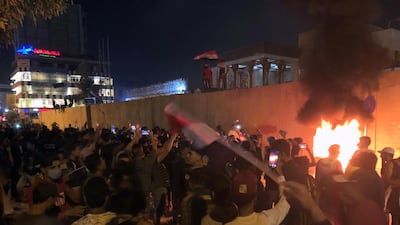
Demonstrators set fire in front of the Iranian consulate, as they gather during ongoing anti-government protests in Kerbala, Iraq November 3, 2019. Reuters -
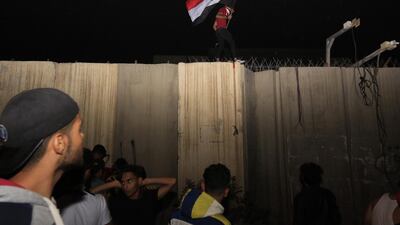
An Iraqi protester waves the Iraqi national flag as he stands on a concrete wall at the Iranian counsulate in Karbala, Iraq, 03 November 2019. EPA -
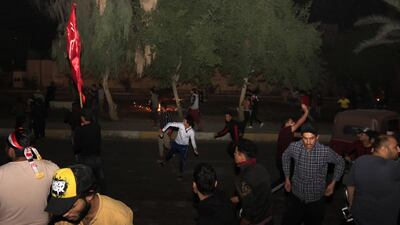
Iraqi protesters throw stones towards the Iranian counsulate during a protest in Karbala, Iraq, 03 November 2019. EPA -
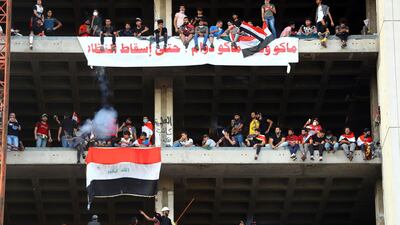
Iraqi demonstrators inside the Turkish Restaurant Building. Reuters -
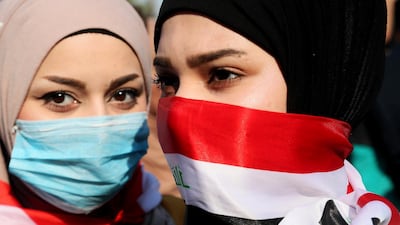
Iraqi women take part in anti-government protests in Tahrir Square, Baghdad. AP -
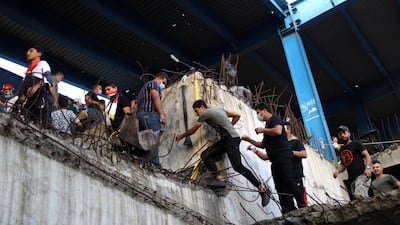
Iraqi demonstrators climb inside the high-rise Turkish Restaurant Building. Reuters -
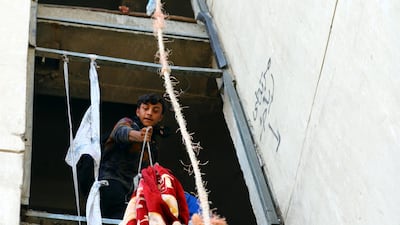
Iraqi demonstrators use blankets to supply food to their fellows inside the high-rise building. REUTERS -
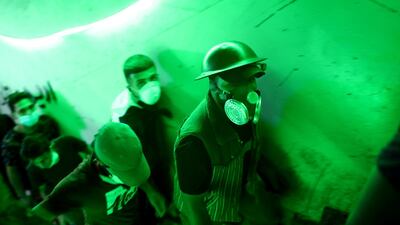
Iraqi protesters inside the Turkish Restaurant Building. Reuters -
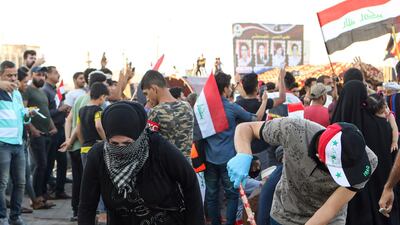
Volunteers clean the site of the protest near the Basra provincial council building during protests in the city. AP -
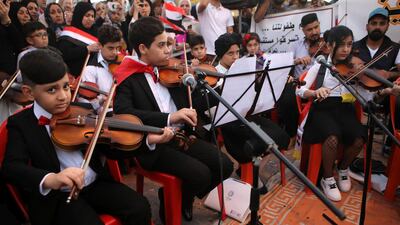
Music school students take part in the protests near the Basra provincial council building. AP -
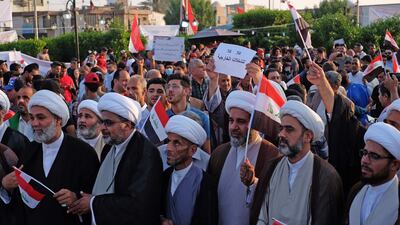
Iraqi Shiite clerics take part in anti-government demonstrations in Karbala city. AFP -
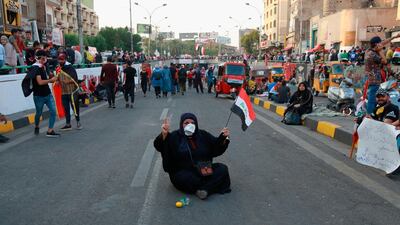
An Iraqi woman takes part in the anti-government protests in Baghdad. AP -
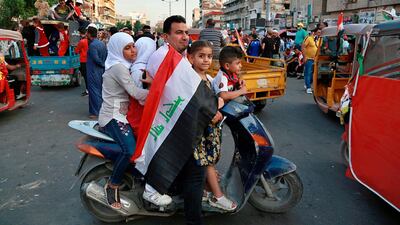
Protesters in Tahrir Square, Baghdad, during the anti-government protests. AP -
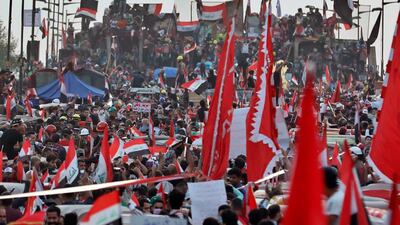
Anti-government protesters stand on barriers set up by Iraqi security to close the Joumhouriya bridge leading to the Green Zone government areas in Baghdad. AP Photo -
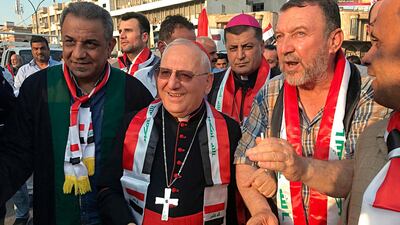
Cardinal Louis Raphael I Sako, patriarch of the Chaldean Catholic Church, visits Tahrir Square in Baghdad. AP


He said the threat to oil facilities and the closure of roads had cost the country billions of dollars and contributed to price increases that affect everyone.
Operations at Iraq's main Gulf port, Umm Qasr, which receives the bulk of Iraq's imports of grain, vegetable oils and sugar, have been at a complete standstill since Wednesday.
Protesters blocked roads with barbed wire and burning tyres on Sunday to keep up pressure on the government to resign.

