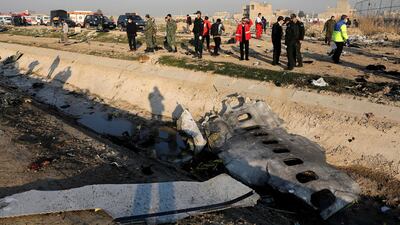
Iran has retrieved data, including a portion of cockpit conversations, from the flight recorder of the Ukrainian airliner accidentally shot down by its Islamic Revolutionary Guard Corps (IRGC) in January, killing all 176 people on board, an Iranian official said on Sunday.
The official's remarks were reported on the website of Iran’s Civil Aviation Organisation, which described them as part of the final report that Tehran planned to issue on the shooting down of Ukraine International Airlines Flight 752.
Iranian authorities at first denied responsibility for the January 8 crash near Tehran, but changed course days later after western nations presented evidence that Iran had shot the plane down.
The incident happened the night Iran launched a ballistic missile attack on US military positions in in Iraq, its response to the American drone strike that killed IRGC Gen Qassem Suleimani in Baghdad on January 3.
At the time, Iranian troops were braced for a US counterstrike and appeared to have mistaken the plane for a missile. Iran, however, has not acknowledged that, only saying that after the missile attack, its air defence was sufficiently alert and had allowed scheduled air traffic to resume — a reference to the Ukrainian plane being allowed to take off from Tehran.
The Ukrainian plane was apparently targeted by two missiles. The plane had just taken off from Tehran’s Imam Khomeini International Airport when the first missile exploded, possibly damaging its radio equipment. The second missile was to have likely struck the aircraft directly, as videos from that night showed the plane exploding before crashing into a playground and farmland on the outskirts of Tehran.
For days after the crash, Iranian investigators sifted through the debris of the plane.
-
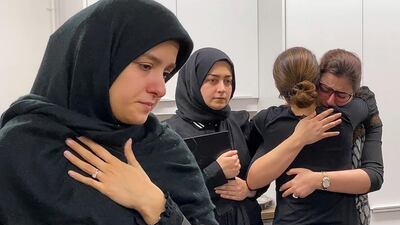
Mourners attend a vigil at the University of Toronto for the victims of a Ukrainian passenger jet which crashed in Iran. Reuters -
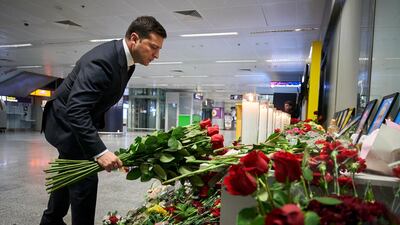
Ukrainian President Volodymyr Zelenskiy lays flowers to commemorate victims of the Ukraine International Airlines Boeing 737-800 plane crash, at a memorial in Boryspil International airport outside Kiev. Reuters -
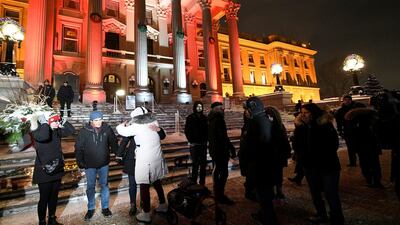
A candlelight vigil held at the Edmonton Legislature building in memory of the victims of a Ukrainian passenger plane that crashed in Iran. Reuters -
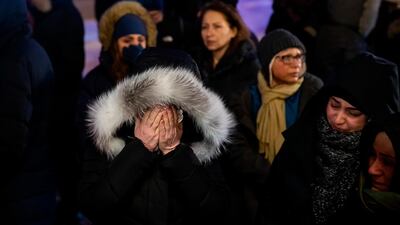
A woman mourns outside the Alberta Legislature Building in Edmonton, Alberta, during a vigil for those killed after a Ukrainian passenger jet crashed. AP -
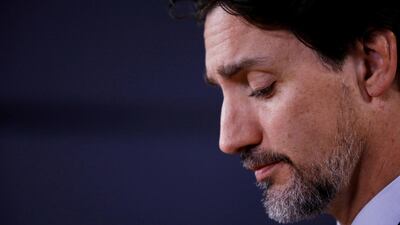
Canada's Prime Minister Justin Trudeau attends a news conference about flight PS752 from Tehran to Kiev that crashed shortly after takeoff, in Ottawa, Ontario, Canada. Reuters -
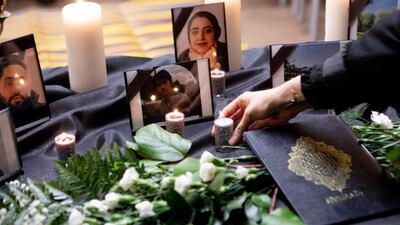
A candle is placed on a table bearing photos of some of the victims of a Ukraine International Airlines passenger flight that crashed after takeoff near Tehran, Iran. AP -

Mourners place candles and photographs outside the Alberta Legislature Building in Edmonton, Alberta during a vigil for those killed after a Ukrainian passenger jet crashed. AP -
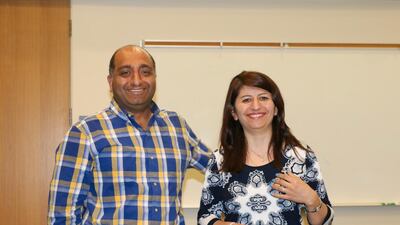
Victims of the Ukraine crash in Iran, University of Alberta professors Mojgan Daneshmand and Pedram Mousavi, pose in an undated family photo in Edmonton, Alberta, Canada. Reuters -

A victim of the Ukraine International Airlines crash in Iran, Dr Parisa Eghbalian poses with her husband Dr Hamed Esmaeilion at their dentistry practice in Aurora, Ontario, Canada. Reuters -
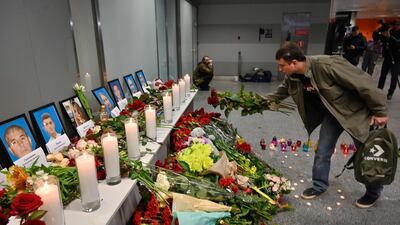
A man places flowers at a memorial for the victims of the Ukraine International Airlines Boeing 737-800 crash in the Iranian capital Tehran, at the Boryspil airport outside Kiev. AFP -
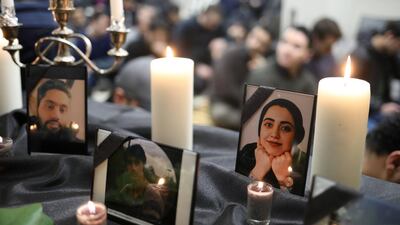
Photographs of student victims of a Ukrainian passenger jet which crashed in Iran are seen during a vigil at University of Toronto. Reuters -
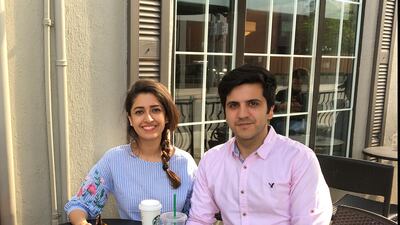
Victims of the Ukraine International Airlines crash in Iran, Negar Borghei and Alvand Sadeghi pose in Toronto, Ontario, Canada. Reuters -
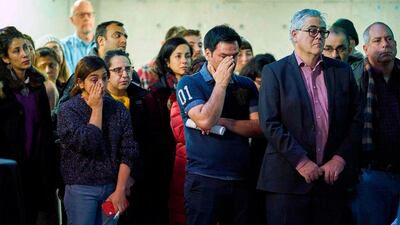
Attendees wipe away tears during a memorial service at Western University in London, Ontario on January 8, 2020 for the four graduate students who were killed in a plane crash in Iran. AFP -
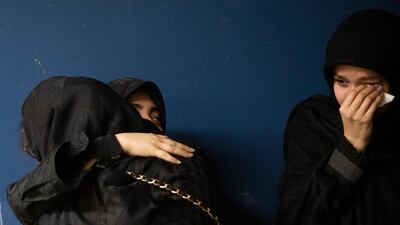
Members of Toronto's Iranian community attend a vigil in Toronto to mourn victims of Ukraine International Airlines Flight PS752 that crashed after takeoff near Tehran, Iran. AP -

Flowers and candles are placed in front of the portraits of the flight crew members of the Ukraine International Airlines Boeing 737-800 plane that crashed in Iran, at a memorial at the Boryspil International airport outside Kiev. Reuters


The head of Iran’s Civil Aviation Organisation, Capt Touraj Dehghani Zangeneh, said on Sunday that the Ukrainian passenger plane’s black boxes had only 19 seconds of conversation following the first explosion, although the second missile reached the plane 25 seconds later. The report quoting him did not elaborate.
He said the first missile explosion sent shrapnel into the plane, which was likely to have disrupted the plane’s flight recorders. He did not reveal any details of the cockpit conversation that was retrieved.
Representatives from the US, Ukraine, France, Canada, Britain and Sweden — countries whose citizens were killed in the crash — were present during the process to gather data from the recorders, Mr Zangeneh said.
In the months since, Iran has struggled with the Middle East’s largest and deadliest outbreak of the coronavirus. The Iranian government is also grappling with both crushing US sanctions and vast domestic economic problems.
Last month, an initial report from the Iranian investigation said that a misaligned missile battery, miscommunication between troops and their commanders and a decision to fire without authorisation all led to the shooting down of the plane.
That report said the surface-to-air missile battery that targeted the Boeing 737-800 had been relocated and was not properly reoriented. Those manning the missile battery could not communicate with their command centre, they misidentified the civilian flight as a threat and opened fire twice without getting approval from ranking officials, it said.
Western intelligence officials and analysts believed Iran shot down the aircraft with a Russian-made Tor system, known to Nato as the SA-15. In 2007, Iran took the delivery of 29 Tor M1 units from Russia under a contract worth an estimated $700 million. The system is mounted on a tracked vehicle and carries a radar and a pack of eight missiles.
The initial report did not say why the IRGC moved the air defence system, although that area near the airport was believed to be home to both regular military and bases of the IRGC.
It also noted that the Ukrainian flight had done nothing out of the ordinary up until the missile launch, with its transponder and other data being broadcast. The aircraft’s black box flight recorder was sent to Paris in June, where international investigators examined it.
“Data recovery activity was all done with the aim of safety and preventing similar incidents,” Mr Zangeneh said, adding an appeal against “any political use of the process”.
He added that Iran’s air space was now “safe and ready” for international flights.

