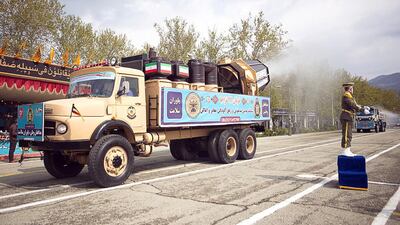
A handout photo made available by the Iranian Army official website of Iranian army disinfection equipment amid the ongoing coronavirus Covid-19 pandemic during a parade inside their base on the occasion of the National Army Day in Tehran, Iran, 17 April 2020. EPA
A handout photo made available by the Iranian Army official website of Iranian army disinfection equipment amid the ongoing coronavirus Covid-19 pandemic during a parade inside their base on the occas

Iran parades medical gear, not missiles on Army Day


  • English
  • Arabic

Iran on Friday paraded disinfection vehicles, mobile hospitals and other medical equipment to mark its Army Day as the country's death toll from the coronavirus outbreak rose by 89 to 4,958.

The total number of cases of infection in the Middle East country hardest hit by the pandemic rose to 79,494, of which 3,563 were in critical condition, health ministry spokesman Kianush Jahanpur said on state television.

A parliamentary report released earlier this week said the coronavirus death toll might be almost double the figures announced by the health ministry, and the number of infections eight to 10 times more given a lack of widespread testing.

Friday's small "Defenders of the Homeland, Helpers of Health" army parade was held at a training centre before a group of commanders in face masks to underscore the military's role in battling the highly infections Covid-19 lung disease.

It was a far cry from the typical Army Day parades, which normally feature spectacles of infantry, missiles, submarines and armoured vehicles, with warplanes flying overhead.

"Due to health and social protocols, it is not possible to hold a parade of soldiers...The enemy now is hidden and doctors and nurses are (instead) at the frontlines of the battlefield," President Hassan Rouhani said in a message to soldiers, disseminated by state media.

Army forces chief Major General Abdolrahim Mousavi thanked the more than 11,000 military medical staff fighting to stem the spread of the novel coronavirus in Iran, which has one of the world's highest death tolls.

Deputy Health Minister Iraj Harirchi warned earlier this week that infections could spread further in autumn.

"We have to get used to living with the virus until an appropriate medication or vaccination is found," Mr Harirchi said on Friday. A recent resumption of "low-risk" business activities "doesnt mean that conditions have returned to normal," he said, warning that the easing of restrictions could lead to increased infections.

So-called low-risk businesses - including many shops, factories and workshops - resumed operations on April 11 across the country, with the exception of the capital Tehran, where they will reopen from Saturday.

Iran's reported temporary release of 100,000 prisoners since February including prisoners of conscience and dual and foreign nationals to help stem the virus was welcomed by the United Nations on Friday as a good step but one that must be expanded.

"Most prisoners of conscience, human rights defenders, conservationists and dual and foreign nationals remain imprisoned," said a letter by UN human rights experts including Javaid Rehman, Special Rapporteur on Iran.

"Some are at great risk from Covid-19 due to their age or underlying health conditions. We call on the authorities to immediately release them," added the letter, which named several prominent imprisoned rights activists and dual nationals.


How to come clean about financial infidelity
  • Be honest and transparent: It is always better to own up than be found out. Tell your partner everything they want to know. Show remorse. Inform them of the extent of the situation so they know what they are dealing with.
  • Work on yourself: Be honest with yourself and your partner and figure out why you did it. Don’t be ashamed to ask for professional help. 
  • Give it time: Like any breach of trust, it requires time to rebuild. So be consistent, communicate often and be patient with your partner and yourself.
  • Discuss your financial situation regularly: Ensure your spouse is involved in financial matters and decisions. Your ability to consistently follow through with what you say you are going to do when it comes to money can make all the difference in your partner’s willingness to trust you again.
  • Work on a plan to resolve the problem together: If there is a lot of debt, for example, create a budget and financial plan together and ensure your partner is fully informed, involved and supported. 

Carol Glynn, founder of Conscious Finance Coaching

Cryopreservation: A timeline
  1. Keyhole surgery under general anaesthetic
  2. Ovarian tissue surgically removed
  3. Tissue processed in a high-tech facility
  4. Tissue re-implanted at a time of the patient’s choosing
  5. Full hormone production regained within 4-6 months
THE DETAILS

Solo: A Star Wars Story

Director: Ron Howard

2/5

How to donate

Send “thenational” to the following numbers or call the hotline on: 0502955999
2289 – Dh10
2252 – Dh 50
6025 – Dh20
6027 – Dh 100
6026 – Dh 200

FA Cup fifth round draw

Sheffield Wednesday v Manchester City
Reading/Cardiff City v Sheffield United
Chelsea v Shrewsbury Town/Liverpool
West Bromwich Albion v Newcastle United/Oxford United
Leicester City v Coventry City/Birmingham City
Northampton Town/Derby County v Manchester United
Southampton/Tottenham Hotspur v Norwich City
Portsmouth v Arsenal 

THE SPECS

Engine: 1.5-litre, four-cylinder turbo

Transmission: seven-speed dual clutch automatic

Power: 169bhp

Torque: 250Nm

Price: Dh54,500

On sale: now

The burning issue

The internal combustion engine is facing a watershed moment – major manufacturer Volvo is to stop producing petroleum-powered vehicles by 2021 and countries in Europe, including the UK, have vowed to ban their sale before 2040. The National takes a look at the story of one of the most successful technologies of the last 100 years and how it has impacted life in the UAE. 

Read part four: an affection for classic cars lives on

Read part three: the age of the electric vehicle begins

Read part one: how cars came to the UAE


MATCH INFO

Uefa Champions League, semi-final result:

Liverpool 4-0 Barcelona

Liverpool win 4-3 on aggregate

Champions Legaue final: June 1, Madrid

Awar Qalb

Director: Jamal Salem

Starring: Abdulla Zaid, Joma Ali, Neven Madi and Khadija Sleiman

Two stars

FIXTURES (all times UAE)

Sunday
Brescia v Lazio (3.30pm)
SPAL v Verona (6pm)
Genoa v Sassuolo (9pm)
AS Roma v Torino (11.45pm)

Monday
Bologna v Fiorentina (3.30pm)
AC Milan v Sampdoria (6pm)
Juventus v Cagliari (6pm)
Atalanta v Parma (6pm)
Lecce v Udinese (9pm)
Napoli v Inter Milan (11.45pm)

How it works

1) The liquid nanoclay is a mixture of water and clay that aims to convert desert land to fertile ground

2) Instead of water draining straight through the sand, it apparently helps the soil retain water

3) One application is said to last five years

4) The cost of treatment per hectare (2.4 acres) of desert varies from $7,000 to $10,000 per hectare 

Mercer, the investment consulting arm of US services company Marsh & McLennan, expects its wealth division to at least double its assets under management (AUM) in the Middle East as wealth in the region continues to grow despite economic headwinds, a company official said.

Mercer Wealth, which globally has $160 billion in AUM, plans to boost its AUM in the region to $2-$3bn in the next 2-3 years from the present $1bn, said Yasir AbuShaban, a Dubai-based principal with Mercer Wealth.

Within the next two to three years, we are looking at reaching $2 to $3 billion as a conservative estimate and we do see an opportunity to do so,” said Mr AbuShaban.

Mercer does not directly make investments, but allocates clients’ money they have discretion to, to professional asset managers. They also provide advice to clients.

“We have buying power. We can negotiate on their (client’s) behalf with asset managers to provide them lower fees than they otherwise would have to get on their own,” he added.

Mercer Wealth’s clients include sovereign wealth funds, family offices, and insurance companies among others.

From its office in Dubai, Mercer also looks after Africa, India and Turkey, where they also see opportunity for growth.

Wealth creation in Middle East and Africa (MEA) grew 8.5 per cent to $8.1 trillion last year from $7.5tn in 2015, higher than last year’s global average of 6 per cent and the second-highest growth in a region after Asia-Pacific which grew 9.9 per cent, according to consultancy Boston Consulting Group (BCG). In the region, where wealth grew just 1.9 per cent in 2015 compared with 2014, a pickup in oil prices has helped in wealth generation.

BCG is forecasting MEA wealth will rise to $12tn by 2021, growing at an annual average of 8 per cent.

Drivers of wealth generation in the region will be split evenly between new wealth creation and growth of performance of existing assets, according to BCG.

Another general trend in the region is clients’ looking for a comprehensive approach to investing, according to Mr AbuShaban.

“Institutional investors or some of the families are seeing a slowdown in the available capital they have to invest and in that sense they are looking at optimizing the way they manage their portfolios and making sure they are not investing haphazardly and different parts of their investment are working together,” said Mr AbuShaban.

Some clients also have a higher appetite for risk, given the low interest-rate environment that does not provide enough yield for some institutional investors. These clients are keen to invest in illiquid assets, such as private equity and infrastructure.

“What we have seen is a desire for higher returns in what has been a low-return environment specifically in various fixed income or bonds,” he said.

“In this environment, we have seen a de facto increase in the risk that clients are taking in things like illiquid investments, private equity investments, infrastructure and private debt, those kind of investments were higher illiquidity results in incrementally higher returns.”

The Abu Dhabi Investment Authority, one of the largest sovereign wealth funds, said in its 2016 report that has gradually increased its exposure in direct private equity and private credit transactions, mainly in Asian markets and especially in China and India. The authority’s private equity department focused on structured equities owing to “their defensive characteristics.”

The Buckingham Murders

Starring: Kareena Kapoor Khan, Ash Tandon, Prabhleen Sandhu

Director: Hansal Mehta

Rating: 4 / 5

Ten tax points to be aware of in 2026

1. Domestic VAT refund amendments: request your refund within five years

If a business does not apply for the refund on time, they lose their credit.

2. E-invoicing in the UAE

Businesses should continue preparing for the implementation of e-invoicing in the UAE, with 2026 a preparation and transition period ahead of phased mandatory adoption. 

3. More tax audits

Tax authorities are increasingly using data already available across multiple filings to identify audit risks. 

4. More beneficial VAT and excise tax penalty regime

Tax disputes are expected to become more frequent and more structured, with clearer administrative objection and appeal processes. The UAE has adopted a new penalty regime for VAT and excise disputes, which now mirrors the penalty regime for corporate tax.

5. Greater emphasis on statutory audit

There is a greater need for the accuracy of financial statements. The International Financial Reporting Standards standards need to be strictly adhered to and, as a result, the quality of the audits will need to increase.

6. Further transfer pricing enforcement

Transfer pricing enforcement, which refers to the practice of establishing prices for internal transactions between related entities, is expected to broaden in scope. The UAE will shortly open the possibility to negotiate advance pricing agreements, or essentially rulings for transfer pricing purposes. 

7. Limited time periods for audits

Recent amendments also introduce a default five-year limitation period for tax audits and assessments, subject to specific statutory exceptions. While the standard audit and assessment period is five years, this may be extended to up to 15 years in cases involving fraud or tax evasion. 

8. Pillar 2 implementation 

Many multinational groups will begin to feel the practical effect of the Domestic Minimum Top-Up Tax (DMTT), the UAE's implementation of the OECD’s global minimum tax under Pillar 2. While the rules apply for financial years starting on or after January 1, 2025, it is 2026 that marks the transition to an operational phase.

9. Reduced compliance obligations for imported goods and services

Businesses that apply the reverse-charge mechanism for VAT purposes in the UAE may benefit from reduced compliance obligations. 

10. Substance and CbC reporting focus

Tax authorities are expected to continue strengthening the enforcement of economic substance and Country-by-Country (CbC) reporting frameworks. In the UAE, these regimes are increasingly being used as risk-assessment tools, providing tax authorities with a comprehensive view of multinational groups’ global footprints and enabling them to assess whether profits are aligned with real economic activity. 

Contributed by Thomas Vanhee and Hend Rashwan, Aurifer

57%20Seconds
%3Cp%3E%3Cstrong%3EDirector%3A%3C%2Fstrong%3E%20Rusty%20Cundieff%0D%3Cbr%3E%3Cstrong%3EStars%3A%20%3C%2Fstrong%3EJosh%20Hutcherson%2C%20Morgan%20Freeman%2C%20Greg%20Germann%2C%20Lovie%20Simone%0D%3Cbr%3E%3Cstrong%3ERating%3A%20%3C%2Fstrong%3E2%2F5%0D%3Cbr%3E%0D%3Cbr%3E%3C%2Fp%3E%0A
LIVING IN...

This article is part of a guide on where to live in the UAE. Our reporters will profile some of the country’s most desirable districts, provide an estimate of rental prices and introduce you to some of the residents who call each area home.