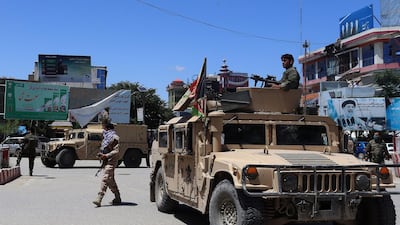
Afghan security forces sit in a Humvee vehicle amid ongoing fighting between Taliban militants and Afghan security forces in Kunduz on May 19, 2020. AFP

Civilian casualties by Taliban and Afghan forces rising, UN says


  • English
  • Arabic

The United Nations on Tuesday called for an immediate reduction of violence in Afghanistan, warning that civilian casualties at the hands of both the Taliban and Afghan security forces are on the increase. The UN mission also expressed concern about stepped-up attacks and brutality of ISIS.

A horrific attack last week at a maternity hospital in the Afghan capital has not been claimed by any group, but the United States said it bears all the hallmarks of Afghanistan's ISIS affiliate - targeting the country's minority Shiites in a neighborhood of Kabul that ISIS militants have repeatedly attacked in the past.

The Taliban denied involvement in the maternity hospital attack, which killed 24 people, including two infants and several new mothers.

The UN report blamed the Taliban for killing or injuring a total of 208 civilians last month and also said that operations by Afghan forces in April had killed or injured 172 civilians. Civilians are often caught in the crossfire of the fighting and Afghan forces say they are targeting the insurgents, not civilians, in anti-militant operations.

Taliban spokesman Zabihullah Mujahid disputed the UN figures in a tweet and blamed "blind airstrikes and artillery fire by US and internal forces" for the casualties.

"Parties have committed to finding a peaceful solution and should protect the lives of all Afghans and not jeopardise people's hope for an end to the war," said Deborah Lyons, the UN chief's special representative to Afghanistan.

She added that "intra-Afghan peace negotiations need to start as soon as possible."

The UN's call for an end to violence comes as Washington's special peace envoy, Zalmay Khalilzad, began another round of talks with the Taliban to press them to start talking to the newly reconciled Afghan political leadership in Kabul and implement an immediate reduction in violence, said the US State Department.

Mr Khalilzad, who is the architect of a US-Taliban deal signed in February, has been trying to salvage the agreement and jump-start intra-Afghan negotiations between the Taliban and the Kabul government.

A power-sharing agreement on Sunday between President Ashraf Ghani and his rival, Abdullah Abdullah, ended months of wrangling and raised expectations that the next round of the US-Taliban peace deal, which calls for negotiations between the Taliban and Afghan leaders, can start.

The Taliban have said a permanent cease-fire would be on the agenda but have been critical of repeated delays in the promised prisoner release, which is to be completed before talks begin.

The US State Department statement said Mr Khalilzad would meet with the Taliban in Qatar, where the insurgents maintain a political office, and would "press for steps necessary to commence intra-Afghan negotiations, including a significant reduction of violence."

Mr Khalilzad will also visit Kabul. US Secretary of State Mike Pompeo, who said in March that the US would cut $1 billion in US aid to Afghanistan unless Mr Ghani and Mr Abdullah resolved their differences, has bemoaned the time lost to their bickering.

"The United States remains committed to supporting the desire of the Afghan people and the international community for a political settlement that ends the 40-year conflict and ensures Afghanistan never again serves as a platform for international terrorism," the State Department statement said.

The U.S.-Taliban deal provides for the withdrawal of US and Nato troops, but only if the Taliban live up to their end to battle other militant groups, such as the ISIS affiliate.

The increasingly brutal ISIS attacks seem to have given urgency to US efforts to get the Taliban into a coordinated battle against the group.

THE%20SWIMMERS
%3Cp%3E%3Cstrong%3EDirector%3A%20%3C%2Fstrong%3ESally%20El-Hosaini%3C%2Fp%3E%0A%3Cp%3E%3Cstrong%3EStars%3A%20%3C%2Fstrong%3ENathalie%20Issa%2C%20Manal%20Issa%2C%20Ahmed%20Malek%20and%20Ali%20Suliman%C2%A0%3C%2Fp%3E%0A%3Cp%3E%3Cstrong%3ERating%3A%20%3C%2Fstrong%3E4%2F5%3C%2Fp%3E%0A
The Abu Dhabi Awards explained:

What are the awards? They honour anyone who has made a contribution to life in Abu Dhabi.

Are they open to only Emiratis? The awards are open to anyone, regardless of age or nationality, living anywhere in the world.

When do nominations close? The process concludes on December 31.

How do I nominate someone? Through the website.

When is the ceremony? The awards event will take place early next year.

Ten tax points to be aware of in 2026

1. Domestic VAT refund amendments: request your refund within five years

If a business does not apply for the refund on time, they lose their credit.

2. E-invoicing in the UAE

Businesses should continue preparing for the implementation of e-invoicing in the UAE, with 2026 a preparation and transition period ahead of phased mandatory adoption. 

3. More tax audits

Tax authorities are increasingly using data already available across multiple filings to identify audit risks. 

4. More beneficial VAT and excise tax penalty regime

Tax disputes are expected to become more frequent and more structured, with clearer administrative objection and appeal processes. The UAE has adopted a new penalty regime for VAT and excise disputes, which now mirrors the penalty regime for corporate tax.

5. Greater emphasis on statutory audit

There is a greater need for the accuracy of financial statements. The International Financial Reporting Standards standards need to be strictly adhered to and, as a result, the quality of the audits will need to increase.

6. Further transfer pricing enforcement

Transfer pricing enforcement, which refers to the practice of establishing prices for internal transactions between related entities, is expected to broaden in scope. The UAE will shortly open the possibility to negotiate advance pricing agreements, or essentially rulings for transfer pricing purposes. 

7. Limited time periods for audits

Recent amendments also introduce a default five-year limitation period for tax audits and assessments, subject to specific statutory exceptions. While the standard audit and assessment period is five years, this may be extended to up to 15 years in cases involving fraud or tax evasion. 

8. Pillar 2 implementation 

Many multinational groups will begin to feel the practical effect of the Domestic Minimum Top-Up Tax (DMTT), the UAE's implementation of the OECD’s global minimum tax under Pillar 2. While the rules apply for financial years starting on or after January 1, 2025, it is 2026 that marks the transition to an operational phase.

9. Reduced compliance obligations for imported goods and services

Businesses that apply the reverse-charge mechanism for VAT purposes in the UAE may benefit from reduced compliance obligations. 

10. Substance and CbC reporting focus

Tax authorities are expected to continue strengthening the enforcement of economic substance and Country-by-Country (CbC) reporting frameworks. In the UAE, these regimes are increasingly being used as risk-assessment tools, providing tax authorities with a comprehensive view of multinational groups’ global footprints and enabling them to assess whether profits are aligned with real economic activity. 

Contributed by Thomas Vanhee and Hend Rashwan, Aurifer

Company profile

Name: Dukkantek 

Started: January 2021 

Founders: Sanad Yaghi, Ali Al Sayegh and Shadi Joulani 

Based: UAE 

Number of employees: 140 

Sector: B2B Vertical SaaS(software as a service) 

Investment: $5.2 million 

Funding stage: Seed round 

Investors: Global Founders Capital, Colle Capital Partners, Wamda Capital, Plug and Play, Comma Capital, Nowais Capital, Annex Investments and AMK Investment Office  

The five pillars of Islam
