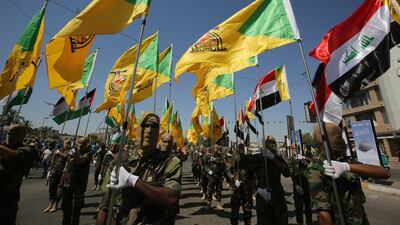

A group claiming to be a new militia organisation in Iraq has said it was responsible for an explosive drone attack against the Saudi Arabian capital, Riyadh.
The statement could not be independently verified, but was reported and praised by news channels linked to official Iran-backed groups.
The US government condemned the attack, saying it appeared to be “an attempt to target civilians,” but gave no further comment.
Saudi Arabia’s Al Ekhbariyah and Al Hadath Television channels reported on Saturday that an unidentified projectile had been intercepted over the city, citing Ministry of Defence sources.
Unverified images on social media later showed streaks of white smoke in the sky and what appeared to have been a small explosion.
Iraqi claims
An Iraqi group calling itself Alwiya Alwaad Al Haq, or the Righteous Pledge Battalion, said the drone attack had been launched “solely by Iraqi hands,” in a statement on its Telegram social media channel.
While there is currently no information on the group, another Iraqi militia group launched in August 2019 first announced its existence on Twitter.
On Tuesday, notorious Iraqi militia Kataib Hezbollah praised the attack through its Telegram account – suggesting the Righteous Pledge Battalion’s claim may have some veracity. Kataib Hezbollah called on other Iraqi militias to follow the same example. Notably, Kataib Hezbollah was accused in May 2019 of launching its own drone attack against Saudi Arabian oil installations.
The group’s statement was also quickly reported by Sabreen news, a pro-Iran news outlet linked to Iraqi militias.
Iraqi security analyst Hamdi Malik said Sabreen is linked to Asaib Ahl Al Haq, a radical Shiite militia linked to the Popular Mobilisation Forces.
The PMF is a collection of militias ostensibly under Iraqi government command, but many of the groups answer directly to Iran.
Since mid-2019 a number of new militias have emerged in Iraq, including Ashab Ahl Kahf and Usbet Al Thaireen, claiming attacks against US military logistics convoys and the US embassy.
The groups claim they are acting alone – and not at the direction of the PMF or Iran – although many of their statements bear a striking similarity to remarks made by PMF commanders.
-

A person looks at a banner displayed at a commemoration ceremony at Iraq's Baghdad airport on January 2, 2020 to mark the first anniversary of the killing of senior Iranian military commander General Qassem Suleimani and Iraqi militia commander Abu Mahdi Al Muhandis in a US drone strike. Reuters -
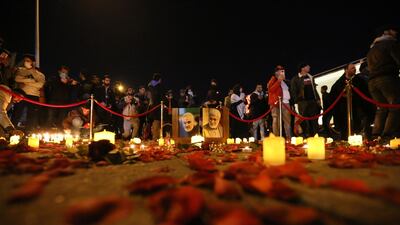
Supporters of Iraqi Shiite Popular Mobilisation Forces light candles at the site of the US drone attack on January 3, 2019 that killed the Iranian general Qassem Suleimani and Abu Mahdi Al Muhandis, leader of the Iran-backed Kataib Hezbollah militia EPA -
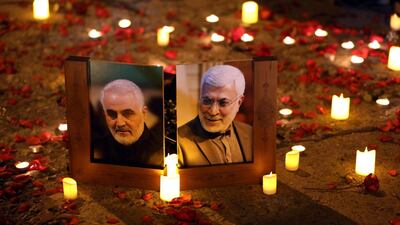
Photos of Qassem Suleimani, left, and Abu Mahdi Al Muhandis are placed on the road to Baghdad international airport during a commemoration of their deaths on January 2, 2020. EPA -
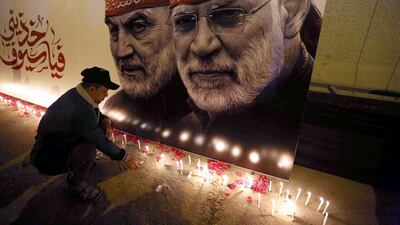
A supporter of Iraqi Shiite Popular Mobilisation Forces lights candles at the site of US drone attack that killed Qassem Suleimani and Abu Mahdi Al Muhandis. EPA -

Popular Mobilisation Forces and their supporters hold posters of Abu Mahdi Al Muhandis and Qassem Suleimani at Baghdad's international airport. AP Photo -
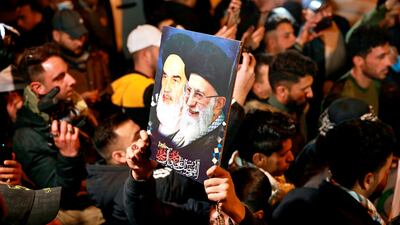
Members of the Popular Mobilisation Forces and their supporters chant slogans against the United States at Baghdad's international airport. AP Photo -

Supporters of the Popular Mobilisation Forces hold a candlelight vigil at the site of the US drone strike on Qassem Suleimani at Baghdad Airport. AFP -

An Iraqi woman holds a portrait of late Iraqi commander Abu Mahdi Al Muhandis and Iranian commander Qassem Suleimani at Baghdad Airport. AFP -

An Iraqi girl carries a portrait of late Iraqi commander Abu Mahdi Al Muhandis at Baghdad Airport. AFP -
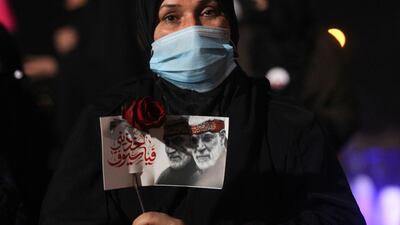
An Iraqi woman carries a portrait of late Iraqi commander Abu Mahdi Al Muhandis and Iranian commander Qassem Suleimani at Baghdad Airport. AFP -

Supporters of the Popular Mobilisation Forces hold a candlelight vigil at the site of the January 3, 2019 US drone strike on Qassem Suleimani. AFP -

Supporters of the Popular Mobilisation Forces wave Iraqi flags at a gathering outside Baghdad Airport. AFP -
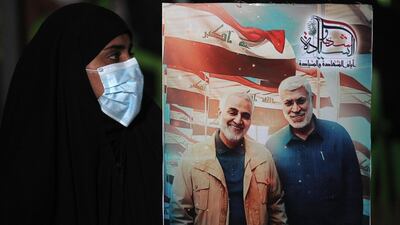
An Iraqi woman carries a portrait of Qassem Suleimani and Abu Mahdi Al Muhandis. AFP


These statements often involve threats against Saudi Arabia and outlandish conspiracy theories, using similar terms to Iranian state propaganda. Iranian English-language channel Press TV also translated the Righteous Pledge Battalion’s first statement.
In May 2019, Iraqi militias were suspected of using Jurf Al Sakhar, an area south of Baghdad controlled by Kataib Hezbollah, to launch a drone attack against two oil-pumping stations in Saudi Arabia. The militias would likely have been supplied with Iranian-made drones, some of which have a range in excess of 1,500 kilometres.
Jurf Al Sakhar is now a no-go zone for the Iraqi army which, alongside Iraqi PM Mustafa Al Kadhimi, has increasingly been at odds with the militias.
Mr Al Kadhimi previously ran the Iraqi National Intelligence Agency, raising accusations from some Iran-backed groups that he is an American stooge.
The creation of new Iraqi militias is probably part of a strategy by Iran to deflect blame away from their established allies in Iraq, including Kataib Hezbollah.
Kataib Hezbollah in particular has come under increasing pressure from Mr Al Kadhimi to obey Iraqi government command, respect human rights in Iraq and refrain from attacking US and Coalition forces, which are assisting the Iraqi army against ISIS.

