


Sunday soccer is a decades-old tradition when Brazilians of all walks of life play on the beaches, in the slums, and on the streets in matches known as “peladas”.
-

-
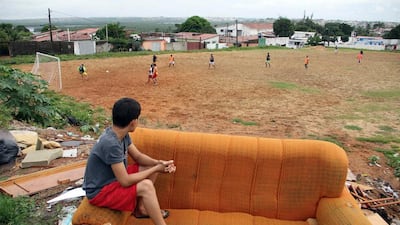
A boy sits on a discarded couch as he watches Sunday soccer in the Bom Pastor neighborhood of Natal. Nuno Guimaraes / Reuters -

The matches are known as ‘peladas’ or ‘naked’. Washington Alves / Reuters -

Pelada can refer to a street match where everyone plays barefoot with ‘naked’ feet, or a match on a grassless ‘naked’ field, or a match with a ball so worn that it is ‘naked’. Nuno Guimaraes / Reuters -

With the 2014 World Cup just one month away, people of all walks of life in the host cities are spending their Sundays practising the sport for which their country is about to become the global stage. Paulo Whitaker / Reuters -

Players battle for the ball during a Sunday ‘pelada’ soccer match on the beach of Salvador, a World Cup host citye. Valter Pontes / Reuters -

Discarded soccer boots hang from an electric wire. Washington Alves / Reuters -

Residents playing a match in the Bom Pastor neighborhood of Natal. Nuno Guimaraes / Reuters -

An amateur team join their hands before returning to the field after halftime during a Sunday “pelada” soccer match in Cuiaba. Marcos Lopes / Reuters -

Teams Azulao, in blue uniforms, and Novo Reino prepare to play a match in the Sao Jose neighborhood of Manaus. Bruno Kelly / Reuters -

Players battle for the ball during a Sunday “pelada” soccer match in the Borel favela of Rio de Janeiro, a World Cup host city, May 4, 2014. Ricardo Moraes/ Reuters -

The 2014 World Cup will be held in Brasilia, Belo Horizonte, Rio de Janeiro, Sao Paulo, Natal, Fortaleza, Salvador, Porto Alegre, Curitiba, Cuiaba, Manaus, and Recife. Valter Pontes / Reuters
In pictures: Brazilians take to the streets to play ‘peladas’ ahead of World Cup 2014
Most popular today

