
US Secretary of State Mike Pompeo revealed international efforts to "secure the Strait of Hormuz and the ... Gulf from Iran's illegal acts".
In a series of tweets on Thursday, Mr Pompeo thanked the UAE, Bahrain, the UK, Albania, Lithuania, Australia and Saudi Arabia for “protecting one of the world’s most critical shipping lanes” from what he called Iranian pirates of the strait, using the hashtag #piratesofhormuz in reference to Iran's Islamic Revolutionary Guard Corps (IRGC).
Attached to his tweet was a grainy black-and-white video, purportedly showing IRGC forces removing a limpet mine from an oil tanker.
The video was originally released by the US military in 2019 when the Singapore-managed Kokuka Courageous tanker was attacked in the Gulf of Oman, damaging its hull, about 70 nautical miles off the coast of Fujairah.
-
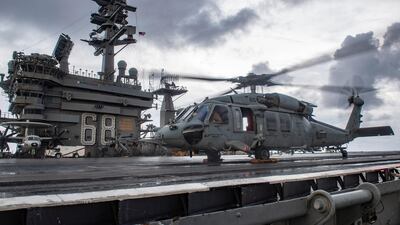
An MH-60S Sea Hawk helicopter conducts flight control checks on the flight deck of the US Navy aircraft carrier USS Nimitz in the Indian Ocean on November 25, 2020. Handout via REUTERS -
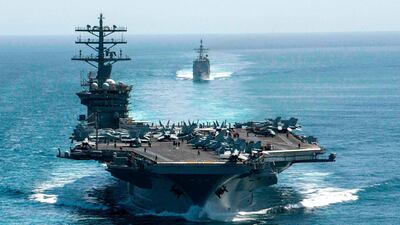
The aircraft carrier USS Nimitz and the guided-missile cruiser USS Philippine Sea in formation during a Strait of Hormuz transit on September 18, 2020. AFP PHOTO / US NAVY -
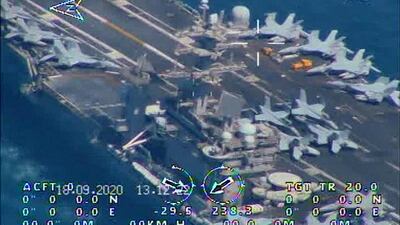
An image provided by Iran's Revolutionary Guard Corps (IRGC) reportedly shows the USS Nimitz Aircraft carrier prior to entering the Strait of Hormuz and the Gulf. AFP -
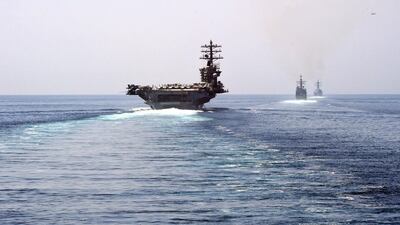
USS Nimitz, the guided-missile cruiser USS Princeton and guided-missile destroyer USS Sterett transits the Strait of Hormuz on September 18, 2020. US NAVY / AFP -
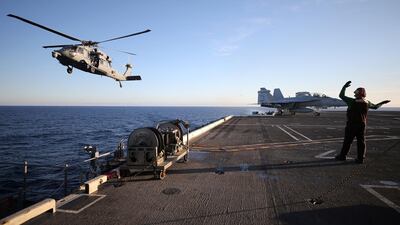
A US Navy helicopter descends to land aboard the USS Nimitz aircraft carrier while at sea on January 18, 2020 off the coast of Baja California, Mexico. Getty Images AFP -
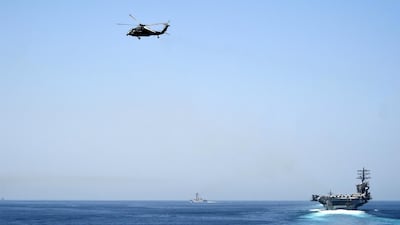
The aircraft carrier USS Nimitz transits the Strait of Hormuz on September 18, 2020. US NAVY / AFP -
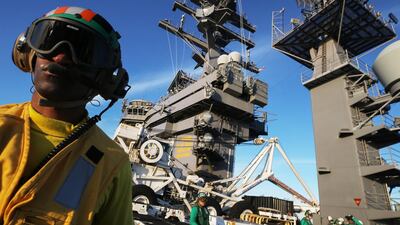
A US Navy catapult officer works on the flight deck of the USS Nimitz aircraft carrier while at sea on January 18, 2020 off the coast of Baja California, Mexico. Getty Images/AFP


By August 2019, the US was leading an international naval task force to protect shipping, after more attacks, including the seizure of the British oil tanker Stena Impero.
By the start of 2020, two international naval task forces, Operation Sentinel and the European-led Coalition In the Strait of Hormuz, were protecting the vital shipping route.
Despite this, Iran's naval activity threatening shipping has increased, although the IRGC is more cautious than in the past.
On January 5, Iran seized a South Korean-flagged oil tanker in the Strait of Hormuz, after announcing that it would increase its nuclear activities.
The IRGC said it detained the vessel Hankuk Chemi "due to repeated violations of marine environmental laws," although analysts point to a dispute between Seoul and Tehran over frozen Iranian funds in South Korea, deactivated bank accounts as a result of US sanctions.
In response to the IRGC's naval actions, which US officials likened to piracy, Mr Pompeo said the naval task force protecting shipping had increased in size, having started with seven partners and now numbered 14.

