


Since early April, diplomats from some of the world's most powerful countries have been involved in complex, technical negotiations that seek to revive the 2015 Iran nuclear deal.
Why are the talks taking place?
The accord has been in disarray since 2018 when former US president Donald Trump withdrew his country from the agreement and reintroduced heavy sanctions on Iran that had been removed under the terms of the deal.
He then expanded those sanctions, such as when he targeted the Iranian national bank.
In response, since 2019 Tehran has repeatedly breached the nuclear limits of the 2015 agreement and steadily built up its stockpile of enriched uranium.
Now the remaining signatories to the deal – the EU, China, France, Germany, Russia and the UK – have engaged in six rounds of negotiations in Vienna to try and breathe life back into it.
Both Iran and the US have sent representatives to the Austrian capital, but have not directly engaged with each other.
Both sides say they want a return to the deal. Iran wants the sanctions to be lifted to support its ailing economy. Mr Trump's successor Joe Biden wants Iran to abide by the commitments of the deal before the US does so.
How much progress has been made?
Slow but steady progress has been made. Diplomats from all sides say they remain hopeful an agreement can be reached.
But diplomats have also intimated that, with time running out, the most sensitive points of disagreement are now being negotiated. The French foreign ministry said on Wednesday that "significant disagreements persist".
Earlier this week, an Iranian government spokesman said "some minute technical, political, legal and practical issues remain", but insisted there was "no impasse".
Saeed Khatibzadeh said a broad agreement had been reached on US sanctions on Iran's industrial sectors, including energy, which have essentially meant a block on Iranian oil exports - a devastating blow for the economy.
But a fundamental sticking point is how far the US will be prepared to go if it does lift sanctions. Iran wants all sanctions imposed by Mr Trump to be removed, something Mr Biden's administration is very uneasy about.
"The advanced, highly efficient centrifuges that Iran has introduced will probably have to be destroyed rather than just taken offline, but Iran is resisting doing that," Mark Fitzpatrick, of the International Institute for Strategic Studies, said earlier this month.
What about Iran’s presidential elections?
It is not expected that any sort of deal will be reached by Friday, when voters in Iran will elect their next president.
Outgoing President Hassan Rouhani was a key figure in the formation of the initial 2015 accord.
The current frontrunner to succeed him is the cleric Ebrahim Raisi. While he has been deeply critical of the US, it is argued his potential election may have no major impact on the talks in Vienna.
-
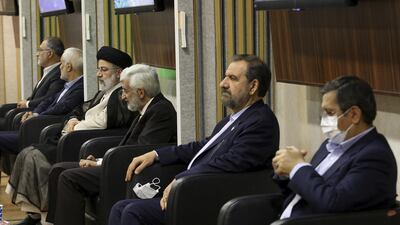
Presidential candidates for Iran's election June 18, from right to left, Abdolnasser Hemmati, Mohsen Rezaei, Saeed Jalili, Ebrahim Raisi, Mohsen Mehralizadeh, and Alireza Zakani before their second debate on state-run TV, in Tehran. A seventh candidate, Amirhossein Ghazizadeh Hashemi, also attended the debate. AP -
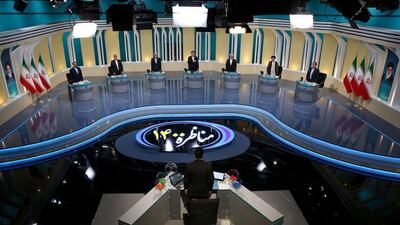
The candidates face a moderator in the television studio in Tehran. EPA -
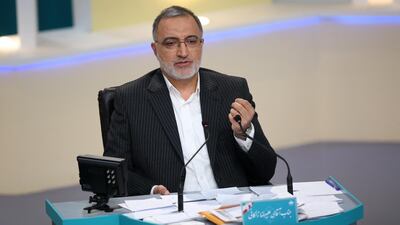
Mr Zakani, an MP, during the debate. AFP -

Mr Ghazizadeh Hashemi, also an MP, uses a map as a visual aid. AFP -
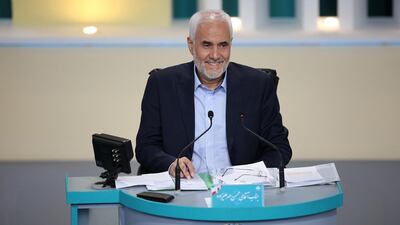
Mr Mehralizadeh is a former vice president. AFP -

Mr Jalili is Iran's former chief nuclear negotiator. AFP -
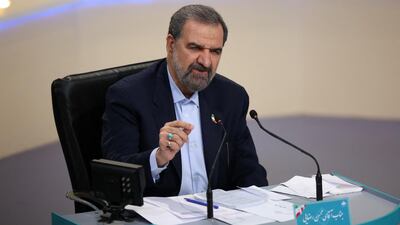
Mr Rezaei is a former head of the Revolutionary Guards and current secretary of the Expediency Discernment Council. AFP -

Mr Hemmati is a former central bank governor. AFP -

Judiciary chief Ebrahim Raisi is being seen as the favourite to win the presidential race. AFP -
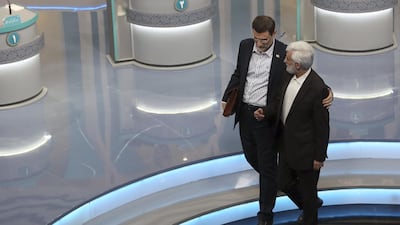
Mr Ghazizadeh, left, and Mr Jalili leave after the debate. AP


That's because Iran's supreme leader Ayatollah Ali Khamenei has shown interest in a return to the deal.
"He is the leader in practice, as well as in title," said Kenneth Katzman, an Iran expert at the Congressional Research Service in Washington.
"He is Commander in Chief of the armed forces. He is not shy about stating his positions.
"He has clearly indicated that if the US comes back into compliance with the nuclear deal, Iran would do so. I think we have to take him at his word," he said last week.

