Vaccinodromes, piazzas and racecourses: where Europeans can be immunised against Covid-19


Jamie Prentis
  • English
  • Arabic

European Union countries are adopting imaginative solutions to help deliver the Covid-19 vaccine as the continent plans to protect its nearly 450 million residents from the virus.

Italy's central piazzas will become inoculation centres with pop-up clinics becoming commonplace in town squares.

Scores of specially-fitted vans in Germany will deliver the vaccine to care homes, while the nation will rely on large 'vaccinodromes' to help immunise the general population.

The UK, which recently left the EU, has called upon major sporting venues such as racecourses to support vaccination efforts.

France has eased rules over how doses are delivered to its people in a country where anti-vaccine sentiments are prominent.

The EU has lagged behind countries such as the US and UK in its delivery programme. The drug regulator in Brussels took longer to approve a first vaccine for the Pfizer/BioNTech vaccine quickly. For instance, the Netherland only vaccinated its first person on Wednesday despite the drug arriving in the country on December 27.

The European Commission, which has signed deals with six vaccine manufacturers for two billion doses, has been blamed by some for the delay. Some claim it did not buy enough doses of the Pfizer/BioNTech vaccine, the first to be approved by Brussels’ regulators – although the EU’s executive branch denied this.

“I don't think that the issue is really the number of vaccines, it is the fact that we are at the beginning of a roll-out,” the commission’s spokesman Eric Mamer said. “We're all judging this as if this campaign is over; in fact, the campaign is just starting.”

While the UK approved the Pfizer/BioNTech inoculation on December 2 and the US on December 11, the EU did so on December 21.

The US authorised the Moderna vaccine on December 19 – the EU did so on January 6 – and the UK approved the Oxford/AstraZeneca product on December 30.

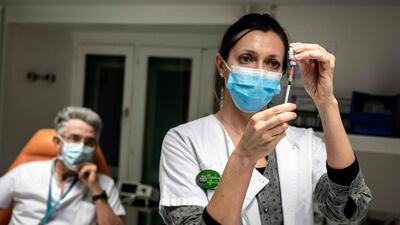
  • A nurse prepares a dose of the Pfizer-BioNTech vaccine at the Croix Rousse Hospital in Lyon, France. AFP
    A nurse prepares a dose of the Pfizer-BioNTech vaccine at the Croix Rousse Hospital in Lyon, France. AFP
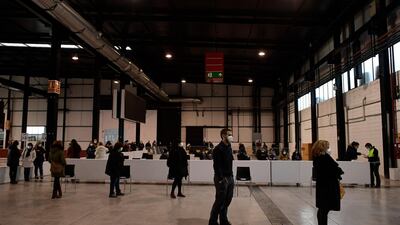
  • Health workers wait to be vaccinated against the coronavirus, in Pamplona, northern Spain. AP Photo
    Health workers wait to be vaccinated against the coronavirus, in Pamplona, northern Spain. AP Photo
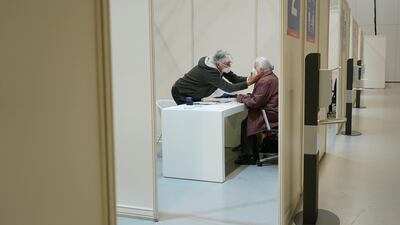
  • A doctor checks an elderly woman before he injected her with the Pfizer-BioNTech vaccine at the vaccination center at the Metropolis-Halle events center in Potsdam, Germany. EPA
    A doctor checks an elderly woman before he injected her with the Pfizer-BioNTech vaccine at the vaccination center at the Metropolis-Halle events center in Potsdam, Germany. EPA
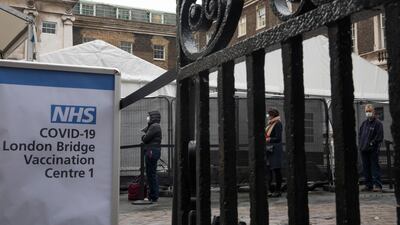
  • People queue for a Covid-19 vaccination at a vaccination hub at Guys Hospital in London, England. Getty Images
    People queue for a Covid-19 vaccination at a vaccination hub at Guys Hospital in London, England. Getty Images
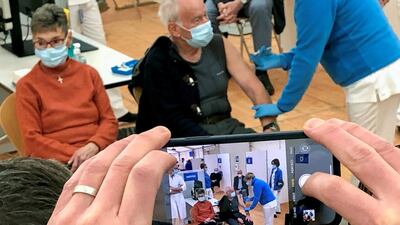
  • Mr. Stuessi receives a vaccine as his wife sits beside at the vaccination reference center at the Epidemiology, Biostatistics and Prevention Institute in Zurich, Switzerland. Reuters
    Mr. Stuessi receives a vaccine as his wife sits beside at the vaccination reference center at the Epidemiology, Biostatistics and Prevention Institute in Zurich, Switzerland. Reuters
  • A healthcare worker prepares a syringe with a dose of the Pfizer-BioNTech vaccine at the Villa Scassi Hospital in Genoa, Italy. EPA
    A healthcare worker prepares a syringe with a dose of the Pfizer-BioNTech vaccine at the Villa Scassi Hospital in Genoa, Italy. EPA
  • Nursing home workers wait their turn to be vaccinated with Pfizer-Biontech COVID-19 vaccines at the Ange-Raymond Gilles care home in Jemeppe-sur-Meuse, near Liege, Belgium. AP Photo
    Nursing home workers wait their turn to be vaccinated with Pfizer-Biontech COVID-19 vaccines at the Ange-Raymond Gilles care home in Jemeppe-sur-Meuse, near Liege, Belgium. AP Photo
  • Netherlands' Health Minister Hugo de Jonge applauds after healthcare worker Sanna Elkadiri, second right, received the first shot of the Pfizer-BioNTech coronavirus vaccine at a mass vaccination center in Veghel, Netherlands. AP Photo
    Netherlands' Health Minister Hugo de Jonge applauds after healthcare worker Sanna Elkadiri, second right, received the first shot of the Pfizer-BioNTech coronavirus vaccine at a mass vaccination center in Veghel, Netherlands. AP Photo
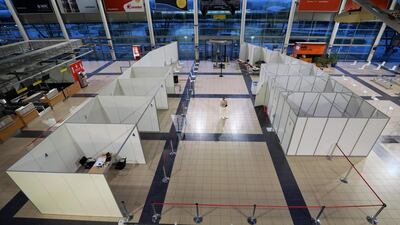
  • A vaccination centre in the terminal of Rostock-Laage Airport in Large, Germany. AP Photo
    A vaccination centre in the terminal of Rostock-Laage Airport in Large, Germany. AP Photo
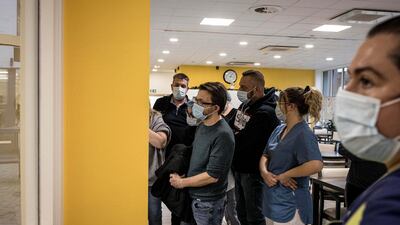
  • Police stand by as people wearing face masks queue to get access to the vaccination center at the 'Arena' in Berlin's Treptow district in Germany. AFP
    Police stand by as people wearing face masks queue to get access to the vaccination center at the 'Arena' in Berlin's Treptow district in Germany. AFP

Plans for a co-ordinated EU-wide distribution fell apart, with individual countries left in charge of how they organise and administer the vaccine.

Those in nursing homes and medical centres were prioritised initially but as delivery of the vaccine becomes more widespread, member states have to come up with creative plans to inoculate their populations on a larger scale.

Germany

Health Minister Jens Spahn said on Wednesday that everyone in Germany will be vaccinated by the summer – if the EU approves further vaccines beyond the Pfizer/BioNTech and Moderna.

The Pfizer/BioNTech drug has already been given to more than 300,000 people, and 1.3 million doses have already been delivered throughout Germany. The country plans to open a series of ‘vaccinodromes,’ which will act as major vaccination centres to administer the drug quickly to as many people as possible.

The Hamburg Messe trade fair grounds has been transformed to offer mass inoculations. Getty

Berlin’s Tegel airport, which closed to passenger traffic in November 2020 and was once one of Europe’s busiest transport links, will become one of the vaccination centres, as will the grounds for the city’s trade fairs.

Dozens of mini-vans will deliver the vaccines to care homes, the vehicles designed to store vials at the minus 70°C temperature the Pfizer/BioNTech drug requires. The operation has not been seamless, however, after around 1,000 doses were kept too warm in transit.

"When reading the temperature loggers that were enclosed in the cool boxes, doubts arose about the compliance with the cold chain requirements,” said the Bavarian district of Lichtenfels.

Berlin's Tegel Airport recently closed for good to passenger traffic and will be converted into a vaccination hub. EPA

Italy

The initial European epicentre of the virus, Italy has been comparatively efficient in delivering the vaccine although there are disparities across the country.

Architect Stefano Boeri is responsible for designing about 1,500 temporary pavilions that will serve as vaccination centres in the country’s piazzas (town squares).

With a wooden interior and a primrose motif on the outside of the roof, he said idea was to "convey a symbol of serenity and regeneration".

"Italy's public life is in our piazzas. We need to make sure that these pavilions will be reachable, comfortable and places that the community consider, for a period of time, part of their lives in order to defeat Covid-19,” he said.

Italy will also invest in local biotech company ReiThera to support vaccine development.

Architect Stefano Boeri has designed 'Primrose' temporary pavilions to be used as vaccination centres in Italian squares. Stefano Boeri Architetti

UK

No longer a member of the EU, the UK became the first country in the world to approve a vaccine in early December and has already given it to 1.3 million critical workers, nurses and members of its elderly population.

Amid government plans to vaccinate 14 million people by February, supermarket chain Morrisons has been recruited.

Three car parks at supermarket chain Morrisons will be used to vaccinate people, with another 47 on standby. PA

From Monday, the car parks of three stores will be used for inoculations, with another 47 offered by the grocery chain as and when they are required.

Community venues such as village halls will also be converted into clinics, as will larger buildings such as sports stadiums and conference centres.

Seven mass vaccination centres will open next week, including Manchester's Etihad Tennis Centre and London's ExCeL, an exhibition space. Premier League football teams Tottenham Hotspur and Aston Villa have offered their grounds, as have the owners of Epsom and Leicester race courses.

Tottenham have offered the use of their stadium to the NHS as a venue to roll out the coronavirus vaccine. PA

Netherlands

Often depicted as organised and focused on detail, the Netherlands has been heavily criticised for its slow response. It started vaccinating on Wednesday, becoming the EU's last member state to do so.

Prime Minister Mark Rutte said the government focused on preparing for the Oxford/AstraZeneca vaccine, which is easier to store than its competitors but has yet to be cleared for use by the EU.

It took delivery of thousands of doses of the Pfizer/BioNTech drug in late December, but is still finalising plans distribution plans.

Health Minister Hugo de Jong said the government had “proved insufficiently agile to accommodate quickly enough the changes that have occurred".

"Perhaps that could and should have been done differently,” he said.

The delay was also blamed on issues surrounding an IT system, which was to ensure people receive the correct dose.

Geert Wilders, the controversial leader of the country’s largest opposition party, described the Netherlands as “the village idiot of Europe”.

Nursing home worker Sanna Elkadiri, 39, receives the first Covid-19 vaccine in the Netherlands, the last country in the European Union to start inoculations. Reuters

France

France has also been slow to respond compared to other EU states, with only several thousand vaccinated in a country where anti-vaxxers are widespread.

Polls have suggested more than 50 per cent would be unwilling to be vaccinated.

The government pledged to ramp up efforts and hundreds of vaccination centres will open next week. Rules demanding that only a medic or a nurse under direct supervision of a doctor inject the drug will be relaxed.

“I’m sorry to see we’re so late and we haven’t been able to vaccinate the people most at risk,” said Catherine Hill, an epidemiologist at the Gustave Roussy institute in Paris. “French bureaucracy is definitely at the root of this delay,” she told Reuters.

The French government has faced criticism over the slow progress of its drive to vaccinate people, a problem compounded by the high levels of public scepticism about the campaign. EPA

Spain

Another country that was among the hardest hit by Covid-19, health officials in Spain have admitted the vaccine strategy has been a slow process.

Many regions did not administer any doses until January 1 and there was a shortage of medical workers over the Christmas holidays.


Nicanor, 72, a nursing home resident, became the first person to receive the vaccine in Madrid. EPA
Our legal columnist

Name: Yousef Al Bahar

Advocate at Al Bahar & Associate Advocates and Legal Consultants, established in 1994

Education: Mr Al Bahar was born in 1979 and graduated in 2008 from the Judicial Institute. He took after his father, who was one of the first Emirati lawyers

A timeline of the Historical Dictionary of the Arabic Language
  • 2018: Formal work begins
  • November 2021: First 17 volumes launched 
  • November 2022: Additional 19 volumes released
  • October 2023: Another 31 volumes released
  • November 2024: All 127 volumes completed
FIXTURES

December 28
Stan Wawrinka v Pablo Carreno Busta, 5pm
Milos Raonic v Dominic Thiem, no earlier then 7pm

December 29 - semi-finals
Rafael Nadal v Stan Wawrinka / Pablo Carreno Busta, 5pm
Novak Djokovic v Milos Raonic / Dominic Thiem, no earlier then 7pm

December 30
3rd/4th place play-off, 5pm
Final, 7pm

Who's who in Yemen conflict

Houthis: Iran-backed rebels who occupy Sanaa and run unrecognised government

Yemeni government: Exiled government in Aden led by eight-member Presidential Leadership Council

Southern Transitional Council: Faction in Yemeni government that seeks autonomy for the south

Habrish 'rebels': Tribal-backed forces feuding with STC over control of oil in government territory

The specs

Engine: 3.5-litre V6

Power: 272hp at 6,400rpm

Torque: 331Nm from 5,000rpm

Transmission: 8-speed auto

Fuel consumption: 9.7L/100km

On sale: now

Price: Dh149,000


INDIA SQUAD

Rohit Sharma (captain), Shikhar Dhawan (vice-captain), KL Rahul, Suresh Raina, Manish Pandey, Dinesh Karthik (wicketkeeper), Deepak Hooda, Washington Sundar, Yuzvendra Chahal, Axar Patel, Vijay Shankar, Shardul Thakur, Jaydev Unadkat, Mohammad Siraj and Rishabh Pant (wicketkeeper)

Gulf Under 19s final

Dubai College A 50-12 Dubai College B

The years Ramadan fell in May

1987

1954

1921

1888

In Full Flight: A Story of Africa and Atonement
John Heminway, Knopff

MATCH INFO

Tottenham Hotspur 3 (Son 1', Kane 8' & 16') West Ham United 3 (Balbuena 82', Sanchez og 85', Lanzini 90' 4)

Man of the match Harry Kane

Mercer, the investment consulting arm of US services company Marsh & McLennan, expects its wealth division to at least double its assets under management (AUM) in the Middle East as wealth in the region continues to grow despite economic headwinds, a company official said.

Mercer Wealth, which globally has $160 billion in AUM, plans to boost its AUM in the region to $2-$3bn in the next 2-3 years from the present $1bn, said Yasir AbuShaban, a Dubai-based principal with Mercer Wealth.

Within the next two to three years, we are looking at reaching $2 to $3 billion as a conservative estimate and we do see an opportunity to do so,” said Mr AbuShaban.

Mercer does not directly make investments, but allocates clients’ money they have discretion to, to professional asset managers. They also provide advice to clients.

“We have buying power. We can negotiate on their (client’s) behalf with asset managers to provide them lower fees than they otherwise would have to get on their own,” he added.

Mercer Wealth’s clients include sovereign wealth funds, family offices, and insurance companies among others.

From its office in Dubai, Mercer also looks after Africa, India and Turkey, where they also see opportunity for growth.

Wealth creation in Middle East and Africa (MEA) grew 8.5 per cent to $8.1 trillion last year from $7.5tn in 2015, higher than last year’s global average of 6 per cent and the second-highest growth in a region after Asia-Pacific which grew 9.9 per cent, according to consultancy Boston Consulting Group (BCG). In the region, where wealth grew just 1.9 per cent in 2015 compared with 2014, a pickup in oil prices has helped in wealth generation.

BCG is forecasting MEA wealth will rise to $12tn by 2021, growing at an annual average of 8 per cent.

Drivers of wealth generation in the region will be split evenly between new wealth creation and growth of performance of existing assets, according to BCG.

Another general trend in the region is clients’ looking for a comprehensive approach to investing, according to Mr AbuShaban.

“Institutional investors or some of the families are seeing a slowdown in the available capital they have to invest and in that sense they are looking at optimizing the way they manage their portfolios and making sure they are not investing haphazardly and different parts of their investment are working together,” said Mr AbuShaban.

Some clients also have a higher appetite for risk, given the low interest-rate environment that does not provide enough yield for some institutional investors. These clients are keen to invest in illiquid assets, such as private equity and infrastructure.

“What we have seen is a desire for higher returns in what has been a low-return environment specifically in various fixed income or bonds,” he said.

“In this environment, we have seen a de facto increase in the risk that clients are taking in things like illiquid investments, private equity investments, infrastructure and private debt, those kind of investments were higher illiquidity results in incrementally higher returns.”

The Abu Dhabi Investment Authority, one of the largest sovereign wealth funds, said in its 2016 report that has gradually increased its exposure in direct private equity and private credit transactions, mainly in Asian markets and especially in China and India. The authority’s private equity department focused on structured equities owing to “their defensive characteristics.”

Our family matters legal consultant

Name: Hassan Mohsen Elhais

Position: legal consultant with Al Rowaad Advocates and Legal Consultants.

Three ways to boost your credit score

Marwan Lutfi says the core fundamentals that drive better payment behaviour and can improve your credit score are:

1. Make sure you make your payments on time;

2. Limit the number of products you borrow on: the more loans and credit cards you have, the more it will affect your credit score;

3. Don't max out all your debts: how much you maximise those credit facilities will have an impact. If you have five credit cards and utilise 90 per cent of that credit, it will negatively affect your score.

Ads on social media can 'normalise' drugs

A UK report on youth social media habits commissioned by advocacy group Volteface found a quarter of young people were exposed to illegal drug dealers on social media.

The poll of 2,006 people aged 16-24 assessed their exposure to drug dealers online in a nationally representative survey.

Of those admitting to seeing drugs for sale online, 56 per cent saw them advertised on Snapchat, 55 per cent on Instagram and 47 per cent on Facebook.

Cannabis was the drug most pushed by online dealers, with 63 per cent of survey respondents claiming to have seen adverts on social media for the drug, followed by cocaine (26 per cent) and MDMA/ecstasy, with 24 per cent of people.

Sustainable Development Goals

1. End poverty in all its forms everywhere

2. End hunger, achieve food security and improved nutrition and promote sustainable agriculture

3. Ensure healthy lives and promote well-being for all at all ages

4. Ensure inclusive and equitable quality education and promote lifelong learning opportunities for all

5. Achieve gender equality and empower all women and girls

6. Ensure availability and sustainable management of water and sanitation for all

7. Ensure access to affordable, reliable, sustainable and modern energy for all

8. Promote sustained, inclusive and sustainable economic growth, full and productive employment and decent work for all

9. Build resilient infrastructure, promote inclusive and sustainable industrialisation and foster innovation

10. Reduce inequality  within and among countries

11. Make cities and human settlements inclusive, safe, resilient and sustainable

12. Ensure sustainable consumption and production patterns

13. Take urgent action to combat climate change and its effects

14. Conserve and sustainably use the oceans, seas and marine resources for sustainable development

15. Protect, restore and promote sustainable use of terrestrial ecosystems, sustainably manage forests, combat desertification, and halt and reverse land degradation and halt biodiversity loss

16. Promote peaceful and inclusive societies for sustainable development, provide access to justice for all and build effective, accountable and inclusive institutions at all levels

17. Strengthen the means of implementation and revitalise the global partnership for sustainable development

Mia Man’s tips for fermentation

- Start with a simple recipe such as yogurt or sauerkraut

- Keep your hands and kitchen tools clean. Sanitize knives, cutting boards, tongs and storage jars with boiling water before you start.

- Mold is bad: the colour pink is a sign of mold. If yogurt turns pink as it ferments, you need to discard it and start again. For kraut, if you remove the top leaves and see any sign of mold, you should discard the batch.

- Always use clean, closed, airtight lids and containers such as mason jars when fermenting yogurt and kraut. Keep the lid closed to prevent insects and contaminants from getting in.


Tottenham's 10 biggest transfers (according to transfermarkt.com):

1). Moussa Sissokho - Newcastle United - £30 million (Dh143m): Flop

2). Roberto Soldado - Valencia -  £25m: Flop

3). Erik Lamela - Roma -  £25m: Jury still out

4). Son Heung-min - Bayer Leverkusen -  £25m: Success

5). Darren Bent - Charlton Athletic -  £21m: Flop

6). Vincent Janssen - AZ Alkmaar -  £18m: Flop

7). David Bentley - Blackburn Rovers -  £18m: Flop

8). Luka Modric - Dynamo Zagreb -  £17m: Success

9). Paulinho - Corinthians -  £16m: Flop

10). Mousa Dembele - Fulham -  £16m: Success